Oh hey there, I′m glad you're here!

Email List Best Practices: How to Welcome, Nurture, and Engage Your Subscribers with Food Blogger Pro

CLICK HERE FOR TRANSCRIPT
Allea Grummert (00:12)
Hey there, welcome to Happy Subscribers, a podcast that explores how bloggers and content creators can create more purposeful relationships with your audience through email marketing. I’m Allea Grummert email marketing strategist, copywriter, email platform expert, and founder of the done for you email marketing agency, Duett. I started as a personal finance blogger in 2016 and have since helped hundreds of bloggers and creators like you maximize your email marketing for more impact, more traffic, and a better connection with your subscribers. Be prepared for some advanced email talk, as well as tactical tips to help get your valuable content into the hands of your audience faster and easier. I’m excited you’re here, so let’s do it. We can create a deeper, more meaningful connection with the community you love and serve through email.
Welcome, welcome to happy subscribers. It is spring cleaning time. That applies to today’s conversation with my friend Bjork Ostrom of the Food Blogger Pro podcast. He actually interviewed me for the Food Blogger Pro membership. And this is a repurposed episode from that member only community, which is really generous of them to allow me to share this with you as well. So buckle up because it’s got a lot of questions. Bjork actually asked Food Blogger Pro members to submit questions. so Bjork and I are talking about things like list cleanup. Like what does that mean to have a clean list of warm subscribers and what does it mean to remove them? And we’re talking about how often you should actually be sending emails or the value of a welcome sequence and why it’s worth your time to have one or create one. So I’m very grateful that you’re tuning in. Continue to listen in to my conversation with Bjork. As always, you can message me on Instagram at @alleagrummert if you want to chat more.
Bjork Ostrom (02:02)
We’re officially live. Welcome, Allea Thanks for being here. It’s fun to see you. It’s one of the things that’s kind of fun about landing in a different spot. You’ve moved to Nashville. that slowly the office comes together? You can kind of see that. It’s kind of fun to see that evolving and different parts and pieces coming in. Love it. Beautiful. We’re going to be talking about all things email today. We have some folks who submitted questions ahead of time. Sometimes people show up live and we’ll take some of those questions as they have questions. Other people submitted questions ahead of time, and we’ll just work through those, before we get into them, Allea do want to give a little bit of background on your story? Your focus obviously is email. And then we can get into some of the questions.
Allea Grummert (02:49)
Yeah, so my name is Allea Grumert, which sounds really bad because I’m congested. It starts with a G, Grummert. So and I run Duett. I used to run it as a team of one. I know it’s like a team of 10. And so I have a really awesome team where we serve our clients creating welcome and nurture sequences primarily. And it’s really fun because we get to determine like what is it that your subscribers want to hear from you or how do you want to just like bless them over the top as they join your email list so that they know how resourceful you are, how great your content is, why they should open your emails. That’s the kind of work we get to do with clients all the time. And then doing the copywriting and all the tech setup in every platform. So it’s kind of like a whole expanse of things that we do. And so, yeah, super excited to be here. I started out as a personal finance blogger in 2016. It’s about at the 10-year mark. It was Memorial Day. I was feeling very lonely.
Bjork Ostrom (03:35)
Yeah.
Allea Grummert (03:47)
Because I felt like everybody was on a boat except for me. So I thought I’d start a blog from my couch. And then eventually, email marketing crept up as this thing that people had a lot of questions about. And it’s really fun for me. And that’s when you need to be in an area if it’s fun and you’re good at it. And then eventually, created Duett in 2018. And now here we
Bjork Ostrom (04:11)
Here we are, love it. It’s been fun to see you on your journey as you’ve grown your team. And email is one of those things that I would almost put it in a similar category to Facebook for food creators, where if you look at the last seven, eight, nine years, it’s become more important, not less important. And, you know, there’s this season for Facebook where people kind of, especially food creators are kind of like, what is this? How does it work? Why is it valuable, that’s become more clear. I feel like that’s also similar with email, especially as things have shifted, as Google’s become less predictable, social platforms have become less predictable, and the value of a click within email because of first-party data has become more valuable, especially for people who have ads on their site or are monetizing in that way. So we’ve noticed this huge shift for email becoming more and more important. And from an industry perspective, but even for ourselves, we’ve noticed that we’ve been placing more emphasis on email and thinking about it as well. So we have some questions that we can work through here. And for anybody tuning in live, if you have a question as we talk through things, you can submit that as a question in the Q &A area. So I’ll start with this first one talking about a sequence. So this person is asking how long should a sequence be and is there a range that works best? So maybe define sequence for those who aren’t as familiar and then talk about if you have an opinion on the how long one should be or how short it should be.
Allea Grummert (05:52)
Yeah, so a sequence is just a series of emails. It could actually be as short as one, or it could be as long as like 80 plus. Like I have a forever series that goes out to my list every Tuesday, and it’s got over 85 emails queued up to go out once a week. So the idea of a sequence, really is more of just like a tool, however you want to use it. So a sequence could be somebody clicks to learn about a product of yours, and you send out a two email sequence with follow up information if they haven’t purchased. Or it could be used like a nurture sequence that could run forever and ever. So it really depends on the type of sequence. So I define a welcome sequence as like the one thing that everybody gets on your list as soon as they join your list, whether they get like a five day quick start guide or a series, or they get one freebie, then they go into this welcome sequence. I like to keep that anywhere from three to five emails. And then from there, we kind of decide. If you wanted them to go into a nurture sequence, it could be five emails, it could be 10 emails, it could be 15. So it’s really, really flexible and depends on the purpose of the sequence.
Bjork Ostrom (06:59)
Yeah, that’s great. I think that’s the key part. depends on the purpose. Welcome is obviously like, you’re welcoming somebody to your email list. my guess is the premise with that is, hey, here’s what I’m about. Here’s what I talk about when I send emails and create content. Here’s where you can follow me. Here’s where you can find out more information. It’s like, hey, welcome to the site. Here’s a little bit about it. But a sequence could also be. Let’s say you send out an affiliate email and it performs really well. And it’s evergreen in the sense that it’s not about Christmas. It’s just like, Hey, here’s 10 products I love. If you send that email out as a broadcast, meaning it’s a one-time email that you send out and it’s maybe, you know, next week you do it and then you see it performs well. What you were saying is like, you could just stack that on and say like, Hey, this is a great email. It’s evergreen. It’s not seasonal. You can stack that on and then everybody will get that moving forward. And you could even do it in a way where you would ensure that people who got the broadcast email that you sent, that they don’t get it once the sequence email comes. Is that right?
Allea Grummert (08:13)
Yeah. So if anybody wants particular details on the tech behind that, we can definitely go through that. Repurposing those emails into an evergreen nurture sequence allows you to know not only did that email perform well, but it’s like, just need to know that everybody on my list has at least heard about Food Blogger Pro. Like I have a Food Blogger Pro promo email in my nurture sequence. Because I sent it out to my list once for Black Friday.
Bjork Ostrom (08:37)
Love it. Thanks.
Allea Grummert (08:42)
Years ago and all I did was take out the limited time pricing data and was like, you should still know about Food Blogger Pro. And so that I just know as a creator, everybody who’s coming through my list is eventually hearing about Food Blogger Pro, even if it’s not something that I’m proactively promoting, you know, years later in the same way.
Bjork Ostrom (09:02)
Yep, and one of the things you could do just as a quick tip is for creators, one of the things you could look at if you’re with Raptive or Mediavine, you can look at the content on your site that is earning the most and maybe you want to incentivize or just make sure that people see that and click on that and go to that content. So you can sort order and see like the highest RPM that you’re getting for a post. Another thing you could do is you could look at the content where people are either clicking the most. So if they go to a page and they’re likely to click through to another page, spending a lot of time on it, interacting with it. And so essentially what you’re trying to do is figure out what are your shining stars and continue to find ways to promote those, email being a great one. And the great thing about a sequence is you can do it once and then not have to think about doing it again. It just lives there for anybody who signs up. So I’ll close out this question. How many emails should I include in my welcome sequence? I feel like we answered that in the previous one, which is it depends on how long you want it to be. But generally speaking, you said a welcome sequence can be three to five emails. You’re welcoming somebody to your list. You don’t want it to be six months. But then you can create a different type of sequence that would run longer, forever series, like you said, where it’s maybe once a week you’re sending something out for two years because you maybe have that many emails.
Allea Grummert (10:29)
So it goes from being like, you know, three emails over four days or five emails over seven days into like your nurture sequence. You just pick like one day of the week that it goes out. So then you’re just like, okay, so at that point it’s a weekly cadence.
Bjork Ostrom (10:43)
And that helps because then you know that you aren’t going to be sending an email. ⁓ If you do a broadcast email, maybe you won’t send it on Thursday if you know that your sequence runs on Thursdays and you can selectively pick which days you’re going to send. Great.
Allea Grummert (10:59)
Yeah, and you just know it’s already working for you. It’s set up to go.
Bjork Ostrom (11:03)
How about this question about using Facebook ads? So Sylvia says, you ever used Facebook ads for gaining email subscribers and are these worth it? So maybe you could talk about your experience, but also the experience that you’ve had working with clients who potentially are building their email list through Facebook ads.
Allea Grummert (11:21)
A ton of experience with it. The most I’ve worked with Facebook ads with clients have been like authors. So people who have like a physical product in that sense. So I don’t know if you have any experience with it.
Bjork Ostrom (11:33)
I would say the thing that is hardest about it is that you need to understand the thing that is hardest about it for creators like us, which I’m guessing most of the people listening to this are also food creators publishing content online, is like, you need to understand how much you are earning from your email subscriber in order to then feel confident spending a certain ⁓ amount to get that email subscriber. And so an example might be, you set up Facebook ads and you are running those ads and it comes to $2 per new email subscriber. So that would be easy to see that that data would be clear. The question then is, do you, as a content business owner, believe that over the next six months, over the next year, that you will from that person subscribing get $2 of value and that could come from a product, it could come from affiliate, it could come from traffic. If you are going to convert that into visits, it might be like 20, 40, 60 visits over a year. So the question would be, do you believe that that person, if you’re only monetizing via traffic and not anything else, will visit your site 50 times in the next year if they sign up for the email list. That’s where it gets a little bit harder to kind of crunch those numbers. And the nice thing about organic is like, your only cost is the time to create the content and then everything else is margin. And so it’s a little bit easier. If you have a product, it gets easier. Like you said, with books, that gets easier because it’s a little easier to track and quantify. But it’s hard when it’s just content. Unless you are really in the details and the weeds and understand that. Miranda says, I’ve seen ads work on LinkedIn in B2B or B2C space, particularly when there’s a valuable lead gen, like a guide to work on Facebook. I think they’d need some kind of downloadable. So it’s a great point. Like you’d need some type of, whether it’s a free meal plan or, you know, best kitchen utensils or getting started with keto, like, I don’t know, thousand different examples, but it’s a good point from Miranda.
Allea Grummert (13:58)
Yeah, I actually just had a discussion with a client this morning about setting up a tripwire, which is kind of like I wish there was a better name for it. Sounds so dangerous. The idea is that it’s so marketing. So don’t don’t hear that. just need a new word. But the idea is that if people are coming in for a freebie, what happens is after they sign up, they get redirected to a page for a small low cost offer. So in their case, they make all of these labels for like homemade vanilla, and they’ve got hundreds of them. Cool. Well, a subscriber is not going to go through your site to go download hundreds of them. But what you can do is you can say, hey, thanks for downloading this homemade vanilla label. If you want all of my homemade jams and syrups labels, click here to buy them for $7. And you just send them to a folder in Drive with all of them there. So you’re creating a convenience for them, but you’re also like, making $7 here or there. That’s something where if you’re actually going to be putting money to certain pages, if you have something on the back end that could eventually pay for the cost of the ads, that’s the whole, that’s kind of the point of it. But meanwhile, you’re also, putting that money back into the ad in order to continue to grow your list.
Bjork Ostrom (15:12)
It’s a great, yeah, sorry, go ahead, finish that.
Allea Grummert (15:14)
I would say the important thing is that you want to make sure you’re only putting ads and stuff and tripwires behind the content that is most related to what you actually want people to subscribe for. like they’re a food blog, they’ve got some baking stuff, but they’re not like a label generating machine. like you just have to make sure that your subscribers that you’re getting are people who also want your recipes.
Bjork Ostrom (15:37)
Yeah, you want to make sure there’s a match there between what people initially sign up for. ⁓ An example, an anti-example would be on Pinch of Yum, there is or was, I think is some content that Lindsay wrote around like a capsule wardrobe. So like a super simplified ⁓ closet, super simplified wardrobe where you don’t have a bunch of clothes. You just have like the stuff that you love the most. People would sign up, they would get that. There’d be like a PDF with it. That’s not necessarily a great value match if then they stay on the Pinch of Yum list because 98 % of the content is going to be about food. People might stick around, but really why they signed up was to get information about a capsule wardrobe. And so it worked, but it wasn’t necessarily as good as a free meal plan where people are like, we know the mindset. We know they’re interested in recipes and what their focus is.
Allea Grummert (16:33)
The other cost is just that Facebook ads are super hard to figure out. like that’s where you were saying like I’d rather have you almost put your time energy into organic growth.
Bjork Ostrom (16:42)
Totally. Yep. The one thing that I do think is super helpful with what you were talking about with this idea of a tripwire or a small product is it simplifies the decision making around ad spend. even if you know that, okay, I can get it to the point where with this product that I’m including, that’s low cost, high value, ⁓ hopefully, that I can essentially break even on the amount that I’m spending. I’m also then just earning it back from this kind of low cost product. And then I know I’m also building my email list. And so there’s not a huge downside if you’re able to break even and build your email list as long as you have a good plan for what to do with that after you build it. Here’s a question about email platforms. What email platform do you recommend for someone who wants to send multiple sequences? Is there one that stands out?
Allea Grummert (17:37)
Yes, I prefer kit for that. There’s ⁓ even just going back to the really simple. So in K, I can set up multiple sequences and under the settings, I can literally say this one only goes out on Tuesdays. This one goes out on Thursdays versus all the other platforms, your workflows or automations, you have to go in and you have to manually just change that. Yeah. Probably, hopefully not within the whole sequence, but if you wanted them to all align to Tuesday, all of a sudden you’d have to go through and manually after that before every email goes out. Alternatively, another example in kit under the settings, if you wanted to exclude somebody who had a certain tag, so say somebody says they just want a weekly email, you’re like, great, the weekly email I’m determining everyone should get is my Sunday email. So you go to your Tuesday, Thursday, Friday sequences and under exclude, you can say exclude anybody who said weekly email and it just takes them right out. You don’t have to like, do anything else, you just hit save. And then another example with those filters, like you were mentioning with a nurture sequence, for each individual email, you can also set up a filter. So exclude anybody who received the broadcast on this date, like with this tag. So there’s just a lot more functionality.
Bjork Ostrom (18:50)
Yeah. Yeah, it’s we use Kit for Pinch of Yum, know a lot of other creators who use it. There’s some great integrations a lot of times in the creator space because kit is creator focused. I think sometimes we think like, well, aren’t all platforms that but it’s like, no, actually, there’s a lot of platforms that are really focused on like e commerce and they’re really good at segmenting as it relates to Shopify sites and Kit is really creator forward. So they think not only of like bloggers, but social media creators, know, somebody who’s popular on Instagram or LinkedIn or Facebook or a blog. And so the natural bend of the product will be for people who are doing work like we are doing. And it’s one of the advantages. And also I was just having this conversation with somebody in the forums and Food Blogger Pro. And they were using MailChimp and it’s like MailChimp is not a bad product. It’s a huge product used for people who are doing all sorts of different things like running a sandwich shop and having a small boutique store and a nonprofit. And Kit does that as well. But I also think if you were to look at the percentage of businesses that are on a platform like Kit, would be, it would skew creator type businesses, does that feel fair?
Allea Grummert (20:22)
Yes, creators, mean, authors, influencers, course creators, things like that. And like, I joke, like everybody starts with Mailchimp. that’s not, I’m not going to. I did. Like when I started my personal finance bug, I did Mailchimp. so yeah, don’t make yourself wrong for that. There’s also just a time and a place where you’re like, if this is, if this platform is no longer serving you and what you want to be doing, then it’s a time to go look at what you’re doing. If you’re just sending out one email to everyone,
Bjork Ostrom (20:32)
We were, we had mail.
Allea Grummert (20:52)
Once a week, Mailchimp could get you pretty far for a long time. But as soon as you start building in products or wanting to build out other sequences, then it’s time to look for another platform.
Bjork Ostrom (21:03)
Yep, that’s great. Last thing, maybe with Kit, that would be worth mentioning that we talked about this first party data integration to Raptive and Mediavine. It’s going to allow you to earn more. And the reason is because when you toggle that on, what will happen is Raptive or Mediavine will append, essentially just add some information to the end of a URL that allows them to track who the user is when they click. And if you can track who the user is, then you can charge a higher premium for the ads and you can earn more. And so that as an example of like a creator forward integration that’s super helpful. Are there other platforms that you know of that have done that like toggle on for Raptive Mediavine ads?
Allea Grummert (21:52)
Only other one I know of is that Flo desk does it for grow. So within, within the email, you can like say like optimized for grow. Cool. That’s the only other.
Bjork Ostrom (21:56)
Okay. Okay, awesome. What are some steps I can take to ensure my lead magnet or my freebie ⁓ attracts loyal readers? So this idea of creating something that’s, you you don’t wanna just half-heartedly put it together. You wanna make sure that it works. What can you do to ensure that it’s actually going to attract people who stick around and become followers or readers?
Allea Grummert (22:28)
Yeah. I have so many thoughts. Well, one of the things I’ve been looking at more in the last few months is even just subscriber retention. So look at the types of forms that you’re already sending out. How many people originally signed subscribed? Like what’s the full total? How many are still subscribed? And count that as like a retention rate. give yourself some data to go off of. And so look at, it could look at like the different types of opt-ins, if it’s just your general newsletter. If pitching like, hey, you want my latest recipes, opt-in here, that might perform really well and people might stick around for a long time. And you could have also like a five day series where people feel super nurtured and they stick around for a long time. So I want you to see those in like the 70 plus retention. What you’re not, what you’re, if you play around with like gated print or even the kit creator network or what’s the other one, like GRO, because they feel a little bit more transactional, you might see a lower retention rate. However, you kind of have to balance like lower retention, but it’s also maybe more higher growth potential. So like, that’s also something to keep in mind is how many people have actually seen these forms. So you don’t want to be making these like database decisions when only 80 people have seen the form or something like that. So you want to get it in front of more people, period.
Bjork Ostrom (23:35)
potential.
Allea Grummert (23:51)
And then on the back end, you do want to make sure you’re actually emailing your list because then you can be like, I’m growing my list, but they’re not sticking around. It’s like, well, they have nothing to stick around for. So there’s all these different variables that have to come into play versus just like the type of opt-in or how it’s being shared. ⁓ I wish I had more definitive, like, if you give this call to action, they’ll stick around forever. I can’t promise you that. But does that help?
Bjork Ostrom (24:17)
I think so. And I think the piece that’s really important to point out is like the there’s different reasons that people sign up for an email list and that’s going to affect whether they become a loyal reader or not. One example, somebody signs up for an email list is because they are already a loyal reader and they’re like, I want to get more of this information and I want to be reminded of it anytime it comes out. Like that’s not going to be hard to convert somebody into a loyal reader. Another reason why somebody might sign up is because they were searching for, we have a question with the blueberry muffin recipe. They were searching for a blueberry muffin recipe on Google. They came to your site. They don’t really care who you are, but they want to make this recipe. They click to print it and they’re forced to put their email address in before they print it. And then suddenly they’re getting three emails from you a week when they don’t want those. They just wanted the recipe. so that’s not bad that that happens and that they unsubscribe, you might be getting more email subscribers because of that. But also because there isn’t a match, an intent match with them actually wanting to be on the email list. They just wanted the recipe. They didn’t want to be on the email list. But a portion of those people who end up on the email list will stay on the email list and they might be like, hey, actually this is interesting. And now I know about this person and now this blog is top of mind in a way that it wouldn’t have been if you didn’t have gated print on. And so I think it’s a really good point. And I think that if the main intent is to get a subscriber to stick around, I think the main consideration is making sure that the way that they originally sign up is matched with then what you are talking about and how you are helping within the email sequence itself. And if that’s not a match, it’s kind of like the capsule wardrobe thing that we talked about. If that’s not a match, then people probably aren’t gonna stick around because it’s not helpful for them. It’s not the mindset that they’re in. It’s not the need that they have. And so ⁓ maybe in a, yeah, go ahead.
Allea Grummert (26:28)
I have two thoughts. I just interrupted you though. Do want to finish?
Bjork Ostrom (26:31)
No, this is you answering. It’s me rambling, okay.
Allea Grummert (26:36)
So a couple things. First of all, what’s so tricky with gated print is like if you don’t have something there, there really is a missed opportunity based on how many subscribers you kept. Like there’s nothing else competing for that space. ⁓ But once you know what kind of opt-ins perhaps perform better, you can always swap it out as your type of opt-in or what you’re sharing on social media with Grocers List or whatnot. Or if you find out Save This Recipe people only stick around 8 % of the time. Ok, what if you replace Save This Recipe with an opt-in like a quick start guide that like really nurtures it, nurtures them more because you can actually swap out what’s in that space where gated print, there’s nothing else to swap out there. That’s the option to have it or to not have it. But then also going back to what you’re saying, as far as when they actually are on the list, then this is what I do with my clients because I encourage them or will write for them an email to those more transactional based subscribers, let them know what’s coming. And you can even like, have them opt in again, if you want. So oftentimes with like, save this recipe or ⁓ gated print, we’re not asking them to confirm their email address. We just like send them the things, right? But once they’re on the list, we wait 10 minutes even and say, hey, did you see that I also have more recipes like this, this, and this? If you’re curious and want more of that, click here. And we might, I think we send two emails and when they click, they get the new subscriber tag. They get added into your welcome sequence just like everyone else. If not, they just get unsubscribed. So you’re not paying for them. You’re not seeing them tank your data on your welcome sequence or your subscriber list, like your broadcast emails.
Bjork Ostrom (28:15)
That’s great. There’s so many different ways that you can ⁓ keep a clean list, that you can ⁓ make sure that people who are on there stay on it. Do you have thoughts or opinions? I was just having this conversation with a group of people yesterday, actually somebody who’s in the world of Disney content creation. He was just saying trying to figure out how to approach people who are inactive on his list. Can you talk a little bit about the process of keeping a clean list, removing people. Sometimes it seems counterintuitive where you’ve worked hard to get an email and then you just remove it from your list. When would you do that? Why would you do that? And maybe how do you do that?
Allea Grummert (28:58)
I think it’s important to think that there are sometimes there’s just a timeline that you’re in somebody’s life and that they aren’t yours. You don’t have to just because you got them once doesn’t mean you need to keep them forever. As much as we want those people to be on our list for 10 to 15 years, you might have those people. I know I have clients who have those people. But at some point, we also have to let them go if they’re no longer interested. Especially in something that’s so timely as Disney trips. Disney is oftentimes, least where I’m from, like you go there once and you’re like, that was a trip of a lifetime. My parents will never haul me there ever again. Right.
Bjork Ostrom (29:40)
To us and then we were like Disney people officially. We would, we would be a long-term Disney email list subscriber.
Allea Grummert (29:47)
Okay, so then the people that are like, hey, thank you so much. We had this amazing trip. We know where to come back if we need to again in the future, but I’d like to unsubscribe. That doesn’t mean you didn’t serve that person. It sounds weird to be like, but I want to maximize them for more traffic. I want to get more money out of every subscriber. And like at some point where they’d be like, there are also people. I’ve unsubscribed from people that I’ve been on their list for years, but like I’m further along in business than what they’re talking about anymore. And part of me is like, thank you so much for your time. Bye. I’m leaving with honor. So there’s a timeliness of people being on your list. ⁓ But with keeping a clean list, it does a lot of things. It makes sure that your emails continue to show up in people’s inboxes. Because if have a bunch of really cold subscribers who are inactive receiving your emails and not doing anything with it, it tells the email people, the email inboxes, the filters that they go through that like, this person keeps sending emails to people that aren’t opening it. I wonder if they’re spam. And so you don’t want to get marked as spam. You also want, I think, to have healthy data on your end. know, I’m in the food blogging space. Most of my clients are food bloggers. And so I know how much we love our data. But like, the open rate went up 1.2%. And I was like, no, isn’t it exciting? But also, don’t base your whole life on that because you never, so it’s like, but we still want our data to be accurate. We don’t want it to be like, I know I just looked at a client today. We had a recap call six months ago when they came to us, their open rate was 18%. We have now set up an automated list clean. They have grown their list, literally doubled it from 22,000 to 44,000 in six months. And I wrote it down. Their open rate is up to 50 % for their broadcast emails and their click through rates are like six and 7%, so the data actually reflects the work that they’re doing now versus like 2 % click-through rate and 18 % open rate, which can be really defeating as well if you think that what you’re doing isn’t working.
Bjork Ostrom (31:52)
In a situation like that, you double your email list, you more than double, almost three times your open rate, click rate goes up. What are some of the things that people who want to have an experience like that, what do you do? ⁓ Practically speaking, how do you go about executing that in order to get to the other side and say, hey, my email list is growing and my open rate is growing? Two wonderful things to grow.
Allea Grummert (32:19)
Yeah, I mean, we started out by filtering out their cold subscribers. So there’s a way you can do it in Kitnow where you, as people join your list, we add them to an automation that says every 90 days or after 90 days, check and see if this person has opened an email or clicked on an email or not. And if they have not, then it sends them a couple of cold, like, hey, you still know, like those kinds of emails, like trying to them up. And if they click, great, we know that they’re warm. Cool. If not, after like a week or two, then they get unsubscribed. So it’s automatically clearing out people who are joining the list and who have been on the list for six years. And so, and then it basically starts the cycle all over again. Like after they click and say, I’m still here. It waits another 90 days and asks the question again. So we cleared out their cold subscribers. We set that up. Their list also like doubled because they grow with Mediavine wasn’t properly connected.
Bjork Ostrom (33:17)
Sure. So it was like fine tuning some of that.
Allea Grummert (33:19)
Yeah, she’s like, I think they found I think they found 20,000 subscribers and grow. That might not be the 22,000 that we see here. Because some of those I’m sure got, know, they were like, what was the size that signed up for ages ago? Yeah, so making sure that everything is connected as it be. And then, yeah, I think having a welcome sequence for them allowed them to like just show up more professionally in front of the people.
Bjork Ostrom (33:25)
Sure. Yeah.
Allea Grummert (33:48)
You know, that are joining their list and they continue to send emails consistently.
Bjork Ostrom (33:54)
Yeah, that’s great. There’s a question here around kind of spacing with emails, but I’d be interested just like email frequency. So this person is saying, how far should I space out the emails in my welcome sequence? But also, how often should you be sending emails in general? Like if you look at it on a week by week basis, what have you seen and what have you seen work well?
Allea Grummert (34:20)
Yeah. So I’ll answer the question about the welcome sequence. We send probably the first two or three emails three days in a row, and then we kind of space it out by two days, fill the remainder. And then for frequency, I say three to four emails a week.
Bjork Ostrom (34:38)
Which I think for a lot of people would be like, Whoa, that’s a lot. That’s a lot. People are going to get annoyed with me. think that’s what a lot of people would.
Allea Grummert (34:44)
Yeah.
Funny enough, am reteaching the same segmentation workshop I gave at Tastemaker, next week on this same topic, because part of it is if you’re afraid you’re going to overwhelm people, then you’re not going to send enough emails. When really people do like your emails, what you need is a way for them to say, if you don’t want this many emails, just click here to tell me and I’ll send you. Giving them the option. So that’s the power of segmentation and allowing them to say, hey, I just want one weekly email and you get to decide what the weekly email is.
Bjork Ostrom (35:06)
Give them the option.
Allea Grummert (35:14)
Or you define your three or four emails throughout the week and you can allow them to, excuse me, opt out of Meet List Mondays or out of like your personal updates on Fridays. Like you’re allowing them this room to be personalized their experience. And then what you do then is just make sure that when you do send your Friday email, you’re excluding anybody who says that they don’t want it.
Bjork Ostrom (35:39)
I love the idea of options, giving people options and saying, you know what, for my business, I think it’s probably best to spend three times a week. personally, I’m not saying this true for me, is somebody might be saying this. I personally feel like nervous that somebody would be like, I don’t like this person now because they’re sending three times a week. But no big deal. You can actually only get one email a week or one email a month, you can have a little option down at the bottom and people could select that if they want. And my guess is not many people will. Like my guess is most people will continue to just subscribe to emails, open them occasionally, interact with them occasionally.
Allea Grummert (36:23)
So what I would do is that by default, everybody gets everything and then they can remove themselves. So in the subscriber preferences in kit or with the link trigger, say like, hey, if you no longer want my Friday updates, totally fine, just click here and you’ll still get everything else. And what that does is it removes the Friday tag. So that way they’re no longer getting the Friday.
Bjork Ostrom (36:41)
Part of that. Great. A few more questions that have come in here. Anybody tuning in live, feel free to drop them in. This question says, is it better to be straightforward in your subject line or offer more of like a curiosity driven teaser to get subscribers to click? For example, is it better to have your subject be my favorite blueberry muffin recipe or something like the muffins I’ve made every week this summer? You know, she said that’s a terrible example, but hopefully you the idea.
Allea Grummert (37:10)
Yeah, I love it. Honestly, I would go for the second one, but it really depends on your audience and see how they feel. I wouldn’t even say that that’s click-baity. It’s just building intrigue. Click-baity is like the muffin recipe that helped the… I lost 20 pounds in two days. That’s when it gets weird. We’re not doing that, but you can build intrigue. Yeah. You can also use your preview text as part of what they see in the inbox. So you don’t think about like, it could even say like, must try this one could technically be your subject line. And the preview text can be like the muffins that we’ve ate with it that I’ve made once a week all summer. So you can kind of play around with it. What I would do is test it out for a while and see how your audience responds to it. If you have a list that’s big enough, like over. They usually say AB testing makes sense over 6,000. You can also do an AB test. And that looks like in kit, at least, is that they send to 5 % of your audience. They send one subject line, another 5%, the other subject line. So it’s 10 % of your list total. And then after three or four hours, which you get to pick the span of how long they wait, whichever one is the winner then gets that subject line sent to the rest of the list.
Bjork Ostrom (38:34)
It’s, I think we’re doing that for almost every email that we send out as like a weekly broadcast email. There’s such little downside to it. Essentially what you’re doing is sending out the email that’s going to have the highest open rate. And I don’t know, sometimes we’ll even do three, like three different emails. What’s going to be the one that wins? That’s the one that that’s been sent out. And for Pitch of Yam, we’re doing titles like this, like, you know, my daughter loved this recipe last night, like versus chicken parmesan recipe. And I think your point, it builds intrigue. And then I think the other thing with clickbait is like, as long as you deliver on the subject line that you are enticing people to click on, I think that’s another variable that oftentimes clickbait that doesn’t exist. It’s like, it’s a really good title, but then you get into it and it’s like, hey, this isn’t actually delivering on the thing that you said it would.
Allea Grummert (39:34)
Do you remember what was it those websites that were like which celebrities are siblings and you have to click through like 60 different pages?
Bjork Ostrom (39:42)
14 different pages and $1.
Allea Grummert (39:46)
And like who is George Clooney’s brother? I don’t know.
Bjork Ostrom (39:50)
We’re gonna tell you on page 22.
Allea Grummert (39:52)
Like we’re not doing that. Like we want to make sure the content is still readily available to them. Other things like with subject lines that you can play around with and test are like including a number, like these 13 gluten-free bars, perfect for qualities or something. You can also play around with an emoji. Sure. See how your list responds to that.
Bjork Ostrom (40:14)
Great. This question, we have a couple more here. I’m having a hard time to understand how to pile up a nurture sequence ⁓ that I would not need to update all the time. So like, how do you build that nurture sequence and then not need to just go back and update it all the time? She’s saying I have a few weekly broadcasts I have had a few seasonal sequences, but how do you make it evergreen so that it doesn’t matter on which season or phase of their journey?
And it says, I’ve heard, you talking that you just move some weekly letters that you write into the sequence. How do you do that within Kit? So just, guess, kind of some questions around maybe seasonality and then some follow up questions that we can hit within it if we need to.
Allea Grummert (41:02)
Yeah. consider this like your forever series or I call it like an endless broadcast nurture sequence, whatever you want to call it. And so mine goes out on Tuesdays. I call it the best of duet when really it’s like 80 % of duet as long as it’s not seasonal. So what I do is after I send out a weekly email or as I’m drafting it, I make a note of whether this is something I want in the nurture sequence or not. And the more I’ve done like you know, I’ve got a podcast now or I’m doing live launches or like a Black Friday sales. Like that stuff. That’s the stuff that’s not going to go into a nurture sequence. But for instance, like some of my favorite products or somebody else’s podcasts that I was on, like I’ll include that email that I’ve written and sent to my list into the nurture sequence. So, yeah, just like excluding anything that feels too seasonal. And I’ve met with clients or I’ve met with prospective clients who are like everything I do is seasonal. Then great, like an automated neutral sequence may not be for you.
Bjork Ostrom (42:04)
Could you set it up in a way where the emails run every November for any new subscribers?
Allea Grummert (42:11)
To do that, you just have remember to go do that, like to add them into the automation and turn it on.
Bjork Ostrom (42:17)
You can’t do it by like a date. It would have to be time. You know what I mean? Like, could you have it be any people who have signed up and haven’t received this starting November 1st?
Allea Grummert (42:31)
You could, so you could set up an automation. still needs a trigger. And I think the trigger would be like any new subscriber from now until next November 1st. And then you have the event date would say like November 1st at 9 a.m. And then they would start filtering through at that point. It would also include like a condition, like if they’ve already received this email to remove them from the automation. So you could do that. I always just think it would be a lot easier just to like duplicate the broadcast, and hit send. So then trying to set it up as an automation, if it’s only like four to six emails, then you actually have a little bit more mental control over knowing who’s getting what.
Bjork Ostrom (43:11)
Yep, that makes sense.
Allea Grummert (43:13)
What was the second half of that question?
Bjork Ostrom (43:15)
Well, the follow up question was around unsubscribing from a sequence and without then unsubscribing from the list. And so it’s kind of giving people the option to opt out if you’re sending, and we’ve done this before where it’s like, we’ll do a series. It’s like, hey, if you don’t want this specific series, click here to opt out, but that doesn’t unsubscribe them.
Allea Grummert (43:39)
So this kind goes back to the segmentation thing. So it’s the same functionality, with the exception of like if it’s your overall content, having something like your subscriber preferences is going to include like, I want Meatless Monday or I want whatever. ⁓ But if you’re just doing kind of a campaign, what I do is I actually use a link trigger to say like, hey, click here if you’re not really interested in Hanukkah recipes. Totally fine. If you’re not interested in Christmas recipes, they click there. When they do that, I have what gets added called a mute tag. I just put all caps mute M-U-T-E colon Christmas 2025. And then in all of my emails for Hanukkah recipes 2025, Christmas recipes, whatever, I just exclude the mute tag. So anybody who got that tag added, I just like make sure that they get excluded. And you can kind of decide like how temporary that tag is or how permanently you want to use that. can say like, anybody who’s not interested in Christmas might not want Christmas next year either and just honor that. And so it could just kind of be more like a permanent type tag. But if it’s something like, oh, I’m not interested in this Black Friday sale, click here. I just got like Black Friday 2025. But next year, you’re going to hear about Black Friday sale, and didn’t tell me again that you don’t want it. So you of get to determine that. And that’s actually one of the resources or one of the tips in the resource that I have for everyone today too.
Bjork Ostrom (45:00)
That’s great. Do you want to mention that real quick? We have a couple other questions to close out. But just mention what that resource is, and we can mention that at the end as well.
Allea Grummert (45:08)
Yeah, so I’ve got here, I’ll share it with everybody. I’ve got this page with a bunch of freebies, but there’s also a guide on there, which is typically like $50, $70. I don’t even remember, but it’s $7 now because it’s considered as my Black Friday for y’all for the next week. But it’s all about tags and segmentation. So you can actually get in and think about specific ways that you can be segmenting your list, how often they want to hear from you, if you want to mute them. I have a special coupon code in there just for y’all. To make it $7. And that’s just going through the next week. But it’s multiple pages. It’s got all the details in there. But yeah, I wanted to share that with y’all as way to start implementing the things that we’re
Bjork Ostrom (45:55)
Love it. It’s a great example. It’s fun to see in situations like this. It’s fun to see you doing the things that you’re talking about with your business. So it’s not only is it a great resource, but it’s a great little case study for how you can use email and some of the things that we’ve been talking about to build your list and also get income and all of those things. So love it.
Allea Grummert (46:05)
Ugh. There was one other part of that question, because that was one that was shared earlier, where she was asking actually about how do you easily copy the content over to a nurture sequence. There’s not an easy way to do that in kit, other than just select all, like coming in A, the whole thing, into the new email, into the nurture sequence. And then from there, make sure you save it and what not. But you can also drag it and adjust the order. I actually think I have mine, like my oldest content goes out first and then my newest content doesn’t go out for like a year. But you can always like shift things around. If I feel like something is important enough that it needs to go out sooner than later, then I’ll drag it up further in this sequence.
Bjork Ostrom (47:05)
Heather says, this is an awesome opportunity. says, hi there, I’ve had several very popular freebies and subsequently have a large list of emails, 30,000 plus. However, I haven’t sent any emails honey. With the exception of the promised freebie. Where do I start? Do I create a sequence for each of those freebies and send the emails to existing people on the list or start sending emails to only new subscribers? For that freebie, should I just put the existing subscribers into a new weekly email flow? Thanks so much.
Allea Grummert (47:38)
Yeah, let’s simplify this. Just start setting a newsletter.
Bjork Ostrom (47:41)
Yeah. You have 30,000 people, you send an email and it’s like, would you even say like you need to have a
Allea Grummert (47:50)
caveat.
Bjork Ostrom (47:51)
You just, you, you just start sending, you send an email, there’s no explanation. Yeah. I think people are more hesitant than they need to be to send emails. And it’s like, if you’re already sending a newsletter, it’s like, then just start sending these 30,000 people a newsletter. Yeah.
Allea Grummert (48:08)
I mean, you can say something like, hey, this is my first time actually sending out a newsletter. I’m so glad that you subscribed, whether it was yesterday or months ago. Just know that you can always update your preferences at the bottom of the email. Like, if you don’t want this anymore, totally fine, unsubscribe. Like, you can be upfront about it. I will say, yes, it can be really terrifying to need to send an email or to want to send an email for the first time. And it’s different when it’s 35,000 and not 35 people. But honestly, just think about it like it’s 35 people. It’s like your mom and your cousin, whoever joined originally. Don’t put too much thought into it, because they are also just people who want recipes or whatever the content is that you’re sending. I’ve got a free content calendar for that as well. Let me see if that’s on that page that I sent y’all. It’s not. OK, well, that’s on my resources page. To help plan what email will I send, just start with once a week. What kind of content do you want to send? Is it a roundup? Honestly, if it helps, just feature one recipe. A little blurb, one recipe, a button, hit send. Alternatively, you can also set up an RSS feed, which I know nobody’s thought about an RSS feed since 1999. But what it does is it sends an email to your entire list when you’ve published a new recipe on your site. So if you’ve got kit, you can do it. Flodesk, cannot. They don’t have that functionality. I’m not even sure about Mailer Lite anymore. But that’s way that like the email can go out without you actually having to send it. But you can balance that out with a more personal email with like a handpicked recipe once a week as well.
Bjork Ostrom (49:45)
Yep, if you are strapped for time and you have noticed that you’re not sending emails because you don’t have time or just because you don’t like the process of email, the RSS email is a great option where you could maybe fine tune around the edges if you’re going to create a newsletter and get it to look a certain way. But just the act of getting an email into somebody’s inbox and getting them used to receiving emails is like a really great place to start. So I’m glad you pointed out the RSS as an option. think that’s great. Two more questions from Jessica and then we’ll round things out. I’m coming back to blogging after nearly eight years as a freelance food writer and photographer. Things are different. What are good opt-ins now? My blog has free recipes, so it seems like I would need something with extra value to get folks to sign up. And then she has a follow up question that you can answer. Maybe we can do it after, but like where should these opt-ins be?
Allea Grummert (50:26)
You
Bjork Ostrom (50:42)
Pinterest, Instagram, Facebook, ads, other.
Allea Grummert (50:45)
Yeah. Okay, so yeah, like eight years ago, we were like to a board booster. We were doing other things as bloggers. So different world. So as far as like what to what to offer as a lead magnet. Yes, you already give away free recipes. But what you get to do is you get to like bundle them up as like, hey, here are five recipes that help you do x, y, z or you’re introducing them to the type of content that you have. So getting them more comfortable with starting their sourdough ⁓ or something like that. So it doesn’t necessarily have to be like all the things. And it does have to be just like one recipe. You could kind of do in between. I call it like an opt-in series. I know Matt Mullen calls it the quick start guide. But even just like having a three to five day series, I’m just like, let me walk you through the process of meal planning. Great. This is how I do it to make it feel really achievable. Another thing you could think about is what do people need to know or have in their kitchen to make your recipes? So if they’re like, I work with a lot of Italian bloggers. like, let me tell you, I don’t even know what that device is. You have to me what I need to make ravioli. Never seen that in my life. I came from a Salisbury steak family. We don’t, we didn’t talk much. It was the nineties. So, um, yeah, like can you give them like a product cheat sheet? Here’s the thing, it doesn’t even have to be a PDF. It can just be one email. So they opt in, they get this one email, give them like a day and then add them into your nurture sequence. So you don’t even have to go design anything. You don’t even have to open up Canva. It can be a really simple like, here are the eight things that I always recommend having for your Italian kitchen. Reply back if you have questions.
Bjork Ostrom (52:31)
Right. Related to that, I know a lot of people will occasionally say, hey, reply back, ask me a question, confirm that you got this. Is that something that you still see people doing that you recommend? And maybe you can talk about the kind of philosophy behind that, why people are doing that.
Allea Grummert (52:47)
My hope is that your inbox is just so flooded that you can’t even see straight. No, that is not the purpose of it. But the idea is that when people reply back, it tells the email people, the computers, that you’re legitimate. It helps with your deliverability and your trustworthiness. have a sending domain the same way that you a domain reputation. Is that what it’s called? I’m blanking on it. That’s all, and then personally, I love it for the sake of like audience research. So people love to like yap about things that annoy them. So just tell them like, what is, what’s driving you up a wall about feeding your children at this age? You know, and they’d be like, let me tell you. And then that’s audience research for you to create reels with or create new content with, create emails with. You could even create a product based on it. You could create a challenge. It could end up becoming a lead magnet, six days to kids eating healthier without processed foods or whatever. And then you can package it up. So I do know that I get a lot of people worried that their inbox is going to be so flooded that they can’t see string. And so right honestly, you’re going to come across a lot of the same responses or same types of responses. You don’t have to create a custom response for each one. Give yourself a little template or two to reply back to. It’s like, great, I actually have more recipes about that here. Thanks so much for letting me know. And just link them back to the category page.
Bjork Ostrom (54:19)
Yeah, that’s great. And kind of threefold. Number one, like you said, that you, it’s email best practice that you see, you know, whether it’s Gmail or Yahoo, as they are monitoring to see is this spam or not, they are seeing engagement, they’re seeing back and forth, that’s a good thing. Number two, you’re getting information about your customers. We always talk about this idea of customer development and understanding your customers better. And then number three, that allows you then to also potentially create products, which is a great outcome of that as well, or lead gen opportunities.
Allea Grummert (54:59)
Yeah. Okay. This person was also asking about where to share things. Yeah. I mean, if you’ve got Grow, you can always try out the Grow Spotlight Subscribe and you can always swap out. Like you can actually promise one particular freebie in there, connect it to a particular form and kit that delivers that freebie. So that way you’re not just doing general newsletter all the time. You can actually test and play around with that.
Bjork Ostrom (55:02)
Yeah.
Allea Grummert (55:21)
I will say pop-up, I also know that a lot of SEO, I know one SEO gentleman in particular that has told me no pop-ups, Allea. And I was like, well, whatever. I’m ⁓ like, yeah, but you’re asking an email person, an email person is a great idea. And so you. What is your goal?
Bjork Ostrom (55:40)
And part of it is like, what is your goal? And if you are getting the majority of your traffic through social, you’re probably not going to be as concerned about SEO. And if you’re trying to grow your email list. so, you know, an SEO person will respond from best practices for SEO and a paid ads person will talk about best from paid ads. And yes.
Allea Grummert (56:01)
Yeah, you can also like test it out for a season. You don’t have to have a pop up forever just because you decide to try one out. It could be something that’s really cool for like doing a seasonal promotion. Like like get in on our 10 days of fall recipes or Apple recipes or whatever. Like run it for two weeks. See how it goes and then turn it off and then send your 10 emails. Then I would say Grocery’s List is another huge way that people are growing their email lists through just sending traffic back to their website from social, but also they actually just announced this the day before Tastemaker, that now people can just subscribe to your list and actually get an opt-in, like get a freebie from you, just by putting their email address in the chat, that you don’t even have to open another page to opt into your landing page anymore, which is really, really great. I know some people have really good return with save this recipe. I think it’s worth trying.
Bjork Ostrom (56:51)
That’s great.
Allea Grummert (57:00)
Because now I think subscribers are getting used to seeing it as well. Those are the ones that come to mind first.
Bjork Ostrom (57:07)
Great. Love that. This is awesome. Allea, it’s always so helpful for me. It’s a good refresher for me on best practices for email. We’ve used a lot of the strategies. Continue to use your company and your services and just have such a deep appreciation for the work that you’ve done for us, but also for this community. Duett.co, people can find out more. There’s also this download that people can get if they want to sign up for that. And then you have this resource that you shared as well in the chat. We’ll include those in the links as well for anybody watching after the fact. Anything else you’d want to say about how you work with folks or if people wanted to connect with you to go through the process of kind of tightening things up for their email?
Allea Grummert (57:51)
Yeah. I mean, I work, we do done for you work for our clients and we’ve kind of got a scale of like how much help you want or not. And so I just encourage you to book a call with me so you can do that on my website. Also, I have a podcast. didn’t even mention that at first. So I’m the host of Happy Subscribers and every spring I do. Well, this is going to be the second annual, the second annual foodie email series. So I know Jenna from Pinch of Yum was a guest and a lot of my guests are food bloggers, but this is what I like. Four weeks in a row, can’t get enough of it. So you’ll want to subscribe to Happy Subscribers and follow along there.
Bjork Ostrom (58:32)
Love it. We’ll link to that as well. Thanks, everybody who tuned in live. Great questions. It’s always nice to have the perfect amount of questions where we can round them out. Three minutes left. And thanks to Emily for helping to make all this happen, sending over the links and getting everything set up to make it smooth. So a hat tip to Emily. And thanks to everybody who tuned in live. Thanks, Gynale. We’ll catch you around. And we’ll see everybody else in the forums. See you.
Allea Grummert (58:58)
Awesome. See you.
Thanks so much for listening to happy subscribers and our conversation about email marketing today. I hope you feel inspired to take action, even if it’s a small change, so you can more confidently share your valuable message with your community through email. Special thanks goes to my team who makes it possible to produce and share these episodes with you. Seriously, thank you guys. If you wanna hear more email marketing tips, strategies, and success stories to help you develop deeper, more meaningful relationships with your email subscribers, Be sure to subscribe to happy subscribers so you don’t miss an episode. If you have a few seconds, I invite you to share this episode link with a friend or post it on social media so your peers and community can benefit from it as well. And if you have a few minutes, I’d appreciate if you’d leave a written review of the podcast since that helps more people hear about it. And I believe we need more creators sending more valuable emails to their audience with more confidence. If you want to reach out to me directly, the best way to do that is to join my email list through one of my top freebies listed in the show notes. You’ll get regular emails from me that are packed with value. And if you hit reply to any of those emails, it’ll land in my inbox and I can’t wait to chat with you there. Until next time, let’s Duett.
Episode Summary:

Today’s episode is a little different — I’m sharing a guest appearance I made within the Food Blogger Pro membership, where Bjork Ostrom had their members submit email questions ahead of time. And y’all, food bloggers ask good questions.
We covered a lot of ground: how often you should actually be sending emails, what makes a welcome sequence worth the setup, the surprisingly freeing practice of list cleaning, and what’s really behind a subject line that gets opened.
Here are the key questions we dive into:
- How often should you actually be sending emails?
- Why should you spend time on a welcome sequence, and what does it actually do?
- What is list cleaning, and why does it feel scary to remove cold subscribers?
- What helps improve email open rates?
- How can you get the most out of their existing content without creating something new for email?
Episode Resources:
- Book a FREE Discovery Call
- Free Duett Resources
- Join the Duett newsletter
- Instagram @alleagrummert
- Food Blogger Pro

Subscribe & leave a review!
If you enjoyed this episode, you can show your support by leaving a review, subscribing, or sharing your biggest takeaways on your Instagram story! Just remember to tag me @alleagrummert so I can see it.
Subscribe on Apple Podcasts or Spotify

About Allea

Allea Grummert is an email marketing strategist, copywriter and tech expert who helps bloggers and content creators make a lasting first impression through automated welcome & nurture sequences. She helps her clients build intentional email strategies that engage readers, build brand loyalty and optimize conversions for sales and site traffic.
Allea is the host of the Happy Subscribers podcast, holds the coveted spot as the email marketing industry expert for the Food Blogger Pro membership community, is a Recommended Expert through NerdPress, a trusted Mediavine partner and recognized as a Kit Approved Expert.
Looking for more ways I can help you?
Book a free call with me (no-pressure zone, promise!) and we’ll chat more about what would benefit your business most in this season.

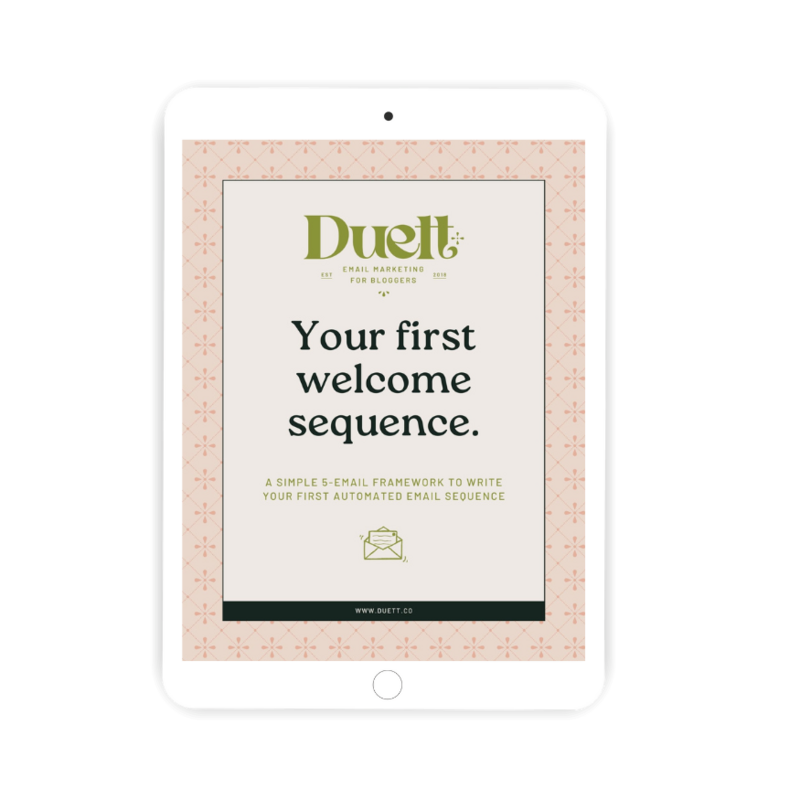
If you’re not welcoming new subscribers and pointing them in the direction of your best, most beloved content — or you feel like the one you have isn’t doing the trick — it’s time we fix that. Use this free 5-part framework to make a meaningful & lasting first impression as you write your first welcome sequence for new email subscribers!
Is Your Welcome Sequence Making a Lasting First Impression?