Oh hey there, I′m glad you're here!

Daily Emails and Doubled Traffic with Ned Adams of Dutch Oven Daddy

CLICK HERE FOR TRANSCRIPT
Allea Grummert (00:12)
Hey there, welcome to Happy Subscribers, a podcast that explores how bloggers and content creators can create more purposeful relationships with your audience through email marketing. I’m Allea Grummert email marketing strategist, copywriter, email platform expert, and founder of the done for you email marketing agency, Duett I started as a personal finance blogger in 2016 and have since helped hundreds of bloggers and creators like you maximize your email marketing for more impact, more traffic, and a better connection with your subscribers. Be prepared for some advanced email talk, as well as tactical tips to help get your valuable content into the hands of your audience faster and easier. I’m excited you’re here, so let’s do it. We can create a deeper, more meaningful connection with the community you love and serve through email. You guys, Ned Adams is here. If you don’t know Ned, he is the chef, the cook, the blogger behind Dutch Oven Daddy. He says that it’s the happy result of a gifted cast iron skillet and meal prep for a family member recovering from surgery. So the inspiration behind his content. And as the desire to keep track of those recipes grew, so did the development of his website. And now he’s a very popular content creator. And it gets all sorts of traffic to his website. And we are meeting today because when Ned and I chatted after Tastemaker, I found out that when he started sending daily emails, everything improved. And I was like, immediately, Ned, need to come onto the podcast. So we are going to chat about his shift from, you know, not so many emails to many, many emails and what that’s done for his business. So Ned, thank you so much for being on the podcast today.
Ned Adams (01:55)
Thanks, happy to be here. It’s be fun.
Allea Grummert (01:57)
Is there anything from your bio that I didn’t share that would be helpful for people to know about you?
Ned Adams (02:03)
So when I started this, I kind of didn’t know what I was doing. I honestly didn’t know what cast iron seasoning was. I thought it was like salt and pepper and what am I supposed to do with that? And in the process, I burned a whole lot of food to help my mother-in-law and I’m sure she just put a smile on her face and decided to eat it anyway.
Allea Grummert (02:25)
Yeah.
Ned Adams (02:26)
But ⁓ over time I actually figured it out and seasoning is not salt and pepper for cast iron so that was that was a good discovery for me.
Allea Grummert (02:35)
Yes. I love it. I’m sure your mother-in-law like all loving people who are receiving caretaking. She’s like, thank you so much for the food that you’ve provided. But it’s so fun because it sounds like you grew and developed through it. What was promising about that for you? Why did you want to get good at cast iron skillet cooking?
Ned Adams (02:57)
So I really like to learn things, learn and grow. It doesn’t happen overnight. There’s a principle called being 1 % better. And I think that is James Clear atomic habits. that’s kind of the approach that I took. I just learned slowly and surely. And over time, it just became a thing on accident, which was cool.
Allea Grummert (03:21)
I love it. Well, let’s tell people about your daily emails because I think you hit me with a stat and I have it in front of me for like what happened with your emails when you started sending daily emails. But let’s start here. Let’s start with the like what was the result and then we’ll get into some of the why. But do you remember like what your jump rate or your open rate jump to or your click rate?
Ned Adams (03:43)
Yeah, I do know that my traffic overall doubled.
Allea Grummert (03:47)
my goodness, like to your actual site.
Ned Adams (03:49)
My actual site the now you’re asking me hard questions like.
Allea Grummert (03:55)
You have it in front of me, Ned. I can just, you can give me a nod on whether it’s correct.
Ned Adams (03:59)
That’s probably correct, but yeah, let’s have you give it a go.
Allea Grummert (04:04)
Yeah, okay, so I have a note that your open rate jumped to about 50 % and your click rate to 6.5.
Ned Adams (04:11)
That’s right.
Allea Grummert (04:13)
like casually that’s right what? 6.5 % yeah so first of all tell me what is your email strategy look like before this?
Ned Adams (04:16)
Yeah. So it was sporadic. It was pretty much like maybe once a week on the weekend. I don’t know. I was like a little too terrified to like email people too much. But it was mostly just like, hey, here’s my new recipe that I just published or redid and have fun with that. And that was it. There was maybe like one or two links in the email and nothing too crazy. Here you go, I guess.
Allea Grummert (04:57)
Okay, so what changed? Where did you get the confidence to be like, and now I’m gonna send daily emails? Because that’s a true fear I hear a lot of people have about like, I don’t wanna bother my audience, yada yada. Like, I don’t wanna dismiss that, that’s a real thing. But like, how did that shift to having the confidence to email them more often?
Ned Adams (05:15)
So when I went to Tastemakers, I actually met some pretty amazing bloggers. So this was not my idea at all. And ⁓ I decided to give it a go. What would be the downside for this? Like, so what, right? And so it was worth trying. And I monitored really closely the unsubscribes because I figured those would go up ⁓ initially. And they kind of didn’t really surprised me. And so I was like, well, all right, I’m getting numbers. I’m still getting subscribers more than unsubscribers. So let’s go. Let’s, let’s go. Let’s do this,
Allea Grummert (05:55)
Yeah. So you’d kind of met people who are already doing this, they kind of gave you that permission slip of like, mean, at least try it.
Ned Adams (06:03)
Yeah, the crazy thing is I’ve been doing this for a while and I’ve never considered myself a blogger. And I think Tastemakers actually gave me the confidence that I’m like, okay, I’m actually a blogger. I’m a content creator. This is not my full-time gig. So I’ve always been like, no, I’m a nerd, right? But I’m not a blogging nerd per se. And nerd’s a good thing in my house. So, yeah, it just gave me confidence.
Allea Grummert (06:30)
Good thing.
Ned Adams (06:32)
That’s really what it was.
Allea Grummert (06:34)
Yeah. Do you think part of it is because it’s not your full-time job that you’re like, what’s the risk?
Ned Adams (06:40)
Yeah, right. Like there’s not really a downside, right? It’s not my main income. So yeah.
Allea Grummert (06:47)
Cool. Okay, so then you start sending emails daily. Did you have like a starting date? You’re like, was it like the very next day?
Ned Adams (06:55)
No, it was like during Tastemakers, I was creating them in the hotel room, like just cranking through it and trying and with help from another blogger, they’re like, yeah, this looks like it’s working.
Allea Grummert (07:08)
my goodness. So, okay, so tell me when you’re sitting down to work on these, is the framework different than what you were doing before? Like the actual layout, the goal of every email?
Ned Adams (07:19)
The layout’s quite a bit different. What I was doing before was like, anytime I’d republish something or republish a new recipe, it was pretty much pulling an RSS feed and I was just pushing that out. Nothing crazy. ⁓ The new format is pretty much completely different. There’s no RSS feed. There’s anywhere between five and 10 links and it’s very, very focused. Nobody, well, I guess I probably shouldn’t say nobody reads newsletters, but they’re really going to scan through it and click on stuff. And I figured out that that is true. Yes. So if you do ⁓ do a lot of links, people click on them. It’s cool.
Allea Grummert (08:07)
Yeah. Are you including, can we get technical? Are you including images? Are you using text links or buttons? Okay. So sometimes with images, like a feature, or sometimes you’ll maybe include an image for each recipe.
Ned Adams (08:23)
It’s usually just maybe one picture at the very beginning. And it also links to the recipe. I’ll say, here’s ⁓ Dutch oven Mississippi chicken or whatever, and ⁓ image right underneath that. Then there’s bonus links past that.
Allea Grummert (08:41)
And you label them as bonus links. Mm-hmm. well we’ve written them for clients Sometimes we’ll say like do you more like this and we link and then we we just do bullet points Are you as bullet pointed?
Ned Adams (08:53)
I don’t even put bullet points, that’s too much time.
Allea Grummert (08:56)
My goodness. Okay. And then are you including anything personal or does it still kind of feel like RSS?
Ned Adams (09:07)
Very little. Sorry, yeah. Sorry, I cut you off there.
Allea Grummert (09:11)
No, you’re fine. Go ahead and me.
Ned Adams (09:13)
Very little personal stuff. A lot of times if I decide it’s like national nacho day or whatever the national day is, I’ll say, hey, it’s great day to have nachos or whatever. And that’s about as personal as I get.
Allea Grummert (09:31)
Yeah. So I have so many questions. How are you planning your content calendar for this many emails? know plenty of folks are thinking, I don’t have time to write that many emails. Then also, what are these emails even about? How did you solve that problem?
Ned Adams (09:50)
So, making a schedule in my day is super highly important for me, especially because this is not my only thing that I’m doing. So, I have to time box stuff. And the reason why I don’t have bullet points and I don’t have a lot of writing and everything in these newsletters, because I just simply don’t have time like everybody else, right? Yeah. And so they have to be very simple and quick and planning content. I mean, there’s some seasonal stuff. There’s the national nacho day or whatever days. I don’t know what there’s calendars that show those. So I pull those every once in a while. Here’s some great chicken recipes. Here’s some great beef recipes. I don’t know. Like to be honest, it’s just fun to try to figure it out on the fly.
Allea Grummert (10:40)
That’s so fun. So do you just like Google like what what food national holidays or international holidays are today?
Ned Adams (10:47)
Yeah. There’s so many calendars that have those and I’m like, I don’t even know how you keep track of like national bacon day or national like there’s so many food holidays that it’s wild to me. I don’t understand that.
Allea Grummert (11:04)
I’m always here for donut day, whenever that comes around. Yeah. Don’t me with that. Don’t miss me with Cinco de Mayo and Sush Chips and Queso. got me. Okay. So content calendar, what is your time spent that you’ve time blocked? What does that look like? Are you kind of planning your emails for the next week from like a high level at like Monday and then breaking out the writing into multiple days? how do you piece that out?
Ned Adams (11:30)
So I, man, I have a Google sheet that I try and kind of plan it out, but I don’t actually make any of the newsletters. I just plan it. And so usually I’m like maybe two or three ahead is all like it’s not I don’t have time to plan like a week or two weeks at a time. Very short, and so I do that. Right. Like it’s I just went blank.
Allea Grummert (12:05)
Yeah, planning two to three days in advance feels like plenty when that’s a lot of content to create. And then it’s like, you’re not backlogged with a bunch of ideas that you haven’t actually executed on.
Ned Adams (12:14)
Yeah, that’s right. And then usually what I’ll do is once I get the plan for two or three, I’ll just go in and crank those out quick and schedule them and be done.
Allea Grummert (12:24)
Crank them out. Crank them out. Are you writing them in a Google Doc or writing them straight into your email platform?
Ned Adams (12:30)
straight in and a lot of times too I’ll duplicate old ones and tweak it so it’s super
Allea Grummert (12:37)
going be my next question. I was like, please tell me you’re reusing some of these emails.
Ned Adams (12:41)
Amen, sister.
Allea Grummert (12:43)
Amen. Are you A-B testing subject lines?
Ned Adams (12:48)
What’s that?
Allea Grummert (12:50)
Yeah, okay, great question. I finally stumped you. No, I’m kidding. That was not the goal. So to A-B test is like to test out two subject lines at the same time, or like change one from last year to the one, a different one this year and just see how they perform differently in terms of open rate.
Ned Adams (13:07)
That’d be really interesting. haven’t even gotten to that point yet, but that would be pretty cool.
Allea Grummert (13:12)
Can I ask how big your list is?
Ned Adams (13:15)
It’s about 4500
Allea Grummert (13:17)
Okay. Yeah. So even within, well, it depends what email platform are you using.
Ned Adams (13:23)
I’m using Kit or Convert Kit or whatever the kids call it these days
Allea Grummert (13:27)
So when you go to send the broadcast where the subject line is at the tail end of that field is like a A, B, little notation. maybe it might even be like a little lab. It’s a flask, not a beaker. Potentially. And when you click on that, it opens up a separate subject line. So then you can type in two of them. And what it’ll do is it’ll, I think you even get to set the parameters. Like, you know, 5 % of your list gets one or the other. And then after, X number of hours, whichever one is winning the most opens. That’s what gets sent to everyone else.
Ned Adams (14:03)
how cool is that?
Allea Grummert (14:04)
Right? So cool. So that’s one way to kind of continue to optimize what you’re already doing. I know it takes a little bit longer to come up with another subject line, but.
Ned Adams (14:13)
That’s what AI is for, I’m not kidding. I utilize AI for newsletters like a boss.
Allea Grummert (14:22)
Anymore like platform, which tool are you using?
Ned Adams (14:26)
Yeah, sure. Like pick your tool. Like to be honest, rewriting and writing tools in AI, there’s a lot. Like most any of them will do that. And so you could pick anything like a chat GBT or a Gemini or a Copilot or whatever. Like they’re pretty much the same in that space, right? And like that stuff’s not too hard for AI to manage.
Allea Grummert (14:54)
Yeah. And then what’s nice about it, and I’ve told my AI this too, I’m like, make it, make up nothing. Like if you can’t pull it from the blog post or you can’t pull it from the show notes, like make a note for me or work around it. So it’s really, it’s still using content that you’ve already created and put a lot of time and energy into onto the blog. And it’s making it a simplified version of that for a blog post in order to send traffic back to the main content. If you are interested in getting my help to grow your email list, send traffic back to your website and create a more meaningful relationship with your subscribers through email marketing, visit duet.co slash happy to book a free call with me. I promise you’ll learn a lot, even in the process, just about your own business, your own goals, and what could potentially be next for you and the growth of your email marketing strategy. Go ahead and book a call with me. I can’t wait to meet you.
Ned Adams (16:00)
sweet, that’s a good tip.
Allea Grummert (16:02)
Yeah. So I’m all about telling AI what it’s not allowed to do. You could also do it like where you request a handful of subject lines or you can give it kind of say like, I want a variation that has an emoji. I want a variation that has something in parenthetical notation or something just so that you have kind of options to pull from. And you’re still, you know, you’re still the managing editor of all of the content. So you get to make the final call.
Ned Adams (16:31)
How fun is that? I’m like a boss or something.
Allea Grummert (16:34)
Yes. People don’t take enough credit for the fact that like, dude, you get to make the final call. The computers are here to help us.
Ned Adams (16:42)
That’s right. Yeah, I’ve always thought that technology should supplement our work, not take over, like robots are not going to take over the world. It should supplement what we’re doing and help us.
Allea Grummert (16:57)
Amen to that. Can I ask, what is your day job? Do you work in tech? Are you an AI? So you’re comfy with it.
Ned Adams (17:04)
Yeah, it’s totally chill.
Allea Grummert (17:06)
I love it. Okay, so going back to this idea of sending your email list way more emails in a week than they were used to, and you didn’t see very many unsubscribes. Yeah, tell me about that. Why do you think that is?
Ned Adams (17:21)
It’s because I’m giving the people what they want. I don’t know. To be honest, I don’t have a scientific answer for that. Maybe you do, but…
Allea Grummert (17:32)
think anecdotal is fine. is a good.
Ned Adams (17:35)
Yeah, I don’t know. I’m just happy to be here and do this, right? Yeah. It worked, and I’m down with that.
Allea Grummert (17:43)
Yeah, I mean, anecdotally, I could say, you know, because your content is so helpful, and maybe the emails are really clean and easy to understand and click through. So it doesn’t feel super noisy. But I would also imagine that it’s because your list has already built so much trust with you, that they’re like, well, no, it’s just more of Ned. I want more of that in my inbox, and I don’t have a problem with it. Yeah, because I was going to ask if you’d asked your list at all if you want to segment. Them by saying no, I don’t want weekly emails. I just want one a week, but my guess is that you probably have it No, you have so much confidence. I love this. You’re just like, yeah
Ned Adams (18:22)
Well, I mean, again, have what do I have to lose?
Allea Grummert (18:25)
Yeah. Well, okay. And then let’s talk about what you gained. Cool. What does that mean? So much traffic. And so it’s even then it’s still a matter of like, what you gain versus what you lose. Like maybe you lose a handful of subscribers, or even 100 subscribers, but your traffic goes up over 50%. That’s why.
Ned Adams (18:49)
That’s like, I think that’s called like stacking W’s or something. I don’t know whatever the kids say. Stacking W’s, I think that’s what it is.
Allea Grummert (18:57)
my gosh, speaking of which, we need to give your shout out to your son.
Ned Adams (19:00)
Yeah, speaking of that, this mic setup, Spencer, you rock. Thank you, So that’s been, I mean, Google Analytics, like let’s talk technical. Like since January, since I started this, it literally doubled my traffic. I don’t know how else to say it other than it doubled, which is cool. And it’s staying consistent, which is neat.
Allea Grummert (19:33)
Yeah, and you would say that that’s worth it for the time and energy you’re putting into it.
Ned Adams (19:46)
Totally. Yes.
Allea Grummert (19:49)
Totally. Do you think is there, just, I’m just, I told you I was going to pick around, was going to root around and ask questions. But like, is there, is there a happier balance that’s fewer emails slash less work for you, but still maintaining that much game? Do you think the plateau is lower that you could get away with that?
Ned Adams (19:55)
Do this. Uh, I don’t know. That’s a great question. I haven’t even thought of that.
Allea Grummert (20:16)
I mean, it could be a matter of looking at which emails are driving the most traffic.
Ned Adams (20:19)
Yeah, I mean, I’m sure, well, I’m sure there’s a ton of optimization I can do and I should probably be doing. And there are times where I go back and look to see if there’s a newsletter that has actually performed maybe a little bit better than the others. But honestly, I don’t spend a ton of time looking at that and I probably should because, you know, stats are cool.
Allea Grummert (20:46)
That’s our cool. I will say though, my therapist always says, stop shutting on yourself. So like, when you’re like, I should do this, I should do this. And she’s like, stop shutting on yourself, because you’re doing fine. yeah. So yeah, like you can, but also the other thing is that if you’re so used to sending daily emails and it feels good for you to like, I mean, there’s something also like, if I’m sending seven emails a week and to go down to five, I wonder if I was missing an opportunity that would be kind of a fear of mine. I’d be like, But is it that much more work to do the thing? No. I’m here to not give answers and just cause confusion. Hope you’re happy.
Ned Adams (21:19)
Right. That’s totally fine. I’m down with that. We can cause all sorts of commotion, can’t we? We can send somebody down a tailspin or whatever the phrase is. I don’t know. I’m just talking here.
Allea Grummert (21:35)
Yeah, but even if you okay if you were to look at your stats more often, because it’s fun and you want to optimize it because you’ve already kind of got this locked in. What what would you hope to see? Or what do you think would change any of your behavior or thoughts?
Ned Adams (21:51)
I’m sure without looking at the stats, I wouldn’t know what behavior it changes because you change a behavior based off of not based off of stats, then you’re just changing stuff to change stuff. So I don’t really technically believe in changing it without knowing why. However, I’m sure that this could be optimized so much and I could squeeze every little trap bit of traffic out of it. And I probably honestly would need maybe a professional to help me with that.
Allea Grummert (22:28)
Well, this is not a freebie that I have available on my website, but I created an air table stats tracker, if you will, for a mastermind event. And I was just playing around with it. So basically what I did is created this air table base that tracks like number of subscribers, day of the week, click rate, total clicks. And then there’s also a section where you can manually, which you could probably AI it somehow to track what the layout of those emails are and what’s being promoted. You can even probably market for a season. You can market if it was a sales or affiliate email or something like that. But then it has all these views on the left-hand side so you can actually see like, okay, based on which days of the week are getting more traffic or more clicks. Maybe if you were to dial up more emails, you send two emails those days. Like Thursdays and Sundays, you send two emails or repurpose an old one and schedule it to go out in the afternoon in the evening. And so like that’s just one idea of like, oh, this is my high traffic day. Or you can also like look at your top subject lines and say like, okay, what do these have in common? So you’re gonna have to do that. And you can also filter by click rates. Yeah, and then look at like, okay, the ones that are getting the most clicks tend to have this format. Things like that.
Ned Adams (23:51)
Yes. See, that’s where the expert comes into play, right? I am not.
Allea Grummert (23:57)
Well, it just gives you some ideas of like what the different variables are. And so, I mean, my other thought that I have for you too is like, if you could automate those emails, if most of them are not seasonal, like you could eliminate writing a whole email or two a week as well. You just stack them all. then you’re like, Monday emails are always good. Great. And if you end up sending the same email twice in a week, I really don’t know if people will notice. You know if they get an automated email on Monday and they’re not this other time. I mean, you, and then what you do is you just pause that sequence in kit. If you do need to send out a sync go to my email. You’re like.
Ned Adams (24:38)
Yeah, good call. Speaking of that, when I say here’s the top chicken recipes, it’s sometimes the same email, but I have a different featured image.
Allea Grummert (24:53)
Hey, I support it. How often are you sending that out?
Ned Adams (24:56)
Maybe once a month.
Allea Grummert (25:01)
Okay, you’re good. Different featured image. I mean, are people complaining? Well, and here’s the other thing. If anything, you’re not constantly creating new chicken recipes. I have a client that when we were planning out her Thanksgiving emails, she was like, there’s literally no other recipe I can create. They are going to get the same Thanksgiving emails from now until eternity. So at some point, there’s only so much content that you have. And so what we’re doing is that the purpose of the emails is to send traffic to.
Ned Adams (25:14)
That’s right.
Allea Grummert (25:36)
Content that you already have. They themselves are not necessarily super unique. so just knowing the role of the email is to send traffic to X, or Z.
Ned Adams (25:49)
That’s right. Yep. And especially with me not have been the full time gig type stuff. I really don’t have that much time to create new content. Like it’s just not going to happen as much as maybe a full time blogger. Just not going to happen.
Allea Grummert (26:07)
Well, and it’s like you could even create an automated sequence that sends out two emails a week. So you’re like, my automated emails go out. They could be your Saturday, Sunday emails.
Ned Adams (26:18)
Sweet, yeah, that’s good stuff.
Allea Grummert (26:20)
You just stack them all in there. And so there’s really no easy way and kit to copy them to a sequence other than literally copying and pasting. And because you don’t have a ton of formatting, easy peasy. Also, while I have you here, do you have the app? It’s called copy clip.
Ned Adams (26:30)
it.
Allea Grummert (26:37)
What? It’s one word, copy clip. But it basically like, it’s just like a, I have it on my computer and it’s a clipboard.
Ned Adams (26:45)
Yeah, I have, Yeah, what’s it called? It’s called Clippy.
Allea Grummert (26:47)
Something like that. So I mentioned that because it’s like copying all the, like copy the subject line first, then copy everything with formatting. You go to the other screen, drop the formatting, drop the subject line, save and move on. Yeah. And then all you do is like actually the backend of the settings in kit is where you can determine which days of the week it goes out. You just say Monday, Tuesday. yeah.
Ned Adams (27:03)
Yeah, absolutely. Dude, that’s cool. See, that’s the thing is like what I was saying earlier, like use technology to help your life.
Allea Grummert (27:21)
Yes.
Ned Adams (27:22)
That’s what it’s there for.
Allea Grummert (27:24)
I mean, if that saves you from needing to write two emails a week, and then, or you use that time, at least with a foreseeable future, repurposing the emails that you have written, or the ones that you wrote over the last week, drop those in there. And then once everybody’s gone through it, Ned, you just add them to it again. That’s basically what you were doing anyway.
Ned Adams (27:43)
true.
Allea Grummert (27:45)
love to see it. Do you have going back to the things that I do for a living? Do you have a welcome sequence?
Ned Adams (27:51)
Yeah?
Allea Grummert (27:52)
You do? Tell me what’s in it.
Ned Adams (27:55)
Let me look. Did I tell you might already have the answer, but let me look.
Allea Grummert (27:59)
I don’t know. I was like, this is the one thing we didn’t talk about. But I’m just curious because when you are sending out that much content, I’m just curious if you’re giving people a preface, at least of who you are and what what they can expect.
Ned Adams (28:12)
Yeah, I have a quick start guide and it talks a little bit about, well, number one, it says, welcome to the community. Like I’m trying to make this a community for Dutch oven daddy. And it’s very simple. It’s like, how do you season cast iron? Because that was the first thing I had to learn, right? And so they might as well start there. And what’s interesting about that is seasoning and which oil you use and everything is very, very, very personal. And people get very passionate about that topic. so it can generate quite a bit of discussion, which is kind of fun.
Allea Grummert (28:56)
Yes, are they replying?
Ned Adams (28:59)
Sometimes, yeah, not a lot in an email, but every once in a while I use this or I use that. Cool. That’s great. And then the next two is the sequence, a start guide, quick start guide sequence. And the next one is, here’s my first Dutch oven meal that I ever cooked. And then the next one is like, here’s some really good easy camp desserts that I’ve done. And so that’s pretty much what it is. It kind of starts laying out the regular emails that I send. They’re in very, very similar formats. So by the time they get that, they’re pretty much used to the daily emails.
Allea Grummert (29:44)
So good. Are you excluding the daily emails from anybody who’s currently in the welcome sequence or the quick start guide?
Ned Adams (29:50)
I don’t think so, maybe, I don’t know.
Allea Grummert (29:53)
You can just exclude them from that. can do it on the second page of your broadcast. You can just say, exclude anybody who’s in the quick start guide.
Ned Adams (30:03)
awesome. Yeah, I haven’t seen anybody complain, so I’m just probably going to leave it, but…
Allea Grummert (30:08)
doing it. Yeah, that’s an option. And then when you if you duplicate broadcasts, that setting stays the same. So you don’t have to like, maybe every time. those are most of my questions. I’m just I want to celebrate with you that this is such a win for you in that you have also created a routine and consistency for cranking these out. Love that it’s boosted your page views and therefore your revenue? Question mark. Yeah, we love to see.
Ned Adams (30:37)
So.
Allea Grummert (30:38)
thumbs up. So if we are, you know, chatting with other creators, I sometimes forget that people are listening to this. Hello, listener. ⁓ But what do you think other creators can learn from your experience here?
Ned Adams (30:53)
So, after I got back from Tastemakers, I put a little note ⁓ underneath my monitor and I hope I don’t get sued by Nike, but it says, just do it. And it’s literally just go do it, go try it, go do those things that you think will work. Even if they don’t, that’s okay, you can revert.
But just go do it. Just do it. I am a blogger, right? It’s just the confidence piece, right? Just go try stuff and if it doesn’t work, then you can pivot. And think that was the biggest thing that I learned over the last few months and so far it’s paying off.
Allea Grummert (31:41)
It’s so cool. You’re so chill, Ned. The blogging space, I hope that they just take away like, look at it. I think that there’s room to experiment. I know that we work, you know, we as a creator space, we work so hard to do things just so and just correctly. I love that you already did the experiment and have proven that it works. And so, not that like we would say, for sure, if you do this, it’s definitely gonna work, but the odds are high. The odds are good. And yeah, thank you for being bold and sharing your story with others.
Ned Adams (32:16)
Yeah, you bet. It’s so much fun. just, that’s, I don’t know. Like, again, I have no pressure, but just have fun. This is great stuff and it’s just cool to be included. So, yeah, that’s it.
Allea Grummert (32:33)
I love it. Well, and I want to go back to as well, just how you’re also welcoming people into a community because sometimes this can really turn into like, this is my money making machine and it feels that way. And I just encourage that you’re not forgetting that those people are people. And yeah, tell me a little bit more about that. How about how you keep that balance?
Ned Adams (32:54)
Yeah, so that’s really hard to do in a tech space, right? Because you’re behind a screen and I mean, social media, you see it all the time where people say things that probably they shouldn’t ⁓ or they wouldn’t if they were face to face with someone. ⁓ that’s the key is like remembering that people are people, they have feelings, they’re trying hard, right? You don’t know what their situation is and just be kind when you have a choice. And I think that’s really important to remember. And ⁓ I don’t know, it just makes sense to me.
Allea Grummert (33:41)
Thank you, Ned. Appreciate that. And thank you so much for being on the podcast. Before we wrap up though, tell people where they can connect with you, get on your email list, all that good stuff.
Ned Adams (33:44)
You’re welcome. Yeah, absolutely. So it’s dutchovendaddy.com. So who’s your Dutch oven daddy? But it’s just dutchovendaddy.com.
Allea Grummert (34:00)
I love it. Awesome. Well guys, go follow Ned, go get inspired by his email cadence, these daily emails, try it out yourself. If you want to DM me on Instagram and be like, Allea, I’m doing it and I will report back. Like I will sit there. I will wait and I will want to hear how it goes. So thank you, Ned, so much for sharing.
Ned Adams (34:23)
I want to know how it goes too
Allea Grummert (34:25)
Yeah, group message, Ned and Allea. Keep us updated. Let’s do it. Thank you so much, Ned.
Ned Adams (34:29)
Let’s do it. Yeah, thank you so much for having me. I really appreciate it.
Allea Grummert (34:39)
Thanks so much for listening to happy subscribers and our conversation about email marketing today. I hope you feel inspired to take action, even if it’s a small change, so you can more confidently share your valuable message with your community through email. Special thanks goes to my team who makes it possible to produce and share these episodes with you. Seriously, thank you guys. If you want to hear more email marketing tips, strategies, and success stories to help you develop deeper, more meaningful relationships with your email subscribers, be sure to subscribe to happy subscribers so you don’t this an episode. If you have a few seconds, I invite you to share this episode link with a friend or post it on social media so your peers and community can benefit from it as well. And if you have a few minutes, I’d appreciate if you’d leave a written review of the podcast since that helps more people hear about it and I believe we need more creators sending more valuable emails to their audience with more confidence. If you want to reach out to me directly, the best way to do that is to join my email list through one of my top freebies listed in the show notes. You’ll get regular emails from me that are packed with value. And if you hit reply to any of those emails, it’ll land in my inbox and I can’t wait to chat with you there. Until next time, let’s Duett.
How many emails should you be sending?

It’s a question I hear from content creators all the time, and the honest answer is: it depends.
What I’ve noticed is that when I encourage people to send more than a few emails a week, there’s often a little hesitation — a worry that it’s too many, that it’ll feel like too much, that their audience will get annoyed and start unsubscribing. But then there are creators on the other end of the spectrum sending daily or even twice-daily emails without batting an eye. With such a wide range of what’s possible, how do you actually know what’s worth your time and energy — without burning bridges with the subscribers you’ve already worked hard to build?
That’s exactly what I wanted to dig into with Ned Adams of Dutch Oven Daddy.
When Ned shifted to sending daily emails to his list of ~4,500 subscribers, his site traffic doubled. His open rate hit 50%. His click rate jumped to 6.5%. And his unsubscribes? Barely moved.
In this episode, Ned and I dig into what his email strategy actually looks like, why it works, and how his “what do I have to lose?” approach might just be the most honest email philosophy I’ve heard in a while.
In This Episode:
- What Ned’s email strategy looked like before daily sends — and the one permission slip he got at Tastemaker that changed everything
- The ultra-simple email format driving all that traffic (one image, 5–10 links, and zero bullet points (!!))
- Why duplicating old emails and tweaking them is not lazy — it’s actually smart
- How Ned uses AI to batch subject line options so he always has something strong to send
- Why his “what do I have to lose?” philosophy might be the most underrated email strategy out there
Episode Resources:
- Dutchovendaddy.com
- Kit (email platform Ned uses)
- Book a FREE Discovery Call
- Free Duett Resources
- Join the Duett newsletter
- Instagram @alleagrummert
- Food Blogger Pro

Subscribe & leave a review!
If you enjoyed this episode, you can show your support by leaving a review, subscribing, or sharing your biggest takeaways on your Instagram story! Just remember to tag me @alleagrummert so I can see it.
Subscribe on Apple Podcasts or Spotify

About Allea

Allea Grummert is an email marketing strategist, copywriter and tech expert who helps bloggers and content creators make a lasting first impression through automated welcome & nurture sequences. She helps her clients build intentional email strategies that engage readers, build brand loyalty and optimize conversions for sales and site traffic.
Allea is the host of the Happy Subscribers podcast, holds the coveted spot as the email marketing industry expert for the Food Blogger Pro membership community, is a Recommended Expert through NerdPress, a trusted Mediavine partner and recognized as a Kit Approved Expert.
Looking for more ways I can help you?
Book a free call with me (no-pressure zone, promise!) and we’ll chat more about what would benefit your business most in this season.

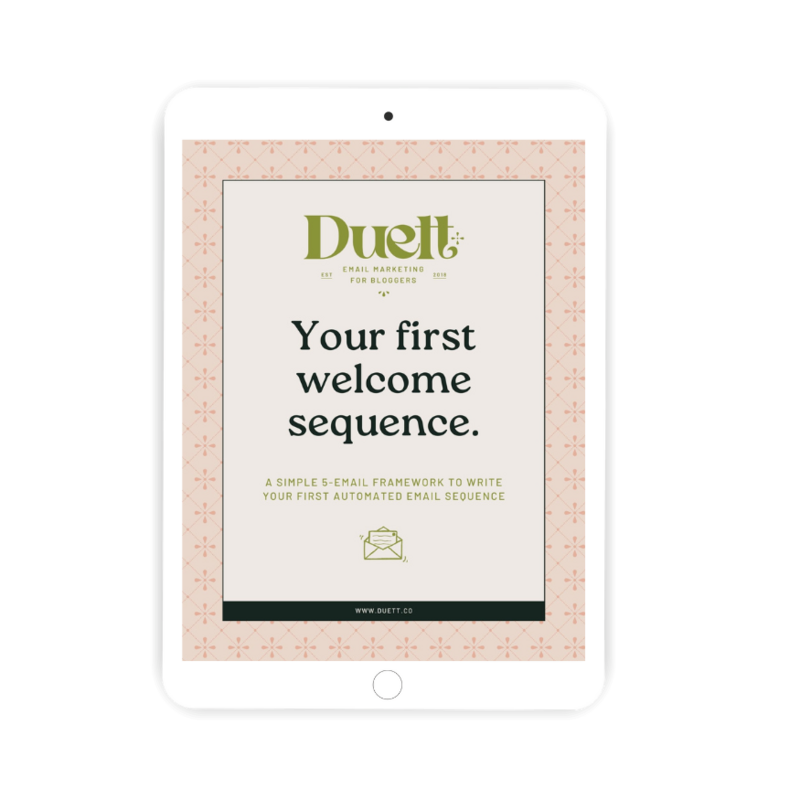
If you’re not welcoming new subscribers and pointing them in the direction of your best, most beloved content — or you feel like the one you have isn’t doing the trick — it’s time we fix that. Use this free 5-part framework to make a meaningful & lasting first impression as you write your first welcome sequence for new email subscribers!
Is Your Welcome Sequence Making a Lasting First Impression?