Oh hey there, I′m glad you're here!

Using AI Intentionally with Andrew Wilder of NerdPress

CLICK HERE FOR TRANSCRIPT
Allea Grummert (00:12)
Hey there, welcome to Happy Subscribers, a podcast that explores how bloggers and content creators can create more purposeful relationships with your audience through email marketing. I’m Allea Grummert, email marketing strategist, copywriter, email platform expert, and founder of the done for you email marketing agency, Duett. I started as a personal finance blogger in 2016 and have since helped hundreds of bloggers and creators like you maximize your email marketing for more impact, more traffic, and a better connection with your subscribers. Be prepared for some advanced email talk, as well as tactical tips to help get your valuable content into the hands of your audience faster and easier. I’m excited you’re here, so let’s do it. We can create a deeper, more meaningful connection with the community you love and serve through email. If you’re curious about Duett and our services and how we work with clients, go to duet.co/happy for a few different free resources. And while you’re there, you can also join my email list, which is where I share so much valuable content that you really cannot get anywhere else. Plus you can reply back at any time to any email and it will go to my inbox as well. Go to duet.co.uk slash happy and I’ll include the link in the show notes so that you can grab more. Okay, guys, today my friend Andrew is on the podcast. Andrew Wilder is the founder and CEO of NerdPress, a certified B corporation that provides human centered WordPress support, optimization and maintenance for independent publishers and small businesses. He’s been building and occasionally breaking and then fixing websites since 1998 and is known for making technical topics easy to understand without jargon or ego. I have met Andrew I don’t know, oh no, I do know where I met you. It was at the very first Tastemaker that I went to. Here’s why I remember that, because you came around the table, we had talked to each other over email or something, you came around the table and you were like, do you hug? And I was like, I am a hugger. And so I had like, that’s my earliest memory of Andrew. I like, I’ve already gotten a hug today. That was lovely. So Andrew, thank you for being on the show.
Andrew Wilder (02:16)
I’m like already blushing. That’s so sweet.
Allea Grummert (02:18)
Core memory unlocked. So bad. You got to watch me unlock that. That was great. Well, guys, I’m having Andrew on today, first of all, because he is my friend and we see each other a few times a year getting to chat at different conferences like MVCon and Tastemaker. And yeah, I knew of Andrew before he knew of me. He’s someone that I look up to and he’s smart as a frickin’ whip and super excited because we’re going to talk about AI today, which is a topic that comes up often on the podcast. I know you hear me talk about it, but I’m really excited to hear about it from Andrew’s perspective. So, Andrew, any opening statement?
Andrew Wilder (02:58)
Okay.
Allea Grummert (03:00)
I’m just kidding. do, I have things I can prompt you on, I will say, is there anything I didn’t share that would be helpful for people before we dive in?
Andrew Wilder (03:08)
I think that was lovely. I would love to explain what a certified B corporation is. sent you my bio and I’m like, that was meant to be written not on a page and you’re not read out loud.
Allea Grummert (03:18)
And I know what it is, so I guess I didn’t even think about it.
Andrew Wilder (03:20)
I think today might even be the one year anniversary of our becoming a certified B Corp last year. And so the whole idea is that business can be a force for good. And so we are a for-profit corporation. Like we’re not a non-profit, but we do business in a way that factors our impact on all stakeholders. So our customers, our team and our employees and the planet, and I include animals on that. And so we are actually legally obligated to factor all of those stakeholders in our decision making and to try to be a force for good. So there’s a little over 10,000 certified B Corps around the world. So it’s a really cool community. I’m going to my first B Corp conference in a few weeks. So I’m very excited to go meet more like-minded folks and hopefully collaborate with them too. anyway, I know that’s not about AI, but it’s maybe as a segue, like this feels like a piece of humanity. Maybe because we’re always asking, as a B Corp, what’s the B Corp thing to do? That’s the way we phrase it. And it’s like, we’re having conversations about all the energy and water that data centers are using and things like that. So we’re trying to factor in not just the, will I be replaced? It’s just a very real question.
Allea Grummert (04:39)
Part of my existential crisis earlier this year.
Andrew Wilder (04:42)
Every day. But not yet. I will say maybe a good way to start this conversation is like two years ago, was like, holy crap, blogs and websites are not going to exist in two years. Like that’s where I was like, I was terrified that websites will be gone. And, you know, two years later, they’re actually still going strong. It’s been a lot of churn and, you know, not everybody’s doing great. I don’t want to like paint too fine, you know, a picture, but people are still really craving human interaction even through the internet. And ⁓ that’s been, I think, the thing that’s going to keep us going. ⁓
Allea Grummert (05:22)
Yeah, thank you. Sound bite, it’s over. That’s all we needed to hear. like sitting on that. Well, and right, so I went through a few weeks of just like, it happened to be winter and I’m not in LA like where Andrew is. So winter here is cold and I’m just like in the cold, the dark, the ice storm. And I was like, A.I. is coming for everything. And like I got real, I got real sour about it. But I’m like, I do. I’m with you as far as thinking through the ethics of all the decisions that we make. So for instance, I don’t want to not pay my team. I’m not looking to use AI to replace the human touch in my business. I do a lot of high touch work for our clients. It’s not commodity wise. It’s humans, it’s strategy, it’s implementation, it’s edits, and it’s talking with a real person. And I love that. But how can I use AI to really simplify it? A lot of, I would say, it’s like the copying and pasting in my business. Like my poor team. I’m like, how many years have you been copying and pasting that from one form to another? So like that’s the stuff I’m trying to fix. But I still, can we talk about the environment for a minute, Andrew? Cause I feel like you would know more than I do. Is it worth it? Is it, I mean, I know that AI is being limited in some ways, like hopefully AI slop that goes out the wayside and we’re not getting these really confusing pictures on threads anymore. Like, but in general, like using it for my business, do I need to have more concern about that?
Andrew Wilder (06:51)
So we internally did not come up with an answer on that. But we also use computers. We’re using power at home, right? Like in all our home offices. Like we’re not like just living off the land in total harmony. So it’s a question of where do you draw the line. So we work with a nonprofit called We Are Neutral that they do our annual carbon calculations and then we actually purchase offsets through them and they do verified offsets. So that way we’re reducing our impact that way. Because we can’t be truly zero emission, so we offset what we can. ⁓ So we posed that question to them. We were like, okay, we’re having this debate. it better or worse? And what do you think? And they were like, well, it takes a tremendous amount of power to train the models. But beyond that, the usage, they said, is probably, they’re thinking is if you can do something faster with AI than you would do it yourself, you may actually be using less power.
Allea Grummert (07:47)
Thank
Andrew Wilder (07:47)
because your computer is on and running. ⁓ I think that argument starts to break down though, because we’re actually doing things faster, but we’re doing more. It’s not like we turn off our computer after six hours instead of after eight hours, right? ⁓
Allea Grummert (07:58)
I do but I’m not your I nap every afternoon and the friends in my life are like I love that for you. Yeah, I’m seizing the day on self-employment, but Yeah, there’s probably still I don’t know I’m thinking there’s some graph of like there’s gonna be a point where Just keep going, but maybe we can and that’s that’s terrifying
Andrew Wilder (08:22)
I think where it’s what’s going to happen is once end users of AI start having to pay what it costs, the usage is going to go down. It’s all subsidized right now. So, you know, I mean, I read this morning there’s 900 million people using chat GPT every week. Most of them are not paying for it, which is why chat GPT is starting to run ads. They’re experimenting with that. But once you either have to be flooded with ads or pay the real cost and then beyond so they can be profitable. Like, you know, are you talking 200 bucks a month, 500 bucks a month, $10,000 a month? the amount of subsidization that’s happening is staggering right now. For us as end users, it’s actually really great because we can take advantage of that in our businesses. But we’re also going to become then reliant on it and then prices are going to go up. And so I think that’s what’s going to cause the AI slot problem to go away is once it really costs it, when it costs too much to make the slop and there’s no return on that, then why bother? Or the costs are going to come down, the energy usage is going to come down, it’s going to get more efficient. Or both these things, right? There’s a lot of people running local models on MacBooks or Mac minis, OpenClaw got really popular ⁓ and people are buying Mac minis and they’re running it locally. So they’re using power at home, but it’s not the massive data centers suck in one concentrated place. You know, TBD.
Allea Grummert (09:55)
Yeah, sidebar. looked at OpenSaw and I clicked right back out. I was like, I don’t think that’s for me. I’m not a developer. So it could be someday. But I’m like, I’m going to put that on.
Andrew Wilder (10:07)
I would stay away from it. Colin, who was on your podcast recently, ⁓ last weekend or the weekend before, he was like, I went deep on open claw. And the short answer is don’t use it. He’s like, there just aren’t enough guardrails. And it’s kind of a, I think he said it’s a mess. think those were his exact words. ⁓ But Claude Cowork and others are coming out that are, have more guardrails, I guess.
Allea Grummert (10:17)
Really? Yes. Correct me if I’m wrong, but the folks behind Anthropic who created Claude came from ChatGBT OpenAI, right? Is that what it’s called? But they’re like the ethics people. The ethics people left ChatGBT to go start Claude. Yes. And already I like them more.
Andrew Wilder(10:48)
NERDPRESS is a public benefit corporation, is similar to a certified B Corp. The certified B Corp is a third party certification, but like NERDPRESS is a public benefit corp. And so that’s like the legal requirement that they have to actually exist for the public good.
Allea Grummert (11:03)
Good. Yeah. So when I saw that they have like their ethics policy and everything on their website and I even asked Claude or I’ll ask Tasklet AI and I’m like, is it safe for me to share this with you? And I’m like, it could lie to me. I don’t know, Andrew. I text, I ask it and then I text Mike Zeylanca, who’s also been on the podcast and be like, is this safe? Like, I’m just like so afraid because I don’t know. Like, it’s just it’s still so new and I’m not in the development space, developing space to know exactly.
Andrew Wilder (11:31)
I would be really careful with client personally identifying information. Don’t upload an email list, stuff like that. Or anything that’s really trade secret that you don’t want getting out. You want to make sure that if you’re using a tool, you’ve told it not to train on your data or your conversations. Because especially if you’re not paying for it, they default to on your stuff. If you’re paying, the defaults may be the other way around. But that’s something everybody should check if they’re concerned about that. If you’re using it to write like goofy songs and don’t care, then no big deal.
Allea Grummert (12:04)
Yeah, it is. It’s pretty wicked cool. I’m not going to lie. I’m in a phase of just like really streamlining stuff in my business. ⁓ But we were mentioning before the call, how do we how do we feel about using AI for content creation? Because I would say I’m not using it for content creation for my business. I have one client who came to me asking for me to experiment with her with AI content. And that’s the only person I’m doing it with. It’s not happening across the board. For strategy writing or anything. So just to be transparent, like I am playing around with that with one client, which has been really, really cool, but also still a lot of work, but we’re only one month in. but primarily not using it for content creation. Curious though what your recommendations are or guardrails around that in a time of.
Andrew Wilder (12:54)
I think it depends on how you define using it for content creation. Yeah, great question. Using it for content creation is different than creating content. ⁓ Where I’m drawing the line is we’re not having it create the content. ⁓ We might have it curate a bunch of information, write an outline, or review something we’ve written, right? We’re using it. A lot for ingesting a bunch of stuff and synthesizing stuff and then making SEO recommendations or suggesting we structure things a certain way. What we find though is when we have it create the content, we spend more time fixing it and making it sound not like AI and making it sound like us and making it sound correct and accurate. you know, there’s all these, I’ll say verbal crutches that AI has that when you use it enough, you start to notice it. The dash being a running joke for a while, right? ⁓ Now in headlines, it’ll say something and then it’ll redefine it in parentheses in the headline. And so that’s off the table. can’t do that anymore. ⁓ so it’s just, every time we try to have it create the blog post, it’s more work, not less. ⁓ But having it help us with like, hey, I need 20 blog post ideas and things like that. And not just like generic ideas, but once it gets to know you and your business and your blog, you know, it can actually be relevant. You know, I just use the $20 a month chat GPT and it’s memory of nerd press is really helpful, right? And important examples. And it’s like, well, for a high touch business like yours, you want to approach it this way, not, you know, not this way, you know. And ⁓ so here’s a funny story, though, like how quickly we get used to this technology. Yes. A couple months ago, this was in December, I was actually at Casey Markey’s Christmas Armageddon party, which is a ago, and I’m driving home Sunday morning. So I’ve got like a two hour drive in the car and I have a self driving car, a Tesla, on the freeway or, know, supervised, quote unquote. And so I’m on the freeway and it’s, know, I’m just like two hour drive Sunday morning, right? So I put the car in autopilot mode and then I take my phone and open the Chad GPT app and put the voice conversation in. And I had like an hour long conversation with Chad GPT about like ideas for my business. And I’m like, what else can we do to support our clients better? And we’re going back and forth and the voice is natural. And it’s like coming up with other things and I’m saying, no, I don’t want to do that. And it’s like, okay, no problem. Let’s have here five more ideas. And I had this amazing brainstorming session and I had to pause for a second. I was like, I’m in the future. This is crazy. Like driving itself. I’m having a real conversation with the computer and I didn’t even blink. Like it didn’t surprise me.
Allea Grummert (15:45)
Right.
Andrew Wilder (15:45)
And so it’s just really interesting how quickly we acclimate to this stuff. I don’t, who knows where we’re going to be in two years. But I just honestly try to roll with it at this point.
Allea Grummert (15:57)
Yeah, yeah, yeah. Part of what gives me confidence with using AI is that, or at least like for my business systems and our workflow, like for instance, like we do something called the email strategy playbook. It is a massive audit. It is comprehensive, but we have like, it’s like a dirty doc. It’s an internal document with all of our notes, all of our like things that we like checklists, the things we look for on their platform for all these different sections. Well, that’s one of the documents that my sweet team members have been copying and pasting to Google Slides for like three years and even before that as well. And so I just spent a few hours last week working with Claude to create a version. I was like, if I give you this doc, can you just give me a version that’s like a Google Doc? And then I wanted to figure out a way to get my team to be able to access that same kind of power without me having to buy a co-work for all of them. But I also want to make sure that our skills were updated. So I was like, how do I do this? Well, have you heard of Taskquit? Surely you have not. Taskquit AI. This is a Mike Zeylonka shout out. It’s only been around for like six or so months, but it’s a it’s you build these agents. So come with me to this journey. So what I ended up doing, because you can connect it with Slack or Asana or your Gmail or something like that. And so I set up a Slack channel so that when I drop the dirty doc, the internal checklist in there, Task Lit takes it, turns it, like I don’t need Claude anymore, because I have now trained Task Lit. But now when you drop the Google Doc link into Slack, it says, on it, be right back. And then within five minutes, it shares a link to the file that it’s already saved in my drive with the link directly in the thread in Slack. So instead of my team member having to set aside 30 minutes or more to go format this and this, you know, looking back and forth, here’s the thing though, you got to train this stuff. Because the first view that I did, it was making crap up. the number of times I have to tell Claude, said, make no s up, sir. Like, no, because everything in that doc is exactly what we want to report to the client. It just needs to be formatted to look a little bit more professional, presentable. And so that’s just in the last few days. So now my team member doesn’t have to ask me to insert it into Claude at all. She can just drop it in there. And I just feel like a superhero.
Andrew Wilder (18:23)
I mean, all of this is a tool, right? And ⁓ it’s the I think the hardest part right now is you have to wrap your you have to have the paradigm shift in your brain of like understanding because it’s a tool that we haven’t had access to before. But then it also is changing like week by week. And you know, when open clock came out, that kind of blew everybody’s mind, right? And that’s where like, you could have your own personal agent, and it could be running in autonomous. And that may or not be a good idea, but it can do it. And starting to think like, like, I still catch myself going, why am I not having AI do this? It’s busy work. And I have to kind of break out of that.
Allea Grummert (19:01)
Well, I’ve shared some of my developments with AI and how I built it out just internally. It’s always like, you’ve become a prompt engineer. I was like, I got a new job title. There’s a skill to using it because you can’t ask it to do too much. You need to give it a place to live once it generates whatever you’re creating. For instance, Android did this last week.
I figured out how to give Claude, like I gave it a bunch of my previous examples of show notes. This is something I’ve always struggled with. I’m like, write the show notes, don’t write the show notes. Like, y’all, I just already had an hour long conversation about it. The content has been created by me. Do I need to be the one to write the blurb that goes on Spotify? I don’t really want to. And so I give it the link and the transcript and it generates like all the different things and it drops it into Airtable. So now it lives somewhere for my team. And that happens in five minutes.
Andrew Wilder (19:58)
Yeah, and before that would have been
Allea Grummert (20:01)
I’m waiting a whole week and then the conversation’s not even fresh anymore. So and then the thing is you have it created and then you read through it and you’re like, yeah, that checks out. That’s the conversation I just had with Andrew.
Andrew Wilder (20:03)
procrastinate for a week. So here’s the problem though, so we do a bi-weekly site report for our clients. You every other Friday morning we send out, and a lot of it’s automated where it’s like ⁓ traffic and what plugins were updated that week, an uptime report. But at the top, we have a curated news from the nerd section. And Miranda and I basically collect a bunch of news over two weeks and ⁓ have the team, you know, send us things. But we write the blurbs by hand. And we’ve tried to have AI write it, and it sucks, and we spend more time fixing it. So it’s a lot of work, but that’s where we try to nail it and be precise and witty if we can and smart and engaging in two sentences per thing. And AI just never gets that right. And I think we could feed it probably years with the site reports and probably still won’t understand our voice. So I think that’s where it’s like trying to automate the busy work, but not the final output that I think is really important.
Allea Grummert (21:13)
Right. Like I’m writing my emails. I’m the one having these conversations. I’m the one going to events or reading the articles that I want to share with my audience. Like that’s the human work. Whereas like, I mean, yeah.
Andrew Wilder (21:27)
So I think a lot of people listening to this probably are like so cringing right now with this conversation though, because like I see conversations ⁓ on Facebook, particularly from content creators who make their living creating content and putting it out on their blogs, ⁓ who just are like, screw this, I want nothing to do with it. And I think there’s a balancing act, right? And I wanna say you do you, but at the same time, like, I feel like because this is a tool, if you don’t start embracing it in some way, you’re going to get left behind is my concern. Or you have to be okay with being like, I’m going let my audience be smaller and really human focused. Not to say that we should be replacing ourselves, but how do we like, I guess AI is not a monolith. Maybe that’s the way to look at it. we’re talking about, we’re using it for certain things, but we’re not using it to replace us. Like it’s augmentation of us.
Allea Grummert (22:17)
I’m a claimer.
Andrew Wilder (22:24)
We’re trying to work smarter and faster so we can keep up with everybody else who’s doing that. On the meta level, I don’t know this is good idea at all or not, but it is what it is at the moment. I don’t think we’re all headed to a 10-hour work week because of this. That’s sad. That’s how this is going to pay out. I guess if you make AI one thing, you’re probably shooting yourself in the foot. Right? Because if you’re like, no, I’m anti AI period. Okay, but then where are you going to be in five years? You know, and if you’re almost ready to retire, then good on you.
Allea Grummert (23:05)
Yeah, you can. You know, it’s got me thinking, Andrew, I have hired plenty of people over the year. Actually, like, I have like 10 team members. It’s wild. Yeah, thank you. I was like, how many how many of the work for you that’s not AI? No, like you’re hilarious. So I like I don’t have individual AI agents, like replacing people. But it made me think of back when I did like task audits. back in the day when it was like just me or just being a project manager. What are all the things that I’m doing in a week and what are the things I don’t need to be doing? Full stop. Then that’s what I would hire for. I don’t actually need to be the one, believe it or not, to be the one writing. I used to be the one to write all of the emails. I’m like, what would it actually mean if somebody else did the writing? Does that diminish the work that we’re doing? No, because I’ve completely trained that person and I oversee that copy. And now I’ve got a copy editor who has written for the team, oversees the copy, and they’re the ones that I trust that it’s doing a good job. So like, I guess I don’t see this being, I guess I’m seeing similarities of like, if you are a blogger or content creator and you look at your week, what are the things you actually don’t need to be the one doing? Is it pulling reports? Is it drafting email replies? You know, and then you go in and you review and hit send. I could potentially have somebody replace Kat to do that. I don’t know if I will. Kat might want me to. Like, if you don’t mind, can actually set up an agent for that? So, you know, it’s part of the evolution of you building your own career. Like, what do you want your day to look like? And, you my business coach has said, too, she’s like, there’s automations with AI, but like having a team to do things is basically also automating as well. Because when I do this, Kat will do this and Tina will do this. That’s how, so it is an automation because they’re doing their jobs. And so both are true.
Andrew Wilder (25:03)
Mr. Mark.
Allea Grummert (25:04)
Yeah, I guess what I want to say is this kind of goes back to the pride that we have in being hustlers who are always working. What if you didn’t have to be and you didn’t actually have to replace it with more work? What if one or five hours of your week could be automated and you’re off of work and you go take a nap with your cat like Allea the email person is? That’s something that you can achieve doing this and it doesn’t necessarily mean that you have to double down and do more. It could just mean what you’re doing is easier.
Andrew Wilder (25:38)
I think if you had said that in 2022, I’d be like, right on, Because right now, I feel like everything is in flux still. I mean, it’s not as bad as it has been for the last two years. I feel like we’re in our new normal. But ⁓ maybe that’s a bit of a correction after the pandemic, I think, ⁓ because so many new websites came online, so many more content creators, especially in food blogs. And now I think
Allea Grummert (25:44)
Tell me why I’m
Andrew Wilder (26:06)
We reach peak content even without AI, without ASLOP, without any of that stuff. And we’ve kind of come back. So now I think we’ve had that correction already. don’t have any proof of that. It’s just my spidey sense. We’re seeing hundreds of sites and we see the traffic. And that’s kind of what it feels like. But I love that you can be like, I just bought back five more hours of my week and I’m going to go take a nap. You’ve decided this is enough for me.
Allea Grummert (26:36)
Yes.
Andrew Wilder (26:36)
Because most people, myself included, say, I’ve got five more hours. What else can I accomplish? Right. And that’s a really interesting question and something that I’ve been thinking about is like, what is enough? ⁓ And I don’t necessarily mean enough in terms of like revenue. mean, in terms of like you asked, think the best question, what do I want my days to look like?
Allea Grummert (26:56)
part of why I’ve had to adopt that. You should know, I come from a life of like where it’s really hard for me to not be productive. But here I also see my brain as a treasure. And if I lay it out flat six or seven hours a day, five days a week, I’m not going to have anything left for my friendships, for my people, for my personal enjoyment. Like even if I were to keep working, things don’t change immediately because of that. Like I could be working 50 hour weeks. I still have to wait for the client lead to come in order for me to get the sale. Like me working 50 hours a week isn’t going to work actually get me closer to my sales goal faster. Like in a lot of it because you’re doing busy work or things you don’t need to be doing at all. And it’s also I’ve worked my tail off training people how to work like me. My whole job isn’t to have my hands in everything anymore either. This is coming from somebody who’s not a micromanager too. So like.
Andrew Wilder (27:55)
I am a micromanager and I’m trying not to be, I’m, I drive my team crazy sometimes. know it. ⁓ and so, I mean, we try not to use the word micromanagement at NerdPress, that’s the shorthand for it. And, ⁓ one of the things actually I’ve been thinking about is, is my jumping into provide feedback, bringing clarity, or is it just replacing my opinion with theirs?
Allea Grummert (28:04)
Sorry I put you on the spot, I didn’t know that. Andrew, my team member Laura has been my project manager for five years. She told me, Allea, next time you see Slack channels that you weren’t mentioned in, you click in and you click right back out. We are not asking for your input. I was like, I’m the boss because it derails them. If anything, it’s given me brain space. It’s given me a wide open of like, nope, I know Laura has taken care of it and Laura can ask me questions at any point.
Andrew Wilder (28:51)
Yeah, I mean, because we both started from solopreneurs or solo freelancers really, which and now we’re both in a CEO role, which is a very different job. So different and not bad, just different. ⁓ trying to learn how to do that, because I didn’t start with I’m to build a 20 person company and run it. I just hired people because I needed more help.
Allea Grummert (29:18)
Yeah. So going back to my comment about reduce your workloads so that you can nap because AI is here and affecting things. And there’s so much you can. I’m assuming that there are a lot of things creators can be doing to help fix what’s happening or respond to it. And so that’s me saying, tell me what that is. And is it a time to Like, is there a level of where we can maintain what is good and wait out what’s happening before? Or are we just hustling for hustling’s sake?
Andrew Wilder (29:58)
So I think it really comes back to being uniquely you and uniquely human. For someone who is a content creator, who is making their business about their brand and their content and their website. And I’m assuming most of the people listening here are making money primarily based on ads and display traffic and that sort of revenue path. Going back to the surge in new websites, during the pandemic, so many websites came online from that. And then we started having all this AI slop come in, right? And the thing that’s going to hold you through to wave this out, I don’t know if we’re gonna wait it out, but you just have to keep moving, is really be uniquely you. And think about your brand and does your website look like everybody else’s, where you could just change the logo at the top and nobody would know they’re on a different website? Are you following a formula on every single blog post because somebody on Facebook told you to? What worked three years ago doesn’t work now in terms of generating traffic but the bottom line and I say this on every podcaster webinar I’m on is like think of your readers and and What is going to connect with them back in December I first heard the term parasocial
Allea Grummert (31:14)
my relationship with Taylor Swift. Continue.
Andrew Wilder (31:17)
Exactly. You can sum it up. You feel like you know her, right? Yeah. So I had people coming up to me at MVCon last fall saying, my God, Andrew, you’re like a celebrity to me. And I’m like, what are you talking about? I watch every SEO for bloggers webinar. And I was kind of mind blown because I’m just sitting in my office on Zoom, But people feel like they get to know me. And I also am pretty transparent and tend to overshare.
Allea Grummert (31:46)
This is why we’re friends.
Andrew Wilder (31:50)
But and I don’t want to be like cynical and say leverage that parasocial relationship. Like it’s not that it doesn’t need to be a dirty thing. It’s like people want to know you. And so you have to let people in, you know, so you have to be on video. You have to, you know, I think gone are the days of like hands and pans. Right. Or if it is, you need to find a really truly unique way to do that in a way that pulls people in. But if you can be compelling and uniquely human and engaging, you’re going to find people. And I think the other part of that is don’t try to find everybody. You know, the old saying, he tries to please, if you try to please everybody, you’ll please no one. And that is so true. And you need to find your audience. And so, you know, if you’re in your late fifties and you only write about avocados, dig into that, right? And you’re going to find people who love avocados, who are nearing retirement. I don’t know. But don’t try to do everything and don’t just…
Allea Grummert (32:37)
you
Andrew Wilder (32:46)
Don’t chase what somebody else is doing all the time. ⁓
Allea Grummert (32:50)
I couldn’t go back to you were saying about a website that if you just change out the logo, would they not know? Would they know it’s you? And that’s, it reminds me a lot of what I talk about with email marketing, especially like a welcome sequence where nobody’s ever met you before. They’re like, your logo means nothing to them. Even if it did have your logo, who are you? And you have room to craft a persona and be known. Nerd time. When I was in college, we learned about in the J-school, and advertising that was my major was the difference between brand perception and brand projection. So the idea of like, how do people currently see you? How do you want them to see you? So like, it’s it’s not even that you’re like making up a brand, you’re just projecting it. And when I started, if you go back to some old podcast interviews with me about starting my business, like it took me like two years to call myself a copywriter. I was full on copywriting. But it was just like, yeah, but I’m not like that kind of copywriter. I’m just like a marketer. who can communicate. Like, that’s all it is. So projection is just saying, like, this is where I like the idea of a welcome sequence, because you’re projecting to them what you want them to know about you. So you say, this is me, I’m in my 50s, I just found avocados in the last 10 years, and I am obsessed. And if that’s you, you’re in the right place. Like, you’re not, it’s not false advertising, it’s just being clear about stating who you are and what they’re going to get from being on your site. So along those lines, it does translate into email, which I’ve always said email is just an extension of your brand. It should match your website. It should match your social media. They should all be in conjunction. Also from the advertising program, it used to be called an integrated marketing campaign. I’m using rabbit ears, ⁓ which was like you have an ad on TV and on radio and a billboard. But the campaign is that they all look and feel the same. What does the Mountain Dew want? Like do the dew or whatever, that’s probably from a long time ago. like, it’s been a while since I was in the day school. But like those things match and what it’s doing is it’s deepening people’s understanding and trust of you because of that consistency.
Andrew Wilder (35:02)
I think also people tend to confuse brand and branding.
Allea Grummert (35:06)
Yes.
Andrew Wilder (35:10)
I didn’t go to journalism school. But my hot take on this is that your brand is how people feel about you when they think of you or what they know about you, their sense of you. And branding is the collateral around that, your logo, your colors, your voice, your style. And you do want to make sure that they are aligned, right? And the branding is what you’re projecting. And so you want to make sure your email
Allea Grummert (35:28)
He said.
Andrew Wilder (35:37)
has the right branding and is consistent in the style and design. you know, what colors you choose impacts how people feel. And, you know, if you want to convey trust, you’re going to use certain colors. If you want to convey excitement, it’s different colors. like, what is that? Like, know, Allea, you’re like this bubbly, fun, engaging person to talk to. And your emails convey that. Like, I read your emails and they have that sense, both design wise, but also the writing and style and tone. Right. And it’s there’s a consistency there. And I think. It’s never done. Working towards that consistency really helps.
Allea Grummert (36:13)
Mm-hmm. Yeah, well, and I like this kind of to end our conversation about to because you’ve mentioned to like this, this wouldn’t have worked two years ago. This wouldn’t have worked, you know, way back when or it’s different now. We are constantly in a season of or in a state of evolution, if you will, like even some of the stories that I share in email now that I didn’t share a year ago. First of all, they hadn’t happened yet. You know, things just happen over time. it’s a consciousness of like
that’s a story I can share with my list, which is like, I used to just be like, I’m only here to like create emails that get turned into blog posts because there’s so many questions I want to answer for people. And so even that has evolved the type of content that I send out or how much I’m allowing people to know me. And like, that’s all part of the evolution and AI is here and it is impacting things. But I think that the personal brand that you have tied with your branding as well. like how
you are and what you’re doing is already good enough for people to want to follow along with you, you don’t have to go make drastic changes. What I would say is my hot take is that it’s a matter of consistently showing up, communicating with your list. Even if it’s not, you don’t have to be on social media. You can just email your people and you can develop a brand that will continue to withstand changes in the online space.
speaker-1 (37:43)
Can I give a shout out to a book I read recently ⁓ by a British writer, Oliver Berkman, B-bar K-E-M-A-N called Meditations for Mortals. It’s all about human finitude. It was really wonderful because it’s these bite-sized ideas about time management or workload. And the biggest thing is like, we are never going to get everything done. And the sooner you make peace with that,
The happier you’ll be. ⁓ My to-do list keeps growing. No matter how much I check off, it gets longer and longer. We joke about that. Welcome to software development. ⁓ And so it’s really just about prioritizing what you need to do or what you want to do. Put that at the top of the Don’t worry about the rest.
Allea Grummert (38:29)
Which is hard to do because it feels like we want to close all of loops every now and then. My Asana is just kind of wild. And I look at it and go, what needs to be delegated? What needs to be deleted? And what needs to be delayed? that can be tricky, but that’s part it’s more of like a personal development thing for you to be able to say, it’s OK that this doesn’t. Y’all, have I started as a blogger and me teaching my team about SEO and formatting blog posts. I had to give up. had to give up. It’s not related to the goal of my business and I’ve just had to say that’s something I can’t invest in.
Andrew Wilder (39:07)
You know, I think I was asked recently ⁓ what this is probably a horrible phrase to use now. Are there any secret cows at NerdPress? When he brought in a marketer and basically what is untouchable? What is the most important thing to you that I don’t screw up? And I had to think about it for a minute and I’m like the NerdPress brand and voice is and how we communicate with our people. And that is that is untouchable. I will not compromise period full stop and everybody knows that now, right? There are other things that I have to learn to let go of, but that is one I’m like, you know what? That’s the stake in the ground. Whereas like, I want somebody who’s working with their press to feel cared for and not bad because they don’t know something. And, you know, we have an ethos. We greet with a hug. that is like, that’s top of my list, right? So then I had to think like, okay, what am I willing, if that’s it, what can I let go of? And then I go, okay, you go do that. I don’t even need to check it or get back to me when you’re done. And I’ll just give it a final pass kind of thing. But it also requires you to do that deep thinking of like, what are your expectations? What is going to move to the top of your to-do list every day and every week? And you know, if you have a team and they’re saying, well, what do you do all day? Your answer is I steer the ship.
Allea Grummert (40:24)
Yeah, that is it. And it’s really interesting. My friend Sean told me once, he said, Allea, you run the most intentional business of anyone I’ve met, which is one way to say, I noticed that you’re not chasing a lot of shiny coins. I say no to a lot of shiny pennies. And yeah, mean, people have built businesses way faster than mine. And so for me, it’s like for me, it was always the customer process and experience. That’s why it took me seven years to create a recurring offer. I was just like honing in on like our signature offer and me being able to pass off roles to different team members and know that the work would be really good. And yeah, that we had these fail safes and whatnot. but I know some people would be like, why didn’t you do that like years ago? And I like, I mentally couldn’t spread myself that thin and also worry about whether it was going to be quality work. Andrew, any parting thoughts for our listeners.
Andrew Wilder (41:25)
You do you. mean, it’s we’re all so busy comparing ourselves to others and what we should be doing. And. I don’t know, Allea, I have so much respect for what you just said of I’m intentional, I’m saying no to all these things. Because when you say yes to something, you’re inherently saying no to something else because we are so finite and we only have time. So you have to be really careful because we’ve got tons of ideas. At NerdPress, we’ve got all these ideas of things we could be doing and we’re like, no, we are sticking to our lane. We are going to be the best in the business at this. Because that’s how we truly excel at that one thing. And if we try to become an agency that does everything, we’re going to please nobody. So I think the parting thought really is lean into your finitude and really focus on what you want to do and what you can do really well.
Allea Grummert (42:15)
I love that. Thank you, Andrew. Thank you for spending all this time with me. I’m the privileged one to be to this time with you.
Andrew Wilder (42:21)
wait, can we tell people where they can find us? What? Please.
Allea Grummert (42:26)
Oh my gosh. Yeah, no, no, everyone, you are required lots of work to go find Andrew on your own. Andrew, how can people connect with you?
Andrew Wilder (42:34)
You can find us online, of course, at nerdpress.net. Sadly, it’s not dot com. The guy doesn’t want to sell it. keep trying. So nerdpress.net is our website. And you can find our contact form now easily on our website. And you can shoot us a question. But we’ve got a bunch of information about the services we offer there. I also want to give a shout out to our plugin, Hubbub. I know Colin was a guest a few episodes back. So that is our website growth tool. And you can find that on more hubbub.com and that has social media sharing buttons. has action buttons. It has a save this post for later feature. So you can go to your list.
Allea Grummert (43:09)
Thanks so much for listening to happy subscribers in our conversation about email marketing. I hope you feel inspired to take action, even if it’s a change. you can more confidently share your valuable message with community through email. Special thanks goes to my who makes it possible to produce and share these episodes with you. Seriously, thank you guys. want to hear more email marketing tips, strategies and success stories to help you develop deeper, more meaningful relationships with your email subscribers, be sure to subscribe to Happy Subscribers so you don’t miss an episode. If you have a few seconds, I invite you to share this episode link with a friend or post it on social media so your peers and community can benefit from it as well. And if you have a few minutes, I’d appreciate if you’d leave a written review of the podcast since that helps more people hear about it. And I believe we need more creators sending more valuable emails to their audience with more confidence. If you want to reach out to me directly, the best way to do that is to join my email list through one of my top freebies listed in the show notes. You’ll get regular emails from me that are packed with value. And if you hit reply to any of those emails, it’ll land in my inbox. And I can’t wait to chat with you there.
Until next time, let’s Duett
How Can We Use AI Intentionally?

If you’ve been running an online business for any amount of time, you know that every few years, something comes along that shifts everything. The way we create content, connect with our audience, run our businesses — it all gets reshuffled, and we find ourselves recalibrating all over again.
AI is that thing right now. And if you’ve felt the pressure to figure it out, use it more, use it better, or at least stop feeling behind — so have I.
But here’s what I keep coming back to: even as the tools change, people are still craving real human connection. And I think that’s actually the opportunity — using AI to simplify the work that drains us so we can show up more fully for the parts that actually build relationships.
That’s exactly what this conversation with Andrew Wilder is about.
Andrew is the founder of NerdPress, a Certified B Corporation that handles WordPress support and maintenance for bloggers and content creators. He’s been in this space a long time, and when AI started shifting things, he didn’t just jump in — he got intentional about it. In this episode, we dig into what that actually looks like in practice.
In This Episode:
- How AI tools work as a “subsidy” for your content — and what that means for long-term sustainability
- Where AI genuinely falls short (and why its confidence is part of the problem)
- The “verbal crutches” of AI-generated content — and how to spot them in your own work
- Data privacy with AI tools — what you should never share, even with paid accounts
- Why “staying in your lane” and leaning into your human perspective is the real competitive advantage right now
Episode Resources:
- Nerdpress.net
- Book a FREE Discovery Call
- Free Duett Resources
- Join the Duett newsletter
- Instagram @alleagrummert
- Food Blogger Pro
Subscribe & leave a review!
If you enjoyed this episode, you can show your support by leaving a review, subscribing, or sharing your biggest takeaways on your Instagram story! Just remember to tag me @alleagrummert so I can see it.
Subscribe on Apple Podcasts or Spotify

About Allea

Allea Grummert is an email marketing strategist, copywriter and tech expert who helps bloggers and content creators make a lasting first impression through automated welcome & nurture sequences. She helps her clients build intentional email strategies that engage readers, build brand loyalty and optimize conversions for sales and site traffic.
Allea is the host of the Happy Subscribers podcast, holds the coveted spot as the email marketing industry expert for the Food Blogger Pro membership community, is a Recommended Expert through NerdPress, a trusted Mediavine partner and recognized as a Kit Approved Expert.
Looking for more ways I can help you?
Book a free call with me (no-pressure zone, promise!) and we’ll chat more about what would benefit your business most in this season.
More like this!:
How to Organize, Segment and Improve Email List Engagement Using Tags and Segments
Experiment, Tweak, Repeat: Growing a Blog, Book, and Email List with Sophie Sadler
2 Tech Hacks for How to Organize and Share Your Free Resources
The Substack Strategy That Grew Her Podcast 999% with Chef Carla Contreras

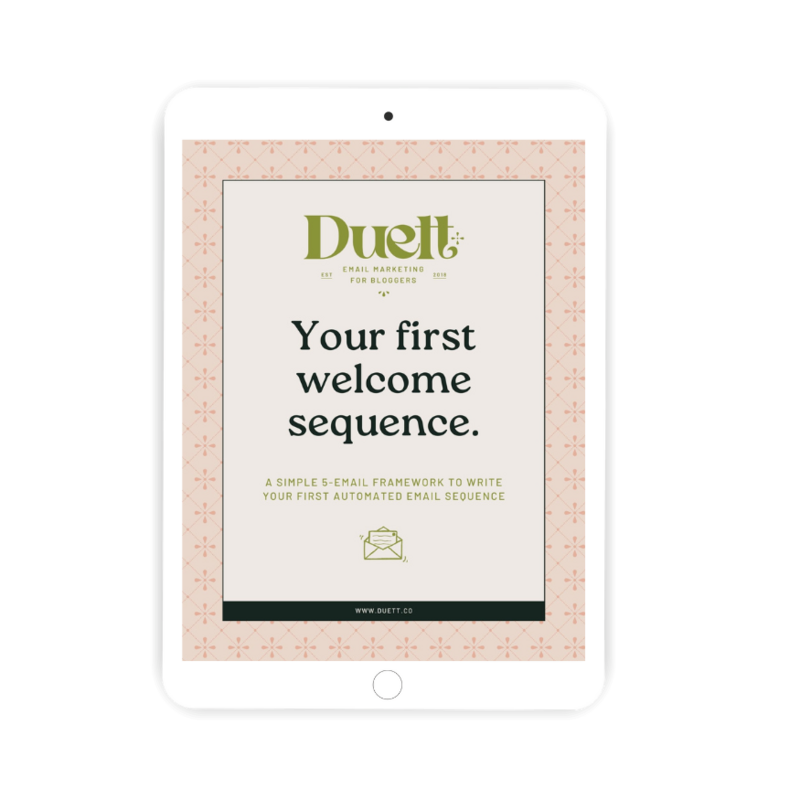
If you’re not welcoming new subscribers and pointing them in the direction of your best, most beloved content — or you feel like the one you have isn’t doing the trick — it’s time we fix that. Use this free 5-part framework to make a meaningful & lasting first impression as you write your first welcome sequence for new email subscribers!
Is Your Welcome Sequence Making a Lasting First Impression?