Oh hey there, I′m glad you're here!

From Burnout to Bold Goals (Without Losing Yourself) with Danielle McGeough, Ph.D.

Click here for transcript
Allea Grummert (00:12)
Hey there, welcome to Happy Subscribers, a podcast that explores how bloggers and content creators can create more purposeful relationships with your audience through email marketing. I’m Allie Grimert, email marketing strategist, copywriter, email platform expert, and founder of the done for you email marketing agency, Duet. I started as a personal finance blogger in 2016 and have since helped hundreds of bloggers and creators like you maximize your email marketing for more impact, more traffic, and a better connection with your subscribers. Be prepared for some advanced email talk, as well as tactical tips to help get your valuable content into the hands of your audience faster and easier. I’m excited you’re here, so let’s do it! We can create a deeper, more meaningful connection with the community you love and serve through email.
Guys, I’m so excited to introduce to you Danielle McGeough, PhD, you should know, is behind her name. She’s got a little alphabet soup behind her name. She is a mom, professor, and women-centered coach who helps women in high-pressure jobs pursue bold goals without losing themselves. I’m gonna repeat this. Did you catch that she’s a professor? I just think that’s like, that’s like her full-time gig, guys. She’s here, probably, just like in her spare time.
She spent 20 years studying how creativity and communication shape change. And she now hosts the top ranked Plan Goal Plan podcast. Her work helps high achievers plan with purpose, reclaim their energy and stay bold at work while still having a life they actually enjoy. I wanted Danielle to come onto the podcast because I know that if you’re listening to this, you are a high achiever. That just tends to be the people that I attract. And so Danielle, welcome to happy subscribers.
Danielle McGeough (01:54)
I’m so excited to be here and I don’t even have elbow patches on even though I’m a professor and I’ve published my work and journals of mildly interesting ideas. I come without elbow patches.
Allea Grummert (02:09)
I bet we could thrift one for you. I’m now, do you, how do you feel about thrifted clothing? I can go find it and wash it. Bring it on.
Danielle McGeough (02:17)
I’ll do thrifting clothing.
Allea Grummert (02:20)
I love having somebody to go look for. We’ll get you some elbow patches and age you like 40 years. Well, is there anything that I didn’t share about you that is important for listeners to know?
Danielle McGeough (02:32)
So I really love water slides. They freak me out, but I try to go on water slides and roller coasters with my kiddos. They are eight and 10. And yeah, so it terrifies me, but I use it as a way to practice doing scary things.
Allea Grummert (02:54)
My body just hurts thinking about it. When I was a kid, I used to go to Kansas City to World of Fun. And I used to think that the Timber Wolf was like the most fun ride ever. Then I went back as like an early thirties person and I’m like, I’m offended at past me forever having liked this roller coaster. Guys, it’s all wooden. That thing is rickety as heck. And you feel every ligament in your body. So don’t recommend.
Danielle McGeough (03:23)
My kid’s favorite one is it’s at this little amusement park in Iowa called Adventureland and it’s called Tornado. And the tornado is an all wooden roller coaster. And every time I’m like, I legit might die. Like this could be how I go out. You know, and I do, I think if I can regulate my nervous system now, then clearly I could speak to thousands of people on a stage and regulate my nervous system.
Allea Grummert (03:53)
I mean, I love that. What application? Also sidebar, I went to Adventureland for a birthday when I was a kid. I was like nine years old or something. We went from Nebraska to Iowa specifically for Adventureland for my birthday. So.
Danielle McGeough (04:07)
What a track, what a track.
Allea Grummert (04:10)
And Okoboji. Iowa has attractions, y’all. Well, Danielle, as we dive in, I’m so curious about your backstory because, y’all, we were talking before the call. There’s so much that Danielle knows. I joke that she’s going to have to be a repeat guest. Have to, because I’m curious. But what’s kind of the nebulous of your work with your online business?
Danielle McGeough (04:37)
So I am really committed to helping women in high pressure roles pursue bold goals without losing themselves. And in part because when I was probably 20, I decided I wanted to be a professor and I didn’t really know what that all entailed. But it turns out you have to get a PhD. And so I was like, hey, I’m going to go get a PhD. And everyone in my life was sort of like, hmm.
Allea Grummert (05:06)
Woo!
Danielle McGeough (05:07)
Because I’m, it’s not that I’m a dumb bunny, but I was never the smart kid growing up. I was the weird kid. Like all my report cards described me as unique. I was described by adults so often as unique that I had a little unique dance that I would do as a little kid. And so when I was like, I’m going to go get a PhD, people were kind of like,
Allea Grummert (05:32)
Are you sure?
Danielle McGeough (05:35)
And because of that, I told myself, if I’m going to be able to do this, I’m going to have to work twice as hard as everyone else. Because I went to school with some real smarty pants McGee’s. One of those was my husband. And they’d grown up their entire lives being told that they were the smart kids, they’re the talented and gifted kids. And so I was like, OK, head down, we’re going to have to work. And so that’s what I did. If there was a work habit, life habit, study habit, you got to have it, I’m going to stack it. And that’s what I did. And it worked. I got the PhD, I got the dream job, I wrote really nerdy books that none of y’all want to read. And then I earned tenure when I was about 35-ish. And I just had my first kiddo too, my second kiddo was on the way. And here I like hit this goal that I had been working on my entire adult life. And I just felt absolutely lost.
Allea Grummert (06:36)
Hmm.
Danielle McGeough (06:38)
And I started to realize that when I actually had the choice, there were so many of these things that I was convinced that I was doing because I wanted to do them. But all of a sudden, when I had a choice, do you want to do these or not? I realized I kind of didn’t give a hoot. I didn’t know what to do with that. And so I really started to experiment with new ways to find myself again. But I also didn’t, you know, I was a new mom and I was really resistant to this idea that becoming a parent meant that I would just need to set myself aside completely. And so I still wanted to do big things. I still wanted to make waves in the world. I wanted to know what my strengths were and be able to serve with those strengths. And some of that serving might be towards my family. But some I really wanted to be able to give to others to extend out beyond that. And so, you know, I wanted to continue to be ambitious, but not lose myself along the way.
Allea Grummert (07:45)
Yeah, because tell me what adds up to burnout.
Danielle McGeough (07:49)
Ooh, what adds up to burnout. So there’s actually some research that indicates that burnout is this sort of trifecta of, it’s exhaustion, it’s demoralization. Actually, burnout and demoralization are a little bit different. I can explain that in a moment. And it’s also depersonalization. So burnout can feel sometimes like that’s when you’re going, going, going. And you’re like, I just cannot keep going at this pace anymore. And a lot of times we might need to incorporate more rest. We might need to find a different pace. But if you’re experiencing demoralization, that’s when you’re like, hey, I’ve been doing work, but it’s lost its meaning. Right? Or I feel like I know what I’m supposed to be doing, but the systems and the structures are blocking me. So an example of that might be, in my work, knowing these are some things that my students would really, really benefit from, but maybe our policies make it hard for me to get the resources to actually teach them. If you are doing content creation, it might be that you spent years and years building something like a blog, and then all of a sudden the algorithm switches or AI happens, and everything feels like it just gets pulled out from under you and you’re like, well, what is even the point anymore? I’ve worked so hard. Does any of it matter? And depersonalization is almost like when you have dissociated from yourself in order to do the work, that in order to survive, you’ve kind of disconnected from yourself in the work.
Allea Grummert (09:40)
How do we record? Okay. So yeah, I mean, I’ve definitely hit seasons of burnout. That sounds so serious in some parts too. Mine, I feel like usually comes from exhaustion. Like I just can’t say no. But I’ve definitely, yeah, you have those moments in your career where you’re like, do I pivot? Do I give up? Do I, how do I get out of this? And so like, what are the — we want to talk remedies or do we want to talk about like fixes to help prevent burnout? Before or after?
Danielle McGeough (10:19)
So I think that there are some tools that we have that could help us a little bit with both that might be good for preventative, but also if you’re in a moment of burnout, you might be able to intervene and quickly reset. And for me, one of the big things that I learned is I used a lot of habits in order to achieve the success that I had. And habits are awesome and particularly great for women because we do carry a really high mental load. And when you are very relationally oriented and you’re thinking about other people and how do I care for other people all the time, whether that is personally or professionally, having habits that you can put on autopilot is so necessary. But what I learned is that habits are designed to eventually become unconscious, to go on autopilot. So if you’re reading James Clear, Atomic Habits, if you do that work, if you have your habits, you have your triggers and your cues, and you’re able to really put these into place, the idea is that you do it without thinking about it. So like brushing your teeth this morning, you might go, well, I know I brush my teeth, but it might take a little work for you to even recall what that experience was like today. The issue with habits is because they ask us to go on autopilot. If you are experiencing a type of burnout that has you feeling like you’re living life on autopilot, like you’re just going through the motions, check, check, check, you can’t fix autopilot with autopilot.
Allea Grummert (12:13)
Tell me more.
Danielle McGeough (12:15)
So I recommend that people use some discernment to decide where do you need a habit? Autopilot. Where do you need something that actually activates presence and creates meaning and fulfillment in your life? And for me, that’s a ritual. So I’ve been studying rituals in my professional work for a while and it took me a bit when I was in my own space of burnout and demoralization to realize that what I needed was some more rituals. And because I had also been studying this more at a cultural level, like how do groups use ritual to change? So we might think about rituals like weddings or when people get married, that’s a ritual. We come together, there are certain things that happen. They say, do, they kiss. We know that those things are gonna happen, but then they leave and they’re different. It transitions them, it transforms them. We might also think religious spaces like baptism is also an example of a ritual. Like after you’re baptized, you’ve changed. Sports use rituals a lot to transition, to get them into a state where they’re ready for high performance and competition. So rituals are something that transition us from one state to another, and they invite presence. And so that’s the biggest difference between a ritual and a habit. So I want you to think about your life and where are the spaces in particular that maybe you need to activate a certain state that you want to move into a certain state or a space in your day where you’re experiencing a lot of transition. That’s probably a sign that what you need is a ritual, not a habit.
Allea Grummert (14:04)
Okay. So what are some healthy, I mean, going kind of going back to the idea of like, preventing the burnout, like what are some places in our lives where we could use purposeful transition, use rituals that like, maybe we just like ride past, like I don’t commute. Like, I wonder if that’s what like get in the car and now you’re at an office, like, I go from my couch, and I go get my coffee, more coffee and I sit down at my desk. Like that’s as long as it takes. And I have a 800 square foot apartment. Like it’s not very far. I mean, I don’t know what comes, what are some examples?
Danielle McGeough (14:45)
Ooh, I think that what you’re naming is a really important one. So a lot of times people have a workday startup or a workday shutdown ritual. So I think that a lot of the women that I work with, they have busy brain, right? At the end of the day, their brain is doing all of the work things. And they might even have a commute and they get home, but they’re making dinner and taking care of everybody and still thinking about work, trying to solve a problem, maybe shooting off an email in the middle. So having something that helps you transition is really, really helpful. I’ll teach it really quick, but then we can go into more detail if you’d like. But I teach something called the RISE ritual method. And it’s four parts. It’s really easy. You can remember it with the acronym RISE. So it is reflect. What is the state that you’re in? What is the state that you want to move to? So if you’re busy brain and you want to relax, an example would be I had a client, she was a school teacher and she wanted to have an end of the day work down or end of the workday ritual and shutdown ritual. And we created, she said, hey, I’m busy Betty, and I want to be relaxed Rita. And so she was able to reflect and really name the state that she wanted to move to. Yeah. Right. And then we’re going to intentionally plan. When are you going to do the ritual? How long are you going to do the ritual? Where are you going to do the ritual? And what we really found with her is she tried to do the ritual at work before she left. And it didn’t work because everybody would come in and —
Allea Grummert (16:29)
It’ll bother her. A little interruption.
Danielle McGeough (16:33)
Eruption. But then if she waited to go home, her kids were like, give me a snack, give me this, give me that. And so we actually created a little ritual box that she would keep in her car. And she would pull into the driveway and she’d keep her car on, she’d play the music that really helped calm her. And she would just pull out her little ritual box. And I think she did a little bit of journaling. And it was short, you know, maybe five to 15 minutes, but just something to quickly say, hey, here are all of the things that I did today. Here’s something I’m grateful for. Here’s how I want to be present when I walk in my door. And then she put it away. She cut off the car and then she could go in the house. And that was just a way to help her shut down. So we’re going to reflect where we name the state. We’re going to intentionally plan so we know when, where, how long. Then we’re going to activate our senses. So this is really important. Our senses actually invite presence and it creates a more embodied experience. So if you do think about a lot of our rituals that you have been a part of, there’s candles or there’s water or there’s something that’s — yes, yes, music. And so if you can activate your senses in some sort of a way that invites presence, that also moves you into that state. So that’s a really important part. So I have a morning ritual that is very sacred to me, and I actually wake up and I’m pretty anxious in the mornings. And so in order for me to enter the day rooted and grounded and calm, I actually wanna calm myself in the mornings. And so I have a big old snuggie that I put on. I love to journal. But you know, my husband, he wakes up and he is groggy grumpy pants McGee. And like, it would not make sense — putting on a snuggie and warming him up and cuddling him, like getting him in cuddle mode would be the worst thing ever for him in the morning.
Allea Grummert (18:57)
You’d like, get that off of me.
Danielle McGeough (18:59)
Yes, he needs bright sunlight, he needs cold air, he needs something cold to kind of wake him up and jolt him into the day. And so you really do want to think about how do you activate your senses, but it needs to be done with purpose that connects you to that first reflection, that state. And then finally, you want to embody your story. So how after you do it, can you keep carrying that state with you that you’ve just transitioned to?
Allea Grummert (19:30)
Yeah. So what’s like your example with your morning routine? How are you embodying that? You keep the Snuggie on all day?
Danielle McGeough (19:39)
So I do have like little sayings that I might keep with me throughout the day that I activate in my ritual, but then I find myself coming back to it. So I might say something like, right now, my word of the year is light. I just think to myself, be the light, be the light, be the light. So my journaling is kind of around lightness. But then during the day, I kind of have this phrase that can just keep me kind of coming back to it. My sister is a chaplain and she was just recently, she sent me a beautiful text message explaining how she used to have these rituals that she did as part of her job. And over time, we can slip out of them just like we can slip out of our habits and need to be reconnected with them again. But she was explaining how important it was that she used to keep a rock in her pocket. So when she was sitting with someone who was going to, you know, was about to die, and they were sharing things and it was heavy. She would actually put her hand in her pocket and she would pass the emotional burden to the rock as a way to say, you can hold this, you hold this. That she could be present and there for someone without it sort of consuming her. And so having a little way that you take the ritual with you the rest of the day — really helpful.
Allea Grummert (21:14)
Hey there, if you have been listening in and you are looking for help and support when it comes to your own email marketing, I would absolutely love to be able to talk with you about how me and my team can support you. Whether it looks like done for you email marketing, where we research your audience, create an email strategy for you, write those emails and set up all of the tech for you so those emails are automated and you’re welcoming new subscribers, or if you want one-on-one coaching, that is an option as well. It’s something I absolutely love to be able to do with my clients on a regular basis. I get to meet with them, discuss strategy, copy tech, as well as operations and working with a team. So if any of this sounds interesting to you or you’re like, Ali, is there something in between? There is, there are. So I would love to be able to chat with you. Please go ahead and book a discovery call with me. It is a free call. It’s a time for me to get to know you and see if it would be a good fit to work together and so I can share more of what we do and I get to learn more about your email marketing goals. So you can book a call at duet.co/contact and we’ll be in touch soon.
So if somebody is currently experiencing this demoralization and depersonalization, which sounds so dramatic, but they are — these are being disconnected from oneself — what do you do in that state? Because it’s, I don’t know, there’s not a fix it, but it’s also, my experience with burnout is that it takes basically my brain coming back down to zero for weeks before I feel like I can actually have my whole brain back and feel refreshed. But I’d love to know your thoughts on that.
Danielle McGeough (22:58)
That’s a good way of describing sort of the physical experience of being in like that burnout mode. I think that when you’re experiencing demoralization or depersonalization, a lot of it is about reconnecting with yourself and not just rest. So it’s like rest plus connection. And so for example, it’s really finding — I would say autonomy, purpose, and mastery in your work again. So if you’re experiencing demoralization, you really feel a loss of agency. I don’t have any choice anymore. And so part of it is how can I create little rituals that might help me go, where are the cracks in the fissures where I do have choice? Or, you know, I was having a conversation. I run a group called the Strategic Growth Lab at the university that I work at. And I’m working with faculty and staff on finding purpose, autonomy, and mastery in their work. And we are having a conversation about how sometimes we can’t change all the meetings that are on our schedule. Or I can’t change the way that the algorithm just switched or how LinkedIn is working now. But what I can do is I can remind myself of how do I want to show up, even in these hard times, what’s my posture towards this? Or I can also go, where are the little spaces that I do have choice? Or even to remind myself that like, I don’t have to do this work. I chose this work. I could quit my job. I could shut down my business. I could just quit making any content. But you’re choosing to continue even when it’s hard, even when it’s unpredictable, even when maybe the results aren’t coming, and reminding myself that what if this is about who I’m becoming in the process, and not just the results.
Allea Grummert (25:10)
You said that so casually. That’s it. This like, who am I becoming in the process of being a business owner of being a creator? That’s incredible because I mean, I have felt it. Somebody was telling me this this last week, they said, Ali, you’re not just like, you don’t just have a job like you’ve created a career for yourself. And I blinked and here I am over, you know, almost eight years later since starting my business and like, she’s absolutely right. And I have a lot more autonomy over how I shift my business. If I want to shift my audience or if I want to shift my services, if I want to be a coach about who knows what, like I could make those shifts and I have a lot more at play there. But yeah, it was kind of just like, how did I get here? And when I look back at my business, actually, Danielle, I haven’t told anybody this. I’d like to read a book, and not just about email marketing, but about how I have grown as a business owner and specifically about how it is a matter of personal growth. I told this to my therapist last week and I was like, Ms. Therapist — I’m not going to give you her name, not you, I would tell you, but it’s the whole internet, you know, they don’t need to know. But like I told her, like, what I’d love to do is interview you and have you pinpoint places where you’ve seen me grow the most in my life. And I want to see what that’s done for me personally as a business owner, because there’s so much about like personal trust and tolerance, like being able to tolerate that like low seasons or slow seasons, like quarters without sales. And you’re like, I’m sorry, or just minimal. Or like how you lead a team and what you’re willing to give up. And so I am all about like, there’s so much more to the work that we’re creating than what we actually put out into the world. Like what we’re actually putting out into the world is like, sure, but we don’t have any control over how people respond to that. Like whether a post goes viral or like you mentioned, like with algorithm changes or stinking Instagram, always changing things. You know, and like, this is why I work in email, because I’m like, that’s stressful. Come to the email side where we can just send an email and your audience gets it. Like, that’s a happy place for me. But if we’re so tied to the outcomes of our work, which I know that it also, you know, we know it’s tied to like our revenue. But like I said, like I’ve had quarters that are super, super low, and then I’ve had like my best month ever literally two months later. There’s — how do we position ourselves — is that part of being a high ambitious person is also knowing that like you only have so much control over parts of it?
Danielle McGeough (28:09)
So I want to share a story and then I hope I can answer the question. So my business happened a little bit by accident. I knew it was in my tough time and I just started hosting planning parties. Basically, I’d had a student give a presentation on how decorative planning really helped her with her anxiety. Basically, she was just taking her planner and she was covering it in doodles. And I was like, well, I can’t doodle, but stickers make me feel artsy fartsy. So let’s go. And I just was like, OK, I’m going to just like start holding these planning parties for students and then out in the community. And it just kind of spiraled. And then, you know, I started a podcast and the next thing I know, I’m coaching and speaking and all of that jazz. But at some point, I realized, oh, I’m really good at this. I should probably be ambitious about it. Then I get all serious about it. And last year, I was doing my reflection in November, December, and I was feeling a little low. And maybe some of you all felt this way, where my revenue just didn’t hit where I was expecting it to. And I put all this pressure on myself to hit a certain money goal, right? And I really hadn’t done it, but I had done all of these things that year. As I was reflecting, I realized I’d done all of these things that year that I’d never imagined for myself, right? I’d held my very first women’s conference. I was selected as an alternate for a TEDx, and now I’m going to do the thing sometime. And I’d been speaking a lot more and I developed, created and designed my own planner and I was selling it. And there’s just all of these things that were so new and so fresh and things that I five years ago wouldn’t have even imagined for myself. And I was doing it, yet because of this one thing wasn’t showing up the way that I wanted it to, I was feeling so low about myself. I think having these practices, so probably my most important ritual is actually a ritual of planning. And the reason that I share that is because I see planning is not as much about time management, but it’s actually about personal development. It is a way for me to collect data on myself, about myself and go, where have I been spending my time? What does that tell me about my priorities? If an alien came down and saw my calendar, would I be embarrassed that they’d think that this is what I cared about? Or am I showing up and spending my time in a way that aligns with my values, aligns with who my future self is? And I think that that’s so important to me because when you have these rituals of reflection, when you have these rituals of planning, when you have these rituals that bring us back to ourselves, you can stop and interrupt those foolish thoughts that I didn’t do enough or I’m not enough or I’m failing and really reframe and rewrite them and go, girl, you’re being silly.
Allea Grummert (31:43)
You’ve done so much. Yeah. When I think of my own business where, you know, with the shifts in AI and all of this, I’m like, I’m learning more about it. I’m a slow adopter. The slowest. So like, I like to think and consider and weigh all the context — context is like one of my top strengths. I’m like, just tell me how this has worked before or could work and we don’t have much data. But I’m thinking about how I’m in such a good position because I have so many assets. But if I were to start using AI for like streamlining part of our internal processes, I’m like, girl, I’ve got SOPs, I’ve got podcasts, I’ve got trainings on this topic. Like even if it’s to inform my team internally and just being like, wow, I’m so glad that I kept going and I created all of this. And so I think of like content creators who like, yeah, you’re creating the blog posts, like, but if you don’t have blog posts to tweak in order to update to the algorithm, you have nothing, you know, so like part of it is to do the creation and then modify how you use it later. Right. Because if, you know, people complain about recipe bloggers talking about their life story before they get to the recipe, well, that used to be how Google liked it because people would spend time there. And then Google was like, I don’t like it. So you have all these old blog posts that you quote unquote have to go update, but it’s like, but you did it. You have the recipe. It’s there. Now you just modify it. But I think it really gives you a lot more leverage as things shift and change when you actually have something to show for your expertise. And even if it requires updating, does it mean it’s invalid?
Danielle McGeough (33:27)
Yeah. You know, I’ve been listening to this song on repeat and one of the lyrics is, you know, we are daughters, we are dreamers, we are builders of new seasons. And as a creator, like I’m a creator, I’m a maker, and it sounds like so many people listening here. Hi, makers. Hi, creators. Right? The part of it is reminding myself that the art of adaptation is also a form of creation, that is me being the builder. And it can be so hard because, you know, going back and editing and adapting a blog post that you’ve already created may not feel as juicy as writing a new blog post. But to remind yourself that that is its own art and it’s its own skill. And how do I adapt it in a way too that then brings forth all of the knowledge that nobody can take away from you, right? That you’ve gained since then. And what a beautiful opportunity to get to bring your current self back to your past self and all the knowledge and skills that you’ve gained since then. And to sort of think about it almost like, if you are making a recipe, right? And maybe you have your favorite and you’ve been making it, making it, making it, and you want to make it again, but you know, you can no longer use sweet potatoes and there’s a new spice you have to use. And that’s an opportunity to make something new in that — that counts.
Allea Grummert (35:07)
It absolutely counts. Well, Danielle, any parting thoughts? Anything that we’ve left out that you feel like it’s important for knowing your background? You probably have a lot of thoughts. But anything kind of based on our conversation today that you want to leave with our listeners?
Danielle McGeough (35:28)
What I would say is if you are feeling stuck, if you are in a place where maybe it’s burnout, maybe it’s demoralization, maybe it’s depersonalization, remind yourself that one, different remedies might be necessary depending on what those things are. There might be overlaps in what would help you, but finding something that matches the moment that you’re in is important. And I would invite you — I have an assessment called, it’s a stuck assessment. It will help you name the type of stuck that you are. And then it will give you a ritual to help you unstick. And so I, because I’m a nerdy researcher, I actually went through several years of coaching calls and I coded them like a qualitative researcher to name these different types of stuckness. And then sat down and spent some time thinking about what the right ritual would be for those moments. So if you’re feeling stuck, go to PlanGoalPlan.com/stuck. And I’ll make sure that I get that to Allea.
Allea Grummert (36:39)
I have it. It’ll be in the show notes — yeah.
Danielle McGeough (36:41)
We got you covered. So take that quiz and also I would love to support you. We also have a book club. So there are all sorts of ways that if you just need community, I gotcha.
Allea Grummert (36:56)
I love it. We’ll include the link in the show notes. And then with people who go through that quiz, will they learn more about the book and the community and other ways they can get connected?
Danielle McGeough (37:04)
Absolutely. So I will tell you this. I do hand calculate these quizzes. So it will take me just a little bit of time, in part because rather than just, I will tell you kind of your first, but also your secondary types of stuckness. And so you will get an immediate email, but then if it takes me like a day or two, be patient, I promise I haven’t forgotten you. It’s just that I’m still rocking it, old school.
Allea Grummert (37:36)
I love that. What dedication, Danielle. Oh my gosh. And in the ninth inning, I’m like, and she hand checks — it’s like she hand reviews it. That’s incredible. Thank you so much for sharing your wisdom and your expertise, your knowledge, your research with us today.
Danielle McGeough (37:54)
Thank you so much for having me, Allea. You are just a ball of light and joy.
Allea Grummert (38:00)
Thank you, I appreciate that.
Thanks so much for listening to happy subscribers and our conversation about email marketing today. I hope you feel inspired to take action, even if it’s a small change, so you can more confidently share your valuable message with your community through email. Special thanks goes to my team who makes it possible to produce and share these episodes with you. Seriously, thank you guys. If you want to hear more email marketing tips, strategies, and success stories to help you develop deeper, more meaningful relationships with your email subscribers, be sure to subscribe to happy subscribers so you don’t miss an episode. If you have a few seconds, I invite you to share this episode link with a friend or post it on social media so your peers and community can benefit from it as well. And if you have a few minutes, I’d appreciate if you’d leave a written review of the podcast since that helps more people hear about it. And I believe we need more creators sending more valuable emails to their audience with more confidence. If you want to reach out to me directly, the best way to do that is to join my email list through one of my top freebies listed in the show notes. You’ll get regular emails from me that are packed with value. And if you hit reply to any of those emails, it’ll land in my inbox and I can’t wait to chat with you there. Until next time, let’s do it.
Episode Summary:

What do you do when the world around your work feels out of your control?
When the blogging landscape shifts…
Algorithms change…
Goals you used to chase don’t feel as motivating anymore…
You’re also… tired?
In this episode of Happy Subscribers, I’m joined by Danielle McGeough, Ph.D. — mom, professor, and women-centered coach who helps women in high-pressure jobs pursue bold goals without losing themselves.
I asked her about burnout, what causes it, and some solid ways to prevent (and intervene, if you’re already in it) so we can keep building our businesses and feel connected to our work in a meaningful way.
If you’re an ambitious creator, influencer, or business owner, come learn about:
- Why more habits isn’t always the answer to doing work or life well
- The lost art of commuting to destress (and what works instead)
- Purposefully transitioning from role to role (like that 9am shift from stay-at-home cat mom to business owner… who me?)
- What can be automated, and what shouldn’t be
- How to build a ritual of “presence” to keep you connected to your work
Tune in as Danielle shares with us small edits that will help your work feel steady, intentional, and sustainable — even if the digital (or physical) landscape has you feeling shaky.
About Danielle

Danielle McGeough, Ph.D. is a mom, professor, and women-centered coach who helps women in high-pressure jobs pursue bold goals without losing themselves. She’s spent 20 years studying how creativity and communication shape change, and now hosts the top-ranked Plan Goal Plan podcast. Her work helps high achievers plan with purpose, reclaim their energy, and stay bold at work while still having a life they actually enjoy.
CONNECT WITH DANIELLE:
Instagram
Stuck Assessment
OTHER RESOURCES:
Duett Free Resources
Book a FREE Discovery Call
Subscribe & leave a review!
If you enjoyed this episode, you can show your support by leaving a review, subscribing, or sharing your biggest takeaways on your Instagram story! Just remember to tag me @alleagrummert so I can see it.
Subscribe on Apple Podcasts or Spotify

About Allea

Allea Grummert is an email marketing strategist, copywriter and tech expert who helps bloggers and content creators make a lasting first impression through automated welcome & nurture sequences. She helps her clients build intentional email strategies that engage readers, build brand loyalty and optimize conversions for sales and site traffic.
Allea is the host of the Happy Subscribers podcast, holds the coveted spot as the email marketing industry expert for the Food Blogger Pro membership community, is a Recommended Expert through NerdPress, a trusted Mediavine partner and recognized as a Kit Approved Expert.

Looking for more ways I can help you?
If your a blogger or content creator and today’s episode sparked ideas for your email marketing strategy, let’s chat! Click here to book a free 15-minute strategy call.
Think of it as a quick strategy boost — we’ll talk about the #1 thing for you to focus on moving forward so you’ll walk away with clarity on where to put your attention to make the biggest impact for your business.
More like this!:

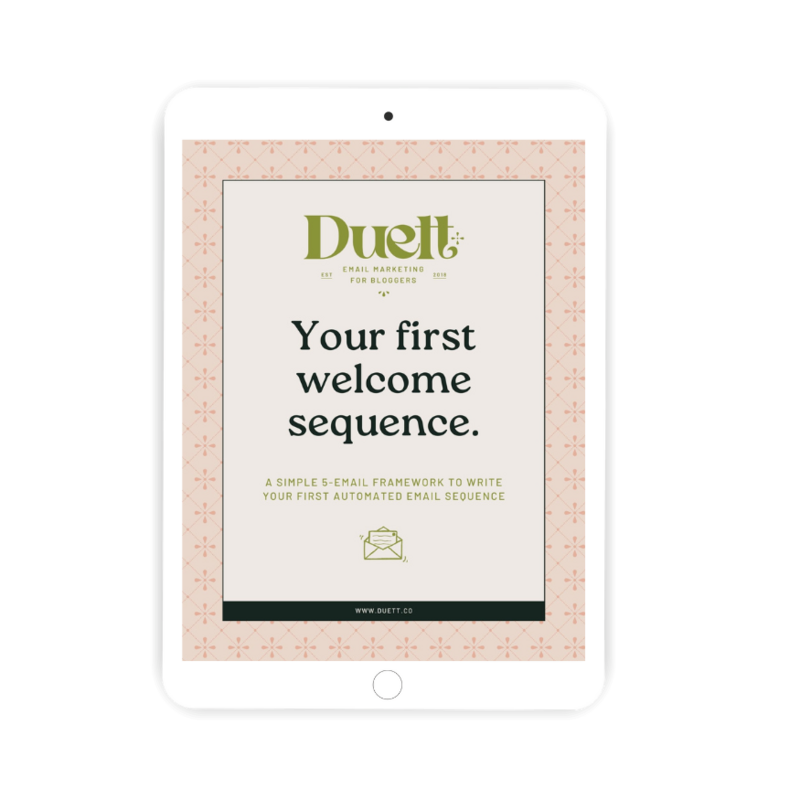
If you’re not welcoming new subscribers and pointing them in the direction of your best, most beloved content — or you feel like the one you have isn’t doing the trick — it’s time we fix that. Use this free 5-part framework to make a meaningful & lasting first impression as you write your first welcome sequence for new email subscribers!
Is Your Welcome Sequence Making a Lasting First Impression?