Oh hey there, I′m glad you're here!

Inside Kristin Lawton’s Signature Cocktail Welcome Sequence

CLICK HERE FOR TRANSCRIPT
Allea Grummert (00:12)
Hey there, welcome to Happy Subscribers, a podcast that explores how bloggers and content creators can create more purposeful relationships with your audience through email marketing. I’m Ali Grimert, email marketing strategist, copywriter, email platform expert, and founder of the Done For You Email Marketing Agency, Duet. I started as a personal finance blogger in 2016 and have since helped hundreds of bloggers and creators like you maximize your email marketing for more impact, more traffic, and a better connection with your subscribers. Be prepared for some advanced email talk as well.
as tactical tips to help get your valuable content into the hands of your audience faster and easier. I’m excited you’re here, so let’s do it. We can create a deeper, more meaningful connection with the community you love and serve through email.
If your brand has a favorite bartender, it would be Kristen Lawton. She is the chief brand mixologist behind District Brand Bar, bottling solopreneur’s brilliance into signature brands that are unmistakable, remembered, and the obvious choice. With 20 plus years in brand strategy, Kristen built the signature brand framework to align credibility, personality, and expression into a cohesive brand system that carries the weight of your marketing. I’m excited to get to know Kristen better today. We met at Craft and Commerce this summer.
And I learned about her really cool welcome sequence strategy and I just had to have her on. Kristen, thanks for being here.
Kristin Lawton (01:34)
Thank you for having me. See ya.
Allea Grummert (01:37)
man. This everything about this, the idea of credibility, personality and expression, I adore that because that’s what those are things that we’re looking to incorporate into the welcome sequences that we write for our clients. But out of all of the things that matter for a brand, why are those three the ones that you kind of narrowed in on for your brand framework?
Kristin Lawton (01:56)
Yeah, I mean I think credibility is the thing that they’ll do trust, right? It’s the fact I think to have a signature brand, like you have there is something credible about your business, right? You didn’t just like one day wake up, see an ad on Instagram and decide that you’re gonna start a business and take a course and like boom, you have it. Like to me that it’s rooted in your lived experience, your actual expertise, like there’s something credible that people can really trust behind about you and about your business.
Right. personality is what, you know, you people can trust you all day long, but that doesn’t mean they’re gonna work with you, right? Because they want to like see that they’re gonna enjoy the process of working with you. They wanna know that you love your work, they wanna have fun with it, depending on what it is, you know, like and you can set yourself apart by showcasing a personality, right? And it doesn’t mean it has to be over the top, you don’t have to have a crazy theme like I do, but there’s an aspect around, you know.
I work with solopreneurs mostly and you are the face of your business and you need to show them what you’re about because we’re all brilliant in our own ways and yeah, so that’s personality. And then expression is how someone experiences everything, right? And that it needs to be consistent and cohesive across the board and you need to be the same person, you know.
I hopefully will be the same person that you met at Crafted Commerce as I am on this podcast, as I show up on my Instagram and in my emails and whatever. And, you know, when to me, a lot about us having a signature brand, it’s like when, you know, you pop up in when I pop up in someone’s inbox, like I want them to immediately be like, she’s the brand cocktail girl. Like this is who she serves. This is what she does. Like, I know I want to read her emails, right? And like
It’s not just sort of like this random person, like there’s, you know, you can recognize my stuff anywhere. and so yeah, that’s where those three come from.
Allea Grummert (03:54)
I like that. And it also stood out to me this idea of being unmistakable, remembered, and the obvious choice.
Kristin Lawton (04:01)
Choice in the room, yeah.
Allea Grummert (04:02)
My goodness. I mean, I’m sure this is all part of your framework, but like what are the elements that make a brand so obviously the right choice? I mean, we’ve mentioned like credibility as one piece, but like those things kind of smooth the the ridges of like would I like working with this person or whatnot, but becoming the obvious choice. Does that also include
elements of like what the what the audience needs to see.
Kristin Lawton (04:27)
Yeah, sure, certainly. I mean, I think it you know, I think it comes down to you’re the obvious choice for that person, right? So it doesn’t necessarily mean that like I’m the end all be all of brand strategy wherever, right? But that I am connecting with my person and when they’re going to make a choice, they are like, Okay, I’ve I’ve heard Kristen’s stuff, I’ve read her stuff for a while, like I seem to gel with like her personality, like she has twenty-five years experience.
And her brand is is really on point. And that’s what I want. And I want, you know, and I need her her expertise and her genius to like help me figure this out. And so, you know, you want to be that person that like it’s easy to refer. It’s easy to, you know, know. And so a lot of it comes down to just like when you’re the obvious choice, it’s because like they know and understand, like this is what they offer, this is what they do, this is why they do it, which I think the why is really important.
that’s part of sort of like the story and the heart and they want to understand like, you know, why they do the work. And so you’ve sort of answered all the questions. If they’ve if they’ve given you a, you know, good enough shot to like answer these things and to see it come through through just like a few pieces of content, like they know, you know, they’re like, okay, you know, Kristen, like Ali’s the one for this. Like there’s no question about like what they do, who they do it for. And so I think that’s what makes you obvious.
Allea Grummert (05:55)
I I agree. And then so does it look like like you mentioned having a few pieces of content, do you kind of have a framework of like how and where to show up for a particular audience? Or is that kind of all worked out in the process?
Kristin Lawton (06:07)
Well, so so I used to be a very much like a brand and marketing person and I did it all and I did not have a signature brand because I just again I you know I have twenty five years experience. I’ve done it all across many sectors. So when I started a business, I was like, I can, you know, so I was working in that like zone of excellence, right? Of like all these check marks that I’ve like, yeah, I built websites, I’ve been social media, like I can write, I can do this, I’ve led a hundred thousand dollar rebrand, like, you know, but
Then no one really knew what I did and how to refer me and I wasn’t the obvious choice. I was just someone who they they knew did good work, but like when they really had that problem to solve, like they’re gonna go to someone else because I was sort of like the catch all.
Allea Grummert (06:53)
Right. Right. Yes, that makes sense.
Kristin Lawton (06:56)
And so so I now narrow down to like I do brand strategy because I actually I do believe and I’ve I’ve seen it over and over that like when you have your brand foundations really set, marketing falls into place and it’s so much easier. And so sure some things might get answered, but like I’m trying to trying to not make that my job because it’s someone else’s zone of genius. And for me, I’m like, I will make sure you have all of the right tools and like there’s a lot of good brand tools that people don’t even think about that I’ve sort of created too.
To help you do this. but it comes down to like your brand, right? Like I just I recently launched a YouTube channel. I probably talked about it crafting commerce because I went around to everyone and be I l I’m a YouTuber today. Like I lo I had to launch before we went to Idaho. And because I’m making cocktails on camera, it doesn’t really work to talk cocktails on a podcast, in my opinion, right? So like that channel was a little more natural leaning for me.
And so I think a lot of it comes down. I work in a lot of like I figure out your personality. We just we we combine all your personality tests, your human design, all the things, and we pull out what makes you value and where you feel natural. And that’s where maybe the marketing and the visibility and like where you should be comes from. But it it’s not necessarily what I’m like doing these days.
Allea Grummert (08:13)
Yes. You know what? I respect a person who stays in their lane, Kristen. As someone who’s been in business over eight years, the fact that I’ve had to like choose my lane over and over and over again and say like I don’t post stuff on Facebook for my clients or Instagram and like we don’t go into your website and set up your forms for you. Like that’s where we draw the line. A lot of our clients have developers too, or like, we will do a handoff. But there’s just that that boundary line of like what you can do well. and be able to yeah, be known for that.
Kristin Lawton (08:43)
Yeah. And I was finding like as I was I had like this whole three month thing and we would do a month of brand and a month of marketing and a month of systems. And like for me and the client, once we hit the marketing piece, we were both sort of like, we’ve had our aha’s, like we’re excited. Now it’s like draining. And I’m like, okay, that is the line. That’s so clear, crystal clear. Yeah.
Allea Grummert (09:01)
So smart.
Kristin Lawton (09:02)
And it’s one of those things that like you you sometimes can’t see yourself, which is where I come in because I can see that in other people.
Allea Grummert (09:09)
Yes. So and the folks on the podcast know I went through a a rebrand well, I’m thinking about a rebrand, like a personal brand experience of sorts, like doing a lot of this digging in for myself. And I will say it does, it feels so much easier to market when you have a lens. Right. And you have like even like one line of messaging that you just that’s the feeling you want to get across at all times. Yeah. my goodness. And that’s what I so much easier.
Kristin Lawton (09:33)
easier doesn’t it?
You know whether it’s and I think it I think it works also, but like the whole point of you know marketing, you have to show up and you have to like put out content and you you know and it takes time and like when you can do it with a lot more ease, which which sees like you can do it with a lot more ease now, like that will lead to better things.
Allea Grummert (09:57)
Yes, and having somebody who can look at me and dig into those things. That’s exactly what my brand gal did. And so that’s such a a wild blessing because there are things like I didn’t realize that like I’m really skilled at pattern recognition. I was like, first of all, didn’t know that was a thing. Yeah. And just being able to say, like, that’s that’s kind of a wild skill, Allie. Like lean into that. And s so it’s also allows somebody else to give you language for ways that you already are. Same
Same thing with those personality tests. Like the day I found out I was an Enneagram six, I actually cried for three days. I was like, wow. I do kind of keep people around because I’m afraid of being alone. And I need to like right. There was a whole like reckoning of that. But on the upside, the cool things about being a six of like being super loyal and being bubbly and making friends with everyone, I was like,
Kristin Lawton (10:46)
Yeah.
Allea Grummert (10:47)
yeah, I just thought everybody was this
Kristin Lawton (10:49)
Right.
I’m a wing sex.
Allea Grummert (10:51)
Or are you a seven? I’m a seven. You’re a seven weeks. Yep. I am a six wings seven to the buddy, which means like I need to stop talking to strangers at the grocery store. Like I’m gonna have my kids are gonna be like, Mm like not another stranger. So but yeah, like having somebody else point those things out and giving you the language. That’s what I really liked about the Enneagram, especially. But this is beyond that and it it applies to the kinds of stories you tell the offers that you create.
The the customer experience you wanna be able to feel.
Kristin Lawton (11:24)
Yeah. And so much of it is just a mirror reflecting back too. Yeah.
Allea Grummert (11:31)
It really
Kristin Lawton (11:33)
but I think and I think when you really understand who you are at your core and why you’ve chosen the path that you’ve chosen, and I’m not a woo person, like at all. Yes. but it’s it just like I put all of these assessments into Cloud or Chat GPT and it it recognizes the patterns across
Enneagram and human design and astrology and Myers Briggs and whatever that like we can’t see or you know, it’s like too much data for us to do ourselves. And so it can recognize all of this. And then it’s just like it almost to me, I feel like it gives you the confidence and like eliminates the imposter syndrome because you feel so confident and like, no, this is my gift, this is why I’m unique, this is why I stand out from everyone else. I don’t, I’m not trying to be other people. I mean, we want the success of other people and like whatever.
But like we you understand your lane more and like why people need you and and what you bring to the table and yeah, it’s very cool. I I know we came to talk about email, but I can talk about this stuff all day long. And we will, and we will. Yeah. Yes.
Allea Grummert (12:35)
Ugh, the segue. We’ll go. We’ll talk about email. okay, so one of the things I’d love to ask our guests to before coming on. Yeah. And you may have received this question, but just like what is it what is it that people get to experience while being on your list? What are you happy to deliver to them when they are getting your newsletters? Yeah.
Kristin Lawton (12:54)
I mean, I think you’re gonna get brand strategy and thinking about your brand differently, but you’re gonna get it in a fun way. it’s gonna be very authentically me. I tell funny stories, I use AI, but there’s not gonna be slop in it, you know. Like and you know, I there’s a lot of cocktails. So I have my my brand is a district brand bar, it is cocktail themed. I use mixology as like a teaching mechanism.
and so it’s just different. And I I use fun graphics and images and there’s there’s the the cocktail experience welcome series that we’ll talk about. But I think you just to me I hope it’s sort of like a refreshing take on your brand and and emails that you look forward to opening because they’re they’re helpful and insightful and I don’t take them that seriously either.
Allea Grummert (13:53)
it’s so cool. I love a good theme. I’ve never been one to have one for myself. Like I do like a pun every now and then. Like I end my emails with let’s doet. Or let’s do it together. Like that’s kind of where that’s kind of where it ends. thank you. and then just like kind of fun brand names of my different packages. I’ve been really thoughtful about that. So I like the duet debut, which like comes with jazz hands. I like can’t not do jazz hands when I say the duet debut.
and then like done and delivered and just putting a lot of thought between behind those things. But as far as like my brand emails, it really is more just like story. I’m pretty straightforward. I’m pretty honest. Like if things went well or didn’t w go well and like knowing that that’s part of my brand as well. but I love this whole like idea of mixology. I was just telling friends yesterday, I’m like, Girls, I don’t I don’t know how to make a cocktail. Like I I don’t, Kristen. This is what I pay other people to do. Yeah. And so
Yeah, that’s a really fun way though, because we know how it works. I often talk about like recipes as kind of being a way of knowing like the elements of things, like segment I would say segments are like recipes and tags are like the ingredients. And so you can kinda like but that that’s the end of my visually visual story.
Kristin Lawton (15:06)
I you know, I love a good metaphor. I probably do it a little too much. it’s it’s very consistent, yes. But to me it’s funny. I you know, and I’ll say like from my experience of just talking with with customers and clients and people who follow, like it feels like half of my list doesn’t drink and yet they still love it, you know, because like everyone gets you know, I would perhaps if you are like going through a program it could be triggering for you.
But otherwise, like you understand the concept. And so and I do think people love metaphors and like anything to help them like sort of like put it into their brain of like where this thing needs to go, it helps them remember it and sort of how to use it and yeah.
Allea Grummert (15:49)
Exactly. So the time we’ve all been waiting for. Can you please, please, please, please can’t wait. Tell me about the cocktail experience that you’ve created for as your welcome sequence. Y’all, this is where like Kristen and I crossed paths for like two minutes at Crafting Farmers and I was
Kristin Lawton (16:03)
next to each other during a keynote and we like were acting like we were already best friends and then at the end we introduced ourselves.
Allea Grummert (16:10)
Yep. I love that about Faft and Commerce though. You’re like if you’re here, you’re awesome. I know that
Kristin Lawton (16:16)
Do like the the side comments about whoever’s speaking and whatever.
Allea Grummert (16:20)
You’re like, wow, look at them go. I’d never thought of doing that strategy before. I I am not small. I’m a strong and independent woman. I can do whatever I want. Like just like how do I hype myself up without, you know, comparing myself to others. But yeah, tell me how did you maybe maybe explain the process itself and it’ll kind of come out how you also came up with this idea.
Kristin Lawton (16:41)
So the first thing that happened is I was listening to my friend Allison Hardy talk, and I don’t even know if we were friends at that point, say that you have to train people to click on your emails. And it was like a light bulb moment of like, yeah, people just read my emails and like they come to read, right? And when
Allea Grummert (17:03)
Yes.
Kristin Lawton (17:03)
I have the the big clicks and they’re not clicking.
It’s like maybe we have to train them, right? That these are emails that you need to click on and you’ll get something fun as a reward. And so that was that was where it started. And I was like, and it was also like I wanted, you know, I had my basic, I don’t know, three to five email welcome sequence that’s like, here’s about me.
And it was fun. It was like, here’s my brand cocktail. I broke down why Aperol Spritz is my brand cocktail. And you know, like any I did the normal thing you’re supposed to do. And that was fine for a while. But I also wanted to evolve it to where I was selling things right away. I was like teaching them. I was getting them to know me. I have a lot of different sort of digital products and and physical product and one-to-one stuff that I sell. And I was like, How can I?
do this in a way. So I first started with like thinking like a cocktail book and you would pick a chapter.
Allea Grummert (18:02)
Yeah.
Kristin Lawton (18:03)
And it just sort of got complicated and not fun. And then I don’t know. I think over the time there was probably a few people I was like boxering with and like talking it out. And there was probably one conversation where, you know, a lot of times again we talked about it, I’m a seven, like I I didn’t talk it out and like, you know, process and
And it just hit me and it was like, a choose your own adventure cocktail thing.
Allea Grummert (18:30)
Yes.
Kristin Lawton (18:31)
And then I attempted to build it and let me tell you, it was a bitch to build. And now I’m updating it and it is a bitch to update. I hope we can curse on here. Yeah, but
Allea Grummert (18:42)
Yeah.
Kristin Lawton (18:44)
Like it is still the most the my favorite thing I’ve ever built. It is so f I think it’s so fun. immediately my click rates went up. I mean I I I sent once it was sort of built, I sent my whole list back through it. and I mean it jumped from like one percent to four percent like right away. Now it’s gone it’s leveled back out. Right. but I was excited by that for sure. And I do if they don’t
choose to play, I send them into a dealer’s choice thing. So they still get it.
Allea Grummert (19:15)
Kristen, that’s so cute. Like bartender’s special. Yes.
Kristin Lawton (19:19)
Exactly.
So basically they enter in. So after after they get, you know, on to my list and they receive whatever digital product or whatever it is that they do, except a quiz, which I’ll talk about, then now they go through a a three email a little bit more about me plus a sell. Now and then it’s like, okay, now you’re entering this.
And you you basically you’re walking into the district brand bar as if it was a physical bar. And the first thing you do is you choose how you enter. And this is tied to my quiz, which is based on disk, the disc assessment.
Allea Grummert (19:56)
Yeah.
Kristin Lawton (19:57)
And so disk has four parts. So if you’re in the dominant, which I call on the rocks.
you know, you sort of like see the spot at the bar that you want and you like hover until the person leaves and you can get it, right?
Allea Grummert (20:14)
I don’t know if that’s me. Keep going.
Kristin Lawton (20:18)
And then the the I influencer is shaken in my role because for my quiz cocktail it is or for my quiz, it’s you know, cocktail tights. And so you’re on the rock shaken, stirred or neat. and so if you’re shaken, you see your table of friends, but you like high five the bartender on the way over, right? If you’re stirred, which is conscientious with dusk, you’re you’re sort of more down to earth, you know, you’re more in the one to one, like
So you go to the quieter table because it’s just you and your one friend who are gonna stay there for a few hours just like chatting, right? And then if you’re neat, which is wait. Sorry.
Allea Grummert (20:59)
That’s C
Kristin Lawton (21:01)
Steady. The S goes with the stirred. Concies goes with meat. you your party’s not there yet, so you’re not gonna take a table. So you’re just sort of like waiting, right?
Allea Grummert (21:14)
Yes.
Kristin Lawton (21:14)
So anyway, so then you go through my quiz results. and if you if you enter in through my quiz alone, you sort of are entering that same way. And so and it build it flows directly into the rest. And so
Once you finish the quiz part of the sequence, then the bartender comes over, you get you see the whole menu and how we’re gonna break it down, and you st you pick start by picking your base spirit. So, you know, you’re either Jin Jin Mezcal Rom or
Allea Grummert (21:46)
You
Kristin Lawton (21:47)
or bourbon.
Allea Grummert (21:49)
Keila.
Kristin Lawton (21:50)
no, because you’ve a mezcal. Tequila is technically a mezcal. And there’s no
Allea Grummert (21:53)
That’s technically
Kristin Lawton (21:56)
And there’s a whole thing about not being vodka on the menu because I don’t think any brand should be vodka because vodka has no flavor and taste until you have to add the flavor in. And I don’t believe that, you know, any brand should be like a basic Tito’s
Allea Grummert (22:10)
Good to go. Love it.
Kristin Lawton (22:13)
and so then as you go through, right? So like when you go through, you’re saying, okay, if I wanna I wanna talk about like my brand voice. And so we pick gin because gin is full of different botanicals and flavors that you’re like infusing into it. If you want to talk brand values, you’re doing Mazcal because it’s really rooted in tradition. brand positioning is bourbon because there’s all these like, you know, things that has to be. I mean, so I have the ROM is like the look and feel. And so there’s, you know, it there’s like logic behind it all.
Then you come back, you choose, and so in each one you’re sort of learning about it and then I’m selling something. and if you click on the thing I’m gonna sell, this is where I’m still building it two years later. you then will like get a a short little upsell sequence, you know. the other thing about this is that it gets sent Monday, Wednesday, Friday at four PM. because that’s like happy hour time in DC. It also means that I just as long as I don’t send emails at that time.
I don’t have to like, I can still send other emails while people are in this giant thing. And we
Allea Grummert (23:15)
Yes, of course. Yeah.
Kristin Lawton (23:16)
go to flavor and then we go to cocktail type, then we go to garnish, and each one has its thing. And then the end, you and and then at the top along the way, it’s showing what your selections have been made. So as you go through, you know that you’ve chosen gin and bitter and con you know, classic and that you want, you know, a spicy rim or whatever.
And then at the end you get a cock well, you get sort of what your recipe is. I haven’t figured this out yet, but I know I can figure it out with AI. But right now you get sent to like a a GPT that you can enter it in and we’ll give you your cocktail. But I there’s gotta be a way where there’s gotta be a way. Because I have a when you’ve been on my list for six months, you get a cocktail recipe from me as like a happy anniversary.
Yes. And that one goes through an automation where it just takes your name and just creates like a fun celebratory recipe.
Allea Grummert (24:13)
Cute.
Kristin Lawton (24:15)
so there’s gotta be a way. But that’s that’s what it is.
Allea Grummert (24:19)
my gosh. Okay, so then the recipe in the end, are you talking about like think it’s an actual recipe that would come to
Kristin Lawton (24:24)
No,
it’s a cock it’s a straight up cocktail recipe. It’s not a brand of cocktail. Straight up cocktail.
Allea Grummert (24:28)
Yeah. How many emails have you written or how much code are you using?
Kristin Lawton (24:34)
There’s a lot of
It’s not I mean it’s it’s all written. I’m using like liquid
Allea Grummert (24:41)
Yeah. Right.
Kristin Lawton (24:42)
conditional formatting, liquid syntax. So like if you have the product that I am pitching, you’re not getting pitched that product. You’re like, and you already have it. Here’s a tip of how to use it. Yes. and then at the top that like progress bar is certainly, you know, all because everything’s tagged. I mean it is it’s involved in the back. But I would say at this point there’s probably around sixty to eighty emails
You get about fifteen to twenty. So maybe not this point there’s like a hundred. I don’t know. I have it all in like no
Allea Grummert (25:17)
Okay. So I’m super impressed that you’re using liquid tagging, conditional content. Yeah. Did you learn how to do all that on your own?
Kristin Lawton (25:23)
No, gosh no. COD. Or Chat G V T at the time. Okay. I you know, I knew I I needed to use it, right? and so I had it in my mind that we would use it, but it has to write it for me. I have
Allea Grummert (25:39)
Okay, okay.
Kristin Lawton (25:40)
to make sure the quote marks are
Allea Grummert (25:43)
Right. Accurate. Yes. So, dear listener, if you’re not familiar with liquid tagging, what I call conditional content, what it is. Are you, Kristen, are you using you must be using Kit? Yeah.
Kristin Lawton (25:52)
I’m not
Allea Grummert (25:54)
We didn’t meet at a Kit conference, so I didn’t want to make an assumption.
Kristin Lawton (25:56)
That didn’t mean anything, yeah.
Allea Grummert (25:58)
Inside of Kit, as well as other tools, not all of them though, you can use this code that basically says if this person has this tag, show this message. Yeah. And if not, show this. And so basically what Kristen’s created is a huge bank of text.
That says if this then that, if this then that, based off of all these different variables. So as you’re telling me that there’s this progress bar, I my brain is like breaking.
Kristin Lawton (26:22)
In the in the email itself, it is so like the I th I especially as you get towards the end when you’re on like choice four or five, it is very long. and you know, then for each choice, right? I have written like two to three emails for each of the four to three choice three to four choices that I have to make sure that the bar is adjusted and working and
Allea Grummert (26:47)
accurate for. Yeah. Wow. Yeah. And my eyes are like, what?
If you are interested in getting my help to grow your email list, send traffic back to your website, and create a more meaningful relationship with your subscribers through email marketing, visit duet.co slash happy to book a free call with me. I promise you’ll learn a lot, even in the process, just about your own business, your own goals, and what could potentially be next for you in the growth of your email marketing strategy. Go ahead and book a call with me. I can’t wait to meet you.
that’s so much work. But how what a delightful experience for your subscriber
Kristin Lawton (27:37)
Think it is. You
get you know, you get a few choice you get a few chances to like make a choice and I give them about like two weeks, right? And then they go into my dealer’s choice one. And I am a little disappointed at just how many people don’t click, but they don’t unsubscribe either. So I’m like, well, as long as they’re still experiencing it and enjoying it, and my open rates are great and my click rates are good, and like the unsubscribes like
No more than a normal email, five to ten, you know? Like yeah. So to me, I think it’s just like it’s such a fun way to experience my brand. And I I want my brand to feel like this immersive experience and that you’re part of it. and I so and I think of my brand as like, you know, a physical space. Like I think it helps me sort of as I build things to be like, okay, if this was a bar and someone walked in, like
How would they experience it, you know?
Allea Grummert (28:37)
Yes. My first thought, I mean, I think of cheers, I think of High Might Your Mother. Yeah, right. even friends with Central Perk, you know, who’s peeking over the couch. Like, yeah. Yeah, that’s so fun. So then you mentioned that throughout the sequence, they’re clicking and kind of choosing their different options, but you’re also linking to different products and such too. So how are you weaving that in? Do they know that they’re clicking on a product or
Kristin Lawton (29:03)
Yeah.
so and that’s what I didn’t want this to feel very salesy. Like as they’re making choices, it is not directly like, you chose this, therefore you’re just getting straight into like a three thing thing. Now if so in it, it’ll be like, and if you basically like if you like this or if you want to explore more of this, but I say it in a better way, you might be interested in this thing, right? I have a deck of cards of like, you know, prompts.
So it’s like, you know, maybe you want this. And so then if they click that, which is very clearly like I’m interested, then they’ll go into sort of like a almost like an abandoned cart sequence.
Allea Grummert (29:44)
Got it.
how far apart are these emails sent you? You said you kinda wait two weeks before you give them dealers’ choice, but then the emails themselves, if they are engaged
Kristin Lawton (29:53)
Every Monday, Wednesday, Friday.
Allea Grummert (29:54)
everybody Friday. Okay. Yeah. And if they don’t click between Monday and Wednesday, are you just giving them a default fix up?
Kristin Lawton (30:02)
yeah, so so basically if they don’t every minus the dealer’s choice, which at that point they’re not clicking, or they’re not giving options, they’re like, and I’ve chosen Jin for you, I’ve chosen this for you. they they’re all different email sequences. So built in kit, it is all different email sequences and many different
Allea Grummert (30:27)
Good tag.
Kristin Lawton (30:29)
No, the the flow.
Allea Grummert (30:31)
the automation. Thank you. So the sequences within an automation. Yes. Yeah.
Kristin Lawton (30:35)
And so there’s lots of different sequences. And so basically, yeah, if they if they get like halfway through, because it’s it’s basically like the first two, they can still sort of start it over or get into dealer’s choice. But at that point it just ends, like for them. And it’s like, but if they don’t click on they don’t have to click on Monday to get the Wednesday, right? Like they can click two weeks later because they’re different email sequences and it’s all based on tagging. So it’s they could all they could say six months later be like, that email from Kristen, let me click it. And it would start that
Section, you know. Section,
Allea Grummert (31:06)
The next section for the Brancock Pap.
Kristin Lawton (31:09)
yeah. No way. Yeah, ’cause it’s all based on tagging, right? And like the tags start new sequences.
Allea Grummert (31:14)
That’s
try to so you’ve got a lot of different sequences. Okay. Wow. So do you have your automation set up as like the individual steps of building a cop too? So that’s where they get they get popped over to that? Okay. Yeah.
Kristin Lawton (31:29)
So I started building a giant automation and using rules in kids. This is gonna get a a little kit focused for a second.
Allea Grummert (31:37)
Go
there with you.
Kristin Lawton (31:40)
and then all of a sudden it stopped working. And I’m like, Kit, what’s happening? and they’re like, Yeah, we don’t recommend people using rules for like tags or to move people through email sequences anymore. I was like, Did you announce that? Did you update your user cord or your little blog? Because you know, chat, my buddy in this is pulling your
On the website.
I had to restart and rebuild it from scratch. And so that’s why everything became so broken out. So literally you have when they make the choice, it’s a different automation and a different email sequence. When they deliver the choice emails, yes it’s different, different automations, like it had to be broken out into so many different steps. And so that’s why I had if you’re ever gonna do this
Create a database, airtable notion, something that then like your cloud or chat GPT can like access and understand and read to help you along the way and to keep track of it all. But
Allea Grummert (32:48)
Yes.
For all of these different automations and then Got So I didn’t know that about rules because I use rules just to tag subscribers based on how they join a list. But they’re saying not to do that anymore either.
Kristin Lawton (33:01)
No, I think that’s fine. I think I was like trying to advance them. You know, like I was trying to do the like remove them from this thing and add them from this thing.
Allea Grummert (33:12)
Yes. So sequences, adding it or removing from sequences via roles, I really d recommend avoiding that when possible. Because
Kristin Lawton (33:19)
It would have been nice to have heard that from you two years ago.
Allea Grummert (33:24)
Because what it does is there’s all sorts of different rules when it comes to how subscribers are added into sequences too. But the big thing is that when you add and remove somebody using rules to and from a sequence, you lose any control over the timing. Whereas in an automation, you could say wait one day, then remove. Yeah. Or wait one day, then send them into the welcome sequence. Some right into this follow-up sequence. Whereas with rules, it’s like as soon as this happens.
The next like as soon as they end one sequence, they’re starting another. So therefore are they getting two emails in a day. Like you you lose control over the timeline. Whereas I do I prefer using automations for that. But with automations, you can only trigger with so many different tags or so many different forms. So that’s why I use rules to add the tags based on like say you have ten different forms, some get ads, some are on Instagram, some are on your website, and they all get the same opt-in tag added.
And that’s what triggers the whole automation. So it just looks a little cleaner that way.
Kristin Lawton (34:24)
Yeah,
you’re right. I still use rules, but it is mostly around probably more forms to things than anything else.
Allea Grummert (34:32)
It’s just like when they need to well and it helps knowing that rules were the predecessor to automations. So long before we had automations, rules were all we had. And so but I’ve been around long enough to know this though. I am not
Kristin Lawton (34:45)
I think so.
Allea Grummert (34:46)
So yeah, it’s kinda become inherent knowledge, but that’s why I like to share about that. The other thing is is if you’re directly adding people into sequences via rules, you if you if you have a sequence as part of an automation somewhere and you turn off that automation.
The people that were added via rules, they’re not pausing. They’re still sending. So like they’re coming in through two different pipelines. Right. So that’s why on the back end of a sequence that lives within an automation, you can say, if if they’ve been added via automation, do you want them to stop or not stop at the after the end of the last email? But it’s that little detail of added via automation that like we just kind of read past because we’re like, Yeah, whatever. But it’s not
All sequences is one of the sequences that live within an automation and the people who came in through the automation and are now in the sequence.
Kristin Lawton (35:33)
Well and I also just recently learned that I was trying to remove people from things using rules or automations and that you can do it right in the sequence now.
Allea Grummert (35:44)
For different things?
Kristin Lawton (35:45)
Yes. So like if they buy upsell that you’re selling instead of in the automation, I was doing it in the automation. Right skip down to this point. Now you exclude them in the sequence itself so that when you get their tag, they they stop the sequence.
Allea Grummert (36:01)
Yes.
Kristin Lawton (36:02)
And that was new for me also.
Allea Grummert (36:05)
You can also exclude them from individual emails within the sequence.
Kristin Lawton (36:09)
I didn’t know that.
Allea Grummert (36:09)
Yep. So there’s a little filter for each email in a kit sequence. You can say, anyone who’s already purchased this, exclude. Uh-huh. And then like what you’re talking about for our listeners is then on the back end of a sequence, you can say, if they have the tag purchased bundle or something, that they’ll just get excluded from the whole automation or so from the whole sequence. And so
Kristin Lawton (36:31)
Get that time.
Allea Grummert (36:32)
once they get that tag added.
And so then within the automation they’re in, they will then end the sequence and complete the automation or go into the next step. Yes. Versus having to use like a jump tag in the automation to move them through it. Right. Look at you. You’re learning it though. I love it. And
Kristin Lawton (36:48)
Yeah, I mean it again, I can like really get nerdy with like some techie things. And so I think I enjoyed building it for sure. That piece, you know, I definitely I had built a lot. I I built about half of it before I opened it up to people ’cause I’m like, okay, by the time they get through, yeah, I have time to keep building it. And then things started breaking and I had to like start over just the bill. I mean the emails were built, right? But like it
It was a lot of information in my brain.
Allea Grummert (37:19)
Just
like want to encourage you, that’s a that’s an undertaking. But I’m sitting here going, wait, how exactly what? Yeah. One thing that you might want to consider when you rebuild it, take it or leave it, is the idea of using conditional using sorry, custom fields within kit instead of tags. So you can have a custom field labeled like steps one, two, three, four, five, six. And it’s either and then like your automation can trigger when that changes or when it’s no longer empty, they get added to an automation.
Kristin Lawton (37:48)
Interesting.
Allea Grummert (37:49)
So it just reduces all the different tags. But actually now that I’m thinking about it, I mean you have to revisit your conditional content because I’d have to say custom fields dot tags.
Kristin Lawton (37:57)
I
so I use custom fields for other stuff I deliver, like the my six month anniversary cocktails a custom field. and I I hate how long each like user
Allea Grummert (38:10)
It’s either there or it’s the list of tags, right?
Kristin Lawton (38:12)
Yes. I’m like, can’t we have folders? I like nesting things.
Allea Grummert (38:15)
We do have folders for tags now.
Kristin Lawton (38:17)
I haven’t played with
Allea Grummert (38:18)
Yeah, take a deep. Yes, so you have the tag the tag folders. I think they still show up at our tags, the bit way you can at least group all of them by campaign. Yeah in there. So man. Okay, so what has the response been from people who’ve gone through this cocktail experience? Brand welcome.
Kristin Lawton (38:41)
I mean, it is nice because I do get emails of people like really enjoying it or finding inspiration for their own brand. And I think it is just sort of like like yes, it is a serious thing and a serious undertaking for me. Not everyone has to do it the way I do it. You can still sort of have these fun. I mean, there’s a lot of people that do really fun things that I’m sure you’ve talked about on here. but I, you know, I want them to see about like, I want them to think about like
customer and brand experience with you know like in that your emails like can be different and fun and unique and vary you and and I think it’s sort of like yes they love it and then the people that like go through it like they are lifers, you know? They
Allea Grummert (39:29)
Yeah.
Kristin Lawton (39:29)
and that I think is like another big thing for me. that you know the ones that have really taken the time to go through it, like, you know, I’ve
Like they’re they’re engaged very much.
Allea Grummert (39:42)
I love hearing that because it means all this work you’ve put into it. We just talked about how it’s an absolute bear to set up and make sure it’s operating. It’s it’s showing the the proof of that. And even if the proof is just a mere like percentage, totally small percentage of your audience. I mean, th those lifers are why we create with such heart ’cause they’re the ones we want to have keep coming back. Right. Do those tend to turn into clients or customers, any direct high
Kristin Lawton (40:12)
Done that, that would be a fun analysis to have Claude do, to be like of the people that have like the end tag of like they completed it. Mm-hmm. Like what of you know, like how many it and like how many other tags do they have, right? ‘Cause if you have lot of tags then you have done a lot of things with me.
Allea Grummert (40:27)
Yeah. You can give it probably a threshold like using the kit MCP, like anyone that has this number. but also like what products have they bought where what interest tags have they clicked on. Right. And yeah, I’d just be really interested to see how that kind of shakes out revenue wise. yeah. Because a lot of times what we don’t see is that heavy investment of care and like intentionality and like what you the word you use expression.
Like your welcome sequence is expression ten times over. Yeah. And that’s why I’m just like in love with it. and I’m over here thinking, what do I need to do? ‘Cause I I need to update my welcome sequence. I haven’t touched it since twenty nineteen. Kristen. I have a workshop about that coming up in two days. Yeah,
Kristin Lawton (41:11)
But the roasters.
Allea Grummert (41:12)
this is what the roast is that’s happening. So
Kristin Lawton (41:14)
I mean, even just like how many years you’ve been in business probably needs to like be updated.
Allea Grummert (41:18)
Well, I kept it evergreen. So I mean, I wrote it with that kind of intentionality, but yeah. So y’all listen to this. The roast is already over, it’ll be September 16th. You’re gonna be like, that’s in the past. But maybe I’ll wrote it again, but my team is roasting my email marketing from twenty nineteen. But it’s super cool because it also means that like what I wrote in twenty nineteen is still largely applicable. Like I’m still doing the same work. We just have different language and honestly brand language. Like now that I’ve gone through all this, but it requires so much time and focus to do it. Like you said, like this is not
you know, something you just complete in an afternoon. No. And I wanna be able to think strategically about it and think about what kind of experience. And so this is really encouraging for me, Kristen, ’cause I’m like, okay, if I’m gonna rewrite a few emails, how else can I add in right elements of engagement?
Kristin Lawton (42:03)
And I think, yeah, just make it fun. And, you know, there are a lot of things that I could do to sort of like, you know, get people to sort of self tag themselves of like they’re interested in the AI, they’re interested in brand, they’re interested in this. I don’t use it for that. I don’t use it as a research tool. I have a lot of research in there now by just knowing what they’ve clicked on. Yes. But I don’t know did they click on gin because they want to know about brand personality or did they click on gin because they like gin. You
Allea Grummert (42:30)
Yeah.
Kristin Lawton (42:31)
know?
So so but I mean there’s so many ways to use it. I’m not a big fan of the and you know, for for people that I like like their emails, like I will click, but I’m not a big fan of the like ones where it’s very obvious like I wanna know are you interested in these types of things because I don’t wanna feel pigeonholed on someone’s list.
Allea Grummert (42:52)
Right. Okay.
Kristin Lawton (42:53)
So I try and make clear that like that’s not what this is doing in mine, right? Because like no matter what, I also don’t like
If you’re going through this email, you’re getting all like if you’re going through this experience, you’re still getting my emails, like my regular emails, right? and so this is just sort of like a separate experience that you also get.
Allea Grummert (43:14)
Yeah. Yeah. Well it’s inspiring to me and I hope it’s been inspiring to you our listeners as well.
Kristin Lawton (43:19)
And yeah. It it was a lot of work. I made it more complicated than it needs to be. You can do a fun choose your own adventure and an engaging email and getting people to click without the headaches. And hopefully by listening to this you’ve learned some things to make it not a headache.
Allea Grummert (43:33)
Yeah, the technical on the technical front. Yes. Well, I’m just really, really grateful that we sat next to each other afterwards. I know, me too. Yeah, I’m over here like, I just I need you on my podcast. And so thank you for making the time. Before we wrap up though, where can people connect with you? Where can they get on your list if they’re a good fit for it? You know? I don’t know if you want everyone coming, but I’m like, go check.
Kristin Lawton (43:57)
I would love for anyone to experience it. So the easiest way is to start by taking my quiz and you’ll discover your brand marketing style. so just go to district brandbar dot com slash quiz. and but I also love to hang out on Instagram. I have a new YouTube channel. You can watch me make cocktails and talk about brand strategy. And all of that is just at District Brand Bar.
Allea Grummert (44:22)
Love it. We will link to those in the show notes. Kristen, thank you so much for sharing me. Lovely expertise with us.
Thanks much for listening to Happy Subscriber.
In our conversation about email marketing today, I hope you feel inspired to take action, even if it’s a small change, so you can more confidently share your valuable message with your community through email. Special thanks goes to my team who makes it possible to produce and share these episodes with you. Seriously, thank you guys. If you want to hear more email marketing tips, strategies, and success stories to help you develop deeper, more meaningful relationships with your email subscribers, be sure to subscribe to Happy Subscribers so you don’t miss an episode. If you have a few seconds,
I invite you to share this episode link with a friend or post it on social media so your peers and community can benefit from it as well. And if you have a few minutes, I’d appreciate if you’d leave a written review of the podcast since that helps more people hear about it. And I believe we need more creators sending more valuable emails to their audience with more confidence. If you want to reach out to me directly, the best way to do that is to join my email list through one of my top freebies listed in the show notes. You’ll get regular emails from me that are packed with value. And if you hit reply to any of those emails, it’ll land in my email.
box and I can’t wait to chat with you there. Until next time, let’s Duett

The day I found out I was an Enneagram 6, I cried for three days.
I sat with it and went, “oh, so I keep people close because I’m afraid of being alone.” Cool. Love that for me.
But then I got to the other half of it. The loyal part. The bubbly part. The part that makes friends with strangers in the grocery store checkout line. And I realized that’s not a bug I need to manage — that’s just me. I’m an excitable person, and if I had to show up every day as a stoic, buttoned-up “professional,” I would shrivel up and die on the inside.
Somebody else gave me language for how I already was. And I felt so much relief.
Which is exactly what Kristin Lawton does for solopreneurs, and it’s what she built her entire welcome sequence to do.
Kristin is the chief brand mixologist behind District Brand Bar, and her brand isn’t cocktail-themed — it’s a bar you walk into. In email form. New subscribers choose how they enter the room, then a base spirit, then a flavor, a cocktail type, a garnish. They come out the other side with a sharper read on their own brand AND an actual drink recipe they can make.
There are somewhere between 60 and 100 emails behind it, running on liquid tags/conditional content. It’s wildly complex, but so worth it.
Her click rate went from 1% to 4% when she turned it on. And the people who play the whole way through? Lifers.
Don’t worry — Kristin says you don’t have to have a crazy theme like she does. (I don’t. I have puns and jazz hands.) A welcome sequence can be five emails that introduce you, hand over your best resources, and ask a question you actually want answered. That’s most of what we build, and it works — because somebody sat down and decided, on purpose, what a new subscriber should experience. That’s the part Kristin and I actually agree on. Sixty emails or five, the intention is what makes it work.
What she has me thinking about is the layer on top. What if new subscribers got to DO something in there?
In this episode:
- Why picking gin over mezcal tells Kristin something real about your brand
- How you end up with a drink you can actually make
- The one piece of advice from a friend that sent Kristin back to rebuild everything
- What happens to the subscribers who don’t play along (don’t worry, there’s a default option)
- The reason there is no vodka on the menu
- The Kit buildout in detail, so you can build something like it yourself
Connect with Kristin Lawton:
- Take Kristin’s Brand Marketing Style Quiz
- District Brand Bar on Instagram
- District Brand Bar on YouTube
Episode Resources:
- Kit
- Manychat
- Free Duett Resources
- Join the Duett newsletter
- Check out Duett Services
- Book a FREE Discovery Call
- Instagram @alleagrummert

Subscribe & leave a review!
If you enjoyed this episode, you can show your support by leaving a review, subscribing, or sharing your biggest takeaways on your Instagram story! Just remember to tag me @alleagrummert so I can see it.
Subscribe on Apple Podcasts or Spotify

About Allea

Allea Grummert is an email marketing strategist, copywriter and tech expert who helps bloggers and content creators make a lasting first impression through automated welcome & nurture sequences. She helps her clients build intentional email strategies that engage readers, build brand loyalty and optimize conversions for sales and site traffic.
Allea is the host of the Happy Subscribers podcast, holds the coveted spot as the email marketing industry expert for the Food Blogger Pro membership community, is a Recommended Expert through NerdPress, a trusted Mediavine partner and recognized as a Kit Approved Expert.

Looking for more ways I can help you?
Book a free call with me (no-pressure zone, promise!) and we’ll chat more about what would benefit your business most in this season.
More like this!:
An Expert’s Guide to Cleaning Up and Organizing Your Email Marketing
Reveal Your Remarkability (And Make Your Marketing Easier) with Rich Brooks
How To Execute On Email Marketing Even When You’re Super Busy (Answers To FAQs From My Readers )
Using Events to Grow Your List and Build Community with Deanna Seymour

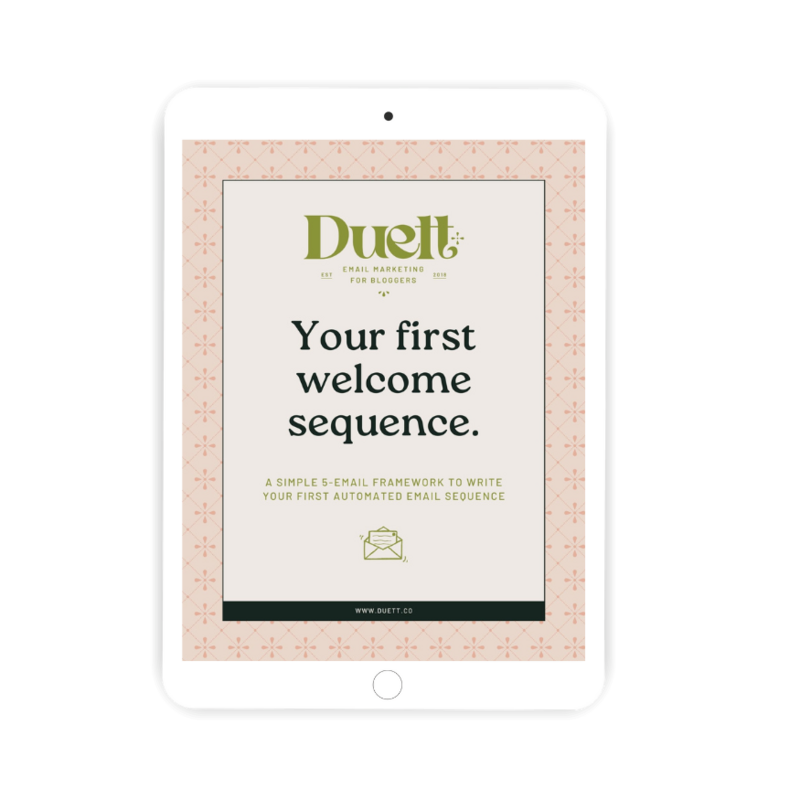
If you’re not welcoming new subscribers and pointing them in the direction of your best, most beloved content — or you feel like the one you have isn’t doing the trick — it’s time we fix that. Use this free 5-part framework to make a meaningful & lasting first impression as you write your first welcome sequence for new email subscribers!
Is Your Welcome Sequence Making a Lasting First Impression?