Oh hey there, I′m glad you're here!

Sam Vander Wielen Needed Her Email to Work Without Her, So She Kept It Simple

CLICK HERE FOR TRANSCRIPT
Allea Grummert (00:12
Hey there, welcome to Happy Subscribers, a podcast that explores how bloggers and content creators can create more purposeful relationships with your audience through email marketing. I’m Ali Grimert, email marketing strategist, copywriter, email platform expert, and founder of the Done For You Email Marketing Agency, Duet. I started as a personal finance blogger in 2016 and have since helped hundreds of bloggers and creators like you maximize your email marketing for more impact, more traffic, and a better connection with your subscribers.
Be prepared for some advanced email talk as well as tactical tips to help get your valuable content into the hands of your audience faster and easier. I’m excited you’re here, so let’s Duett We can create a deeper, more meaningful connection with the community you love and serve through email.
Sam and I have crossed paths in a few different ways through conferences, mastermind events. As the author of When I Start My Business, I’ll be happy entrepreneur, author and trusted legal educator for online business owners and host of the On Your Terms podcast. She cuts to Genoa’s with no fluff legal tips, refreshingly honest marketing strategies, and down to earth business advice to help entrepreneurs grow with confidence. And I will say she’s a phenomenal storyteller. And so I’m really excited to have you on today.
Sam Vander Wielen (01:27)
Thank you. Thanks for having me, Allea
Allea Grummert (01:29)
Yes. Okay, what is something that I didn’t share in your bio that you think would be helpful for listeners to know about you?
Sam Vander Wielen (01:36)
Well, I don’t know why this came to mind. But the first thing I was gonna say was that I have way too many mugs. Like like coffee mugs. It’s just like you just we have to get that out of the way. Like it’s a problem. And every time we travel I get another one. So it’s an issue. but that that’s one thing. so I would say that definitely. Yeah, that definitely counts. I would say the other thing is probably just how much I love what we do, like all the little parts of what we get to do.
I feel like that’s missing from my bio is that I’m like genuinely excited to write emails and record podcast episodes and like figure out stuff in my funnel. And I guess I just wanted to throw that out there for anybody who might be listening who’s in a miserable job right now or just doesn’t love the job and like wants to leave. I was 100% in your shoes and it’s not that everything is perfect, far from it, but like I am very excited about what I get to do these days. So there is light at the end of the tunnel. Yes.
Allea Grummert (02:33)
Well in so I dated an attorney, Sam and I heard the stat about just like attorneys are some of the most like likely to become alcoholics. Like it’s just such a what what’s the reason b that people say that or that that that’s even a statistic?
Sam Vander Wielen (02:48)
I think it’s because unfortunately, you know, a lot of people go to law school with really good intentions. And I also I guess I should give the disclaimer that there are like plenty of good lawyers out there doing good work and all that kind of stuff. However, unfortunately, the majority of what’s happening in America are lawyers just kind of moving money around from like insurance companies to people to this to that. It for things that it’s like nobody’s taking responsibility for anything. It’s just a really bad system. And so I think that a lot of
People go to law school like myself with this idea that we’re fighting for justice. And then we find out that justice doesn’t really matter and that what matters at the end end of the day is who’s willing to spend the most money on lawyers. And it’s a little bit heartbreaking. On
Allea Grummert (03:30)
Yeah. Yeah. Yeah. That would
Sam Vander Wielen (03:32)
top of all of the hours, like the long hours, the money is not as good as what people think. So it’s like it’s just a bad, it’s a bad combo, I would say, all around. A very dark energy, I would say as well. Yeah.
Allea Grummert (03:43)
Well and so just looking at your career going from being an attorney to having an online business, people would be like, Why would you give up all that money and security and safety or whatever? And just knowing that the reality of that is not as peachy as maybe people think.
Sam Vander Wielen (03:55)
Yeah. I don’t I don’t say this to be like cross or whatever, but I make more in like a week or ten days than I did all year as a lawyer. So it’s like I I think that there’s I think the cool thing and what’s more important to me is that I do that with having a ton of flexibility, a lot of freedom, a very high profit margins of a business with a cool little team of three amazing women who I love working with and yeah, and I like thoroughly enjoy what I do. So it’s like that’s more important to me. But
I think when I was still working, I saw it as such a trade off of like, I’m going to leave behind all the money of being a lawyer in exchange for making less but having freedom and I never would have thought like, actually I could generate more. I I didn’t I I’m not a very confident person. I’m more confident now in the in my experience of like what I’ve done in my business, but in general, I didn’t leave because I was betting on myself.
Allea Grummert (04:50)
Yeah. So you didn’t leave because you were betting on yourself, you were leaving because you needed the freedom.
Sam Vander Wielen (04:55)
Yeah, I just needed to get out. I need I couldn’t take it anymore. I really just truly hated it. And I thought I was leaving in exchange for a worse situation, you know, maybe personally, like, maybe I won’t make that much money and like I won’t be able to take vacation as much, but at least I can work on my own hours or something like this. And it was like, wait, I actually can do all of that and a lot more. And in fact when I go on vacations now, it’s like I I
fully relaxed, but after a couple of days, usually three, four days, I’m like itching to write some emails to my list or write a sub stack or something like because I really enjoy, you know, what we do.
Allea Grummert (05:29)
Yeah. I love that. I actually started my business out of burnout and depression. And so even just the way that I built the business was like, here’s where the line is between how much people can expect from me and how much I expect of myself. And then over time, as you like flex the muscles and you do have income coming in, you have a lot more yeah, a lot more room to play with how you run your business and the enjoy like getting to s sit down and write emails. What a privilege.
Sam Vander Wielen (05:55)
So I honestly that’s how I look at it. I kind of feel like I got out of prison. I know that sounds dramatic, but I really every day still wake up and be like, wow, I can’t believe that I still get to do this and like this thing is still working, you know? but similar to you, I I s so when I first started the business, I I started it because I left the law and I did all the things that now I would tell people not to do, but I also fully recognize as kind of like a required, I think, like a almost like our version of a hazing period for new entrepreneurs. So I
I hustled. I was on my phone constantly. I was answering every single like comment as people were leaving them. Like I was so anxious to do everything at the second it was happening. And then both of my parents died, as you know. And I and when my parents died, that was my kind of reset, restart, I guess, of how is this business gonna look different moving forward? Because I am a different person. I’m super depressed. I’m I’m trying to figure out like how to pick myself back up. And it
that actually is what allowed me to build a way more successful business. I mean my business was still successful on paper in the beginning, but it’s what like catapulted it to the next level, I think.
Allea Grummert (07:02)
Was that like what was the what was the linchpin for that success like taking off then? Was it trusting your team? Was it getting clear about your offers?
Sam Vander Wielen (07:11)
I think that when my so my dad got sick first, my dad had leukemia and I was taking care of him and and that just completely zapped my time and my energy. And so the the first thing that that did was make me seriously zero in on what things am I doing day to day that actually matter, what things are moving the needle and what is going to bring sales in that I don’t have to be involved in at every step of the process.
And so that was back in twenty eighteen. That’s what required that’s what led me to create my first funnel. My it was an evergreen funnel at that time. And it’s the same one I have today, actually. Yeah. And then so I created that purely out of like emergency, essentially. Like I just had to because my I was taking care of my dad. And so at first I got this funnel up and running and it was like, wait, I can make sales without me having to get on sales calls with people. I can make sales without having to create content.
Every single day doing Instagram stories and trainings and our stories like we used to back then. So I it just it’s what opened up for me this idea of like, I can actually do less. That’s more impactful. And then that started doing so well that in late twenty nineteen it allowed me to take some of that capital and invest in ads. And then that just started to catapult the audience, which then catapulted the sales and it just kind of kept going like that. So it’s been a multi seven figure business every single year since twenty nineteen.
Allea Grummert (08:32)
my goodness. And then how did you learn how to write your first funnel?
Sam Vander Wielen (08:35)
so I was working with my friend Margot.
Allea Grummert (08:38)
Yes, that’s how I knew of you long before.
Sam Vander Wielen (08:41)
And so Margo was like, you know, she knew what was going on and she was a copywriter, like a contractor for me. And Marga was like, I think we should build out this funnel. And so it was like we just did a series of interviews and kind of collaborated on this and was like, let’s build this out. Let’s build out the emails. let’s set up the webinar itself. Let’s like record it, see how it goes, test it out. I tested out the titles to my audience. Like we just did so much testing and back and forth and built it out and put it up and
I remember we put it up just like I would say three months after my dad had gotten sick and everybody was telling me it was so crazy because they’re like, You can’t just go straight to Evergreen. At that time, you know, experts like Amy Porterfield were all saying, You have to be live, you have to be live several times before you can do this. I was like, Well, I don’t have time. I can’t. I can’t be live. I can’t be live in a chemo room. So I put it up and it was like boom. I it wasn’t crazy at from the beginning, but it
It started to do well. It’s like ten thousand dollars a month, thirty thousand dollars a month, fifty thousand, seventy five, a hundred. It just kept going and going. Yeah.
Allea Grummert (09:44)
can you explain the bundle itself? Like what was the price point? And how has that changed perhaps to what it is now in twenty twenty six?
Sam Vander Wielen (09:51)
Yeah. So it’s funny, it’s I the price was probably a mistake I made early on, but the prices essentially stayed the same. The only difference is that it’s it’s about two thousand dollars total. but in the beginning, I was extremely resistant to taking payment plans. And so I did not want to do this because it is an upfront digital product that gives you ten legal templates. So essentially the ultimate bundle gives you these like pack of legal contracts and website policies, and then a series of trainings that teach you how to start an online business legally.
everything from how to register to getting trademarks to getting copyrights to protecting your content, everything else. And so I was like, well, everybody’s getting this all up front. I’m not giving a payment plan. And so it worked at first, but then I maybe it was Margot back then who was like, I really think you need to change your mind about this. And like it yes, it’s natural that some people will bounce, some people will steal. Like this is how this works. And it’s like, okay, I’ll try it. So I started doing the payment plan. And I think that was really the thing that broke the dam. Yeah.
Allea Grummert (10:49)
Especially those people getting started to have a lower power of entry.
Sam Vander Wielen (10:51)
It makes a lot of sense. And so I would honestly I would say I’m like looking back on it, you know, you can just be stubborn about certain things in your business that you have an idea of like what you do and don’t want to do. but that’s probably what’s changed the most, especially as we’ve gone through different like economic downturns, I would say, or different like shifts in j the job market. I tend to see a lot of like reverberation from the job market. So when people are leaving their jobs or their jobs aren’t going well, we see a big influx because people are thinking, I can start.
My business now, if they get laid off, like during COVID, for example, we we were beneficiaries, unfortunately, of that time because it was just people were either getting laid off or coming to the realization that they didn’t want to be in their jobs anymore. And so, you know, I’ve I’ve then that has caused me to like play with price points to give people a more affordable opportunity. So now I have like a 12 month payment plan that makes it way lower. in one time of year I make that even cheaper. So
Yeah, I’ve tried to I’ve tried to make it as accessible as possible while keeping our costs okay.
Allea Grummert (11:53)
Yeah. Well and I just think it’s really cool because so many attorneys online have templates and like they do bundle them, but I didn’t realize that yours comes with education.
Sam Vander Wielen (12:04)
Yes, it comes with a literal step by step. It’s a ten step video. it’s really cool. I actually just reshot it at Kit Studios back in December because I wanted to I had an idea to like completely redo the bundle. So it used to almost be more like a course library of of videos you could go in and if you wanted to learn about what an LLC was, like that was there. If you wanted to learn how to register a tree mark, that was there. But what I decided to do was go in and create ten micro videos that you literally go through step by step and each one is an action item. So it’s like
Register your business, get business insurance, you know, get a this contract filled out, do this, do that. And I just go through the steps where so that at the end everybody just has a fully packaged, protected business. So people are are really liking it so far.
Allea Grummert (12:48)
Well yeah. After all these years too for it to still be so successful. And think of all the businesses you’ve helped set up, Sam.
Sam Vander Wielen (12:56)
We have over four thousand five hundred people just in the bundle alone. And then we obviously have thousands and thousands of people who have bought individual contract templates. I sell those too. But yeah, I some one of my friends always tells me I’m a business duela, which I think is funny. And I’m always like, that’s really cool. Like I do feel like I get to be a part of a little bit a a little part. Actually, someone just sent me a really sweet, like handwritten note in the mail yesterday about how like
She just wanted let me know like what she had started and then that that had impacted people. And then she told her friend who wanted to start a business. And I’m like, that that is definitely the biggest blessing of what I do.
Allea Grummert (13:30)
Yeah. Well, and you easily could have spent a lot of your time creating content just about the legal side of things. But for you, what was the thought process of expanding into how to help people actually start the business? Cause I feel like that’s different, right?
Sam Vander Wielen (13:45)
Yeah, they can be different, but it’s funny because I only ever have sold legal templates. I don’t sell other things, but a couple of things happen. I mean, one is that I was one of the earlier people who started a legal templates business and you know the business was successful and grew. And so then, you know, just naturally people started asking, like, how are you doing this? And like, why are people buying your things so much? Or like, Why why you have so many people on your email list? And like people were just asking a lot of those questions. But I also realized
Two things early on. One is that I really am not interested in the law at all anymore. I have no interest. I’ve never have been. I’ve just always thought that it was a good business idea. And I like the byproduct of what I get to do. I like the fact that it creates people’s businesses. I don’t like the actual substance of what I talk about. And
Other people don’t like it either. Nobody, nobody wants to get lectured by their accountant, their lawyer, the doctor telling you, like, don’t eat so much sugar. Like, nobody wants that, right? And so I early on realized they don’t want to talk about this. They don’t want to eat they know that that’s what they need, right? And like it’s like the doctor telling you eat your vegetables. Like, I know, I know, I know. Like, okay, stop telling me that. Tell me the fun stuff, right? Yeah. And so I realized very early on from a marketing perspective that.
It would not only satisfy me, but satisfy other people a lot more if I talked about like, hey, you know what like you need to do to grow your email list? This. but by the way, like can spam is a thing. And so like make sure you don’t get sued as you send emails. So I I think I was just found this way early on as to like combo it and and that made me really happy and it seems to have made other people happy.
Allea Grummert (15:20)
Yes. Especially as you talk about the business building part of it, you have a lot more to talk about.
Sam Vander Wielen (15:25)
Yeah, th it gives me endless ideas.
Allea Grummert (15:28)
Seriously. When I’d started out as a personal finance blogger, I don’t know if you knew that. But I like ran out of I was like, I don’t know how often I and I hadn’t even done it all that long. I was like, How like looking at the next five years, do I want to be writing about personal finance and be like, no?
Sam Vander Wielen (15:43)
Because it also doesn’t change. I think that’s what sometimes people don’t realize. And like the law very slowly changes. And I’m not talking about like individual state laws. I’m talking about kind of generally speaking, like hardly anything has changed in the ten year I’ve been doing this for ten years talking about this is the difference between an LLC and a sole proprietorship. Like I can’t take it anymore if I just keep saying it. On the other hand, I would tell you as a marketer, it is really important to keep repeating yourself.
If you’re my ideal client kind of always stays the same. Like they haven’t really like grown up in a way, right? Because I’m still always attracting people who are new to online business. Right. It’s just that I’ve also kept all the people along the way who have already started the business. So I’m kind of trying to satisfy like two different things on the one hand, but every once in a while I have to like come back to center and be like, okay, but I still have newbies who are trying to figure out how do I start my business and I speak to them. But I’ve also got plenty of that content, you know
Don’t all don’t also kill yourself by recreating like the wheel every single time. And I have two hundred plus podcast episodes on my podcast about legal stuff. So now I don’t do legal episodes anymore because I’m like, I’ve done it. I’ve like created the foundation. And so when people have questions, we send them that episode. Like I don’t need to keep doing the episode over and over again.
Allea Grummert (16:57)
Yeah. How long have you been doing your podcast?
Sam Vander Wielen (16:59)
I’ve been doing my podcast for over five years. Yeah. Okay. And it’s been awesome.
Allea Grummert (17:04)
I’m still talking to you.
Sam Vander Wielen (17:07)
Yeah, dedication it’s hard, right?
Allea Grummert (17:10)
Yeah. Well and it’s fun ’cause having guests on means that there’s always a different angle to hit when it comes to email and and there are a lot more email trends perhaps than there are legal trends.
Sam Vander Wielen (17:20)
Lot has changed. I mean, a lot of changes in email. I g yeah, I guess in terms of the trends of what we send, obviously the even like clicking behavior, tracking behaviors changed a lot. So you can go anything from like the techie side to more of like the content side. Changes a lot. But yeah, law gets boring real fast.
Allea Grummert (17:38)
Well,
tell me about what it’s like to sit down and write your newsletter. You said it’s something that you look forward to. How do you and you’re you’re a good storyteller too. Like and it’s just it feels so easy to read. So kinda tell me like what’s how have you gotten there? What’s your process?
Sam Vander Wielen (17:52)
Thank you. I well, I get to write it this afternoon and I’m like dying to do it. I love it. So I think maybe maybe one thing I one tip I would give for people is to like make it fun, like whatever that means for you. So for me, it’s always a coffee shop date with myself. So I go, I get myself something fun, I put on like really, really loud music in my headphones, and then I write the newsletter more quickly than people want to hear about because people get really mad when I say how fast it’s like.
Allea Grummert (18:17)
My latte was still hot, usually.
Sam Vander Wielen (18:24)
Yeah, so I’ll skip that part. But I but honestly I think I think that has helped in like making it fun. And then because it’s consistent, it’s a habit, just the same as brushing your teeth or going to the gym or doing anything else, I also am then in the habit of when I’m out and about collecting stories, as I say. So just this morning, for example, I I’m one of those people that like I build up things a lot more in my head than they really need to be.
So I hurt my foot really badly playing tennis over the summer and I haven’t been to my gym. My gym’s like this very cozy community. Everybody’s in everybody’s business. I love it normally. but I’ve been building up all this anxiety about going back because I was like, everybody’s gonna be like, Where have you been? Where have you been? And I didn’t feel like explaining it. And I’m like, you’re probably just overblowing it. So I go to the gym this morning for the first time, long time. Everybody it like ten times worse than what I had imagined. And so it was fine. I got through it, I did my workout, it was fine. But
The point is, like, as that was happening to me, I was like, This is what my email is gonna be about tomorrow. Because my email is gonna be about like how many people do that same thing with their business, how many people ghost their email list, or they’ve been putting off starting their business because maybe things have been tough in their family or with their home life. And, you know, we put stuff off and we build it up so much harder. And I’m an example of like what happened at the gym. It actually was as bad as I thought. But guess what? I got through it and it’s fine and you’re never gonna get started if you don’t just go.
Like that will literally be my email for tomorrow. So I I think also just getting in that habit of looking for opportunities, doesn’t have to be anything mind blowing. but anything that you can essentially translate into being a lesson for your for your people.
Allea Grummert (20:00)
Yeah. Well, and I like that the way that you approach things are both it’s both businessy, but also about your personal life and the value that you have in that. What when you sit down to write, how do you kind of make sure that everything feels balanced that kind of fits that brand? I know it probably comes out naturally, but do you have like reminders of
Sam Vander Wielen (20:20)
It does yeah, it does come out naturally. I think but that naturally the the kind of cadence that I’ve gotten into is that first of all I always in the start of an email they always drop into a moment so like I won’t be like yesterday I went to the gym. Like it won’t start out like that. It’ll be like I had to take out my headphone for the tenth time as somebody approached me and said, Like, where have you been? Right. Like and it was just that’s exactly what I was afraid of, which is exactly why I didn’t want to
Go there. Like that’ll probably be the beginning of my house off the top of my head, right? Yes. So I always kind of drop into the moment of tension, or just some kind of like, what is she talking about? And then I explain, like, here’s what happened. and then I usually like to use transitional senses of like, Why the heck am I telling you about how hard it was for me to get back to the gym when all you really want to do is start your business? Well, because you
Like you, Allie, might feel like right now you’re putting off your email list because you haven’t emailed them over the summer and you’re worried that everybody’s gonna be like, where have you been? But meanwhile, continuing to put it off isn’t helping. Like, so I will just transition and that’s that’s usually when I I don’t know, that’s usually at the cadence I’ll follow. Like you do the story, transition, and then make it the lesson about.
Allea Grummert (21:26)
Mm-hmm. Yeah. At some point making it about the reader. I know that I usually start with a long preamble and I have to go back and edit myself because I’m like, girl, it is not all about you. And so, but you kind of like for me, so that’s me. I’m like kind of dumping it all out. And then, okay, now how do I tie this in to the person reading and why does this matter to them? Yeah. it’s
Sam Vander Wielen (21:47)
go ahead.
Allea Grummert (21:48)
as I say, it’s usually the other way around. I’m like, I know what I want the point I want to get across and I have to think about a story. Yeah. But I
I I probably need to think about my story gathering more proactively, like in my
Sam Vander Wielen (21:59)
Day.
I do both. Cause it, you know, it depends. Like somebody you might have a week where, like, I’m about to go into a big promotion for my live workshop on October nineteenth that I’m hosting. And, you know, so like in the weeks leading up to that, this is exactly the kind of topic that I try to talk about because I’m like trying to talk to people who are maybe putting off getting started. Because then the best next step for that person is to sign up for my legal workshop on October nineteenth. So I try to think of stories like that. So some if that hadn’t happened to me this morning.
I would have been like, What’s a time that I was like procrastinating? Like what’s a time I’ve been putting something off? And then I do think about a real story that happened and I I reverse engineer it. I do the same thing.
Allea Grummert (22:38)
You do too. Yeah. Mm-hmm. How is it with talking to beginners? Because you’ve been doing this for so long now. Like, how do you maintain that relevance to their right? Cause like they’re like, I barely feel like I can even go to the gym, let alone write an email. What’s your approach to like speaking to that audience?
Sam Vander Wielen (22:58)
This is something that I’ve been struggling with honestly more recently than than ever before, is that for the first time in my business career, I feel like what I’m going through is not at all relatable to what my people are going through. And something I really struggle with is like
How I’m going to be perceived, right? So like everything I go to write, I’m like, they’re gonna think that this is like me complaining, or I’m never allowed to complain about anything because my business makes a lot of money. Or like everything that I say that I go and do, like I took the summer off. Well, everyone’s gonna say that’s only because you have a team. And I realized through like a lot of therapy and mindset work is that a lot of that is me trying to control the perception and me trying to control like
How everybody feels about me all the time and making sure people aren’t mad at me or disappointed in me or don’t like me. Right. And so some of this has been like unraveling that a little and just sharing pe with people, like this is what I’m going through. I don’t really know how else to do it other than just being myself. but so like I’ve I’ve tried to, I’m I guess I’m like working on that behind the scenes. But but one of the things I actually did a couple of months ago that worked really well was that I really wanted to tell a story.
that w that was current day, but that was like really not relatable. Like I that basically about taking time off for like several months in my business. And how like I’m taking several I take several months off at a time. I do it all the time. I just don’t tell anyone. And my business makes like multiple six figures a month, even when I’m off. Right. And so it’s like we we can’t talk about this. Like everyone’s gonna roll their eyes. So I thought back to twenty eighteen when in the summer of twenty eighteen, I really wanted to take some time off because I had just had brain surgery recently and it was like
pushing really hard at my new business then and I was really tired and I was like, okay, how am I gonna take some time off? And then my dad gets sick. And then I figure out, okay, I I need time off, but in a way different way than I thought I did. Not not on a beach, but in a chemo room. So what am I gonna do? I’m gonna build an evergreen funnel. So I wrote this email from me w in 2018. so it was like a it was like me in that summer being like, this is what I want to do and this is how I’m gonna plan. And then like, then this happened and then this happened and it stopped it all.
It I got like a thousand replies from people. People loved that email. So that was an interesting like twist for me to be like, maybe it’d be interesting to share more stories from like when I was more in their position as well. Yeah.
Allea Grummert (25:26)
Yeah. Well, knowing that you can only you know, you’re not reliving those old experiences again and again to have new perspectives necessarily. D
Sam Vander Wielen (25:34)
Yeah.
Allea Grummert (25:35)
have you thought of like how to make all of that evergreen?
Sam Vander Wielen (25:40)
Mm. Mm-hmm. All those common stories. Yes. I mean, I’ve considered creating like an evergreen a long tail, evergreen welcome sequence of sorts that when people are coming onto the list, like those are the emails that they get for a while. it it’s kind of been counteracted by the f by the like strategy that’s worked really well for me, which I call easy emails. So essentially I’ve made it so that people can just sign up directly to get my emails every week. They don’t have to go through some long funnel and people love it.
and they just immediately get dumped on the list. So it has its pros and cons, obviously. I I think we retain a lot more people. We also attract a lot of people because they’re like, this is so easy. But then I don’t get that nice evergreen tail.
Allea Grummert (26:22)
Yeah. Well that’s fun to know because I work in welcome sequences, Sam. Yeah. So tell me about how how are you getting people up to speed with all your different types of content or just who you are. How are how are you doing that with your new subscribers?
Sam Vander Wielen (26:38)
Yeah. So even with my easy email strategy where on like social media I just say, Hey, do you want to get my weekly newsletter called Sam Sidebar? Like seventy thousand of your peers get it every week, blah, blah, blah. people just sign up right away. They get an initial welcome email. and that welcome email orients them to like, Hey, this is what you signed up for. This is what you can expect every week, every Tuesday, they get the email. And then there’s a little very brief like kind of bio of like, this is how I got here.
and in in the process of doing so, I’m like, you know, I never thought I would write a book and start a podcast and blah, blah, blah. And then all those things are linked. Linked. so that people can go around and find they can go read my book when I start my business, I’ll be happy, or they can listen to the podcast on your terms. and they I think can they’re also maybe invited to follow me on Instagram. And so we we orient them with that. And then there’s one more email that they get that works really well for me that’s just like, hey.
You know, emails nowadays end up in all the wrong places like I just wanna make sure you got this. I’m not gonna sleep tonight until you respond. Can you just hit reply and say, Got it? and every it’s on my inbox every morning when I wake up is just got it, got it, got it, got it, got it like a million times. That
Allea Grummert (27:48)
my gosh, I love
Sam Vander Wielen (27:50)
works really, really well, but also gets them early to start replying.
Allea Grummert (27:53)
Yeah.
Yes. Get them replying to keep that deliverability squared
Sam Vander Wielen (27:57)
Yeah.
Allea Grummert (27:58)
away. I like that. So yeah, you have what I call like a one email. Welcome to
Sam Vander Wielen (28:02)
Basically. Yeah, it works really well.
Allea Grummert (28:04)
Yeah,
I love that. So yeah, getting them into your current loop sooner than later. Have you thought about like do you have an evergreen nurture that could just run alongside of it? Like another
Sam Vander Wielen (28:15)
I have so for all my other freebies, like I just created a new AI cheat sheet, for example, or I have like a legal guide or checklists and stuff. That all basically they I have it designed in kit so that they essentially get the delivery email. So they get the freebie itself, they get maybe one more follow up delivery email, and then they all get funneled into a general nurture sequence that walks them through. So that’s that’s what I do for everything besides the easy email strategy.
Allea Grummert (28:41)
Well. And then in that nurture sequence, could that essentially be your like your long tail welcome?
Sam Vander Wielen (28:46)
yeah, that’s where I would do it. If I if I was going to do this, that’s I would just con I would probably take my top emails. I just ran a little bit of an experiment for August because I took off for the summer, but I was still writing Sam Sidebar every week because I like it. And then for August I was like, I really want to take off and I wanna try an experiment. So I I asked everybody, do you wanna see my top five emails from the entire year? And I’ll break them down and tell you like why I think like what my strategy was, like why I did it the way I did it.
But also why I think my analysis of why I think it went well. and what I would do differently if I wrote it again. And everybody was like, yes, yes, yes. So for August, every Tuesday they got the top five emails in reverse. So five, four, three, two, one. And in the top, I would just do my little analysis and at the or intro. And then at the bottom of it, I would analyze why I think it went well. And that went really, really well. And so I think first of all, that might be another strategy I deploy for like,
December, for example, or around holidays or something, but also to what you’re saying, like I could see building out this sequence where you’re like, Here’s my top ten emails. and maybe I don’t do the analysis since they’re new, I just include the actual emails, but they were ti like still timely and evergreen. They were great. Yeah.
Allea Grummert (29:58)
Yeah, even even if you didn’t tell them that they were old emails, they probably wouldn’t know the difference.
Sam Vander Wielen (30:02)
I wouldn’t I wouldn’t say anything. I think I would just take I think that’s just how I would aggregate, like, I’m gonna send them my most popular ones. I also this wasn’t on purpose, but in taking those what those five were, it was really cool to see that they were all very different, all had a very different strategy for me and had a different call to action. So it was kind of cool to see like a mix of these different emails. like an email I wrote about
protecting your personal privacy, for example. as an entrepreneur was really popular this year. And so like that that was that’s one like I could see going so great to everybody who comes onto the list.
Allea Grummert (30:38)
Yeah. Absolutely.
If you have been wanting to segment your email list and get a better understanding of what people on your list want, what they don’t want, and be able to segment them based on how often they want to hear from you, I have a workshop for that. I did a workshop with a live audience and I’ve made the replay available to you. It is a 50-minute workshop, and I walk through how to segment your list based on their frequency preferences using specifically.
kit, flow desk, or mailer light. So if you’re interested in that workshop, it is $30. It is available on demand and you can get it at duet.co slash trainings, du e-t-t dot co-o slash trainings with an S.
You’ve also got, do you use snippets? Yes. Your kit. Yeah. So you could always add in snippets for adding in like what’s happening in real time, like this workshop or whatnot could be live in those emails as well. I just think of like all of the content you already created and since it’s performed so well and has already like generated this audience that just loves you, like you know generated is not the word. kind of collected these people who like know you, like you, trust you.
And want to hear from you and you’ve already told all these stories and it’s already just resonated well. And so just making sure you get the most out of those.
Sam Vander Wielen (32:03)
Absolutely. Such a balance, right? Between making sure you’re not reinventing the wheel and not creating we I think it’s easy for us to fall into the habit of like thinking we have to create so much more content than we really need to.
Allea Grummert (32:16)
Well and then well, I keep going back to the fact that you kinda have these two segments. You’ve got your beginners and you’ve got your people who’ve been around for a long time. Have you like truly segmented them to know like what kind of content to send one versus the other?
Sam Vander Wielen (32:30)
Yeah. So we segment them in two places. One’s within the emails themselves, people have an opportunity to to click. And not only do I segment about where they’re at, I and nowadays I’m segmenting for why are you here? More for data collection purposes at this point. and maybe for like future books and things like that. But I asked people, like, are you here for the legal? Are you here because you want to like steal my marketing strategies? Or are you here for the whole thing? And so it’s been interesting to see what people will.
Obviously the beginners are clicking on like the legal stuff. Usually they’re coming in through an ad. so they’re seeing an ad about something legal. So they’re like, why would I ask you about marketing? But then other people are like the people who follow on Instagram or something are like, no, I just want to hear your marketing or just tell me everything. so it’s it’s interesting to follow for that. So we do that and then I also segment for like where you at in your business. Like I’m just I just have an idea. I’m already up and running, I’ve been up and running for a while. so I’m doing that in the emails, I’m also doing that through many chat.
so we’re running a lot of sequences on many chat in Instagram DMs where we’re asking people like, Hey, Allie, real quick, why are you following me? And then like, what are you hoping to get here? Where are you at in your business? So we’re asking a lot of questions there.
Allea Grummert (33:40)
Fine. And then is that impacting the type of content you send, or are you using conditional content in an email, or some emails go to one audience versus the other?
Sam Vander Wielen (33:49)
I’m not sending I’m not sending different emails to different people at this point. mostly because it’s one of those things where you collect the data and you’re like, yeah, why am I collecting this because what am I gonna do about it? I’m not gonna write a legal email and then write a marketing one. Right now I’ve been doing, I think, an okay job at keeping both and I don’t see attrition on my list. Like my list just keeps growing. So I’m like, I think it’s working. But for future it’s helpful. Like when I came out with my book last year, I think a lot of people who were already
in my audience were like, this makes a lot of sense. This book, my book has nothing to do with legal. It’s all about how to build a successful online business. It’s a the marketing side. It’s about funnels and emails and stuff and sales. And so I I think like those people were all like, this makes sense. But other people were like, is this a legal book? So I think I just learned my lesson that I should have it a little bit more separated and I could have targeted it a little bit differently.
Allea Grummert (34:42)
Yeah. It’s tricky though because so say you have this long term nurture sequence. You could technically exclude people from individual emails. Like if the people were like marketing only, you just skip saying then the legal ones, which makes sense. But if you had the legal people skipping marketing, then other than them getting the bundle, they’re kind of at the end of the road. So like how do we make sure that they still know that there’s more to get from Sam?
Sam Vander Wielen (35:03)
I was also talking to our mutual friend Chanel the other day about this and they’re saying like one of my difficulties or like issues with segmentation as well is that people change. So like p somebody might have come onto my list from the ad and said, just tell me about legal because they just saw a legal ad from me. But then when they get to know me better, they’re like, Wait, you have a book and you’ve done this and you’ve done that and like, wait, I like the way you write your emails. It’s not what I was expecting. But yeah, now I’d like to hear the marketing stuff, but you just clicked
legal and now I’m gonna exclude you from stuff. So it it’s a little like, I don’t know, it’s a little bit tricky where I I also want to give people the ability to evolve. I also think as a creator, it’s really important that you ask yourself of like, I guess I I guess the point that I’m getting to these days is like I’m kind of like this is me. This is what I’m going through, right? Like, yes, I’m a lawyer and I’ll teach you all the legal stuff and don’t worry, if there’s any big news, I’ll let you know and you have to be on my email list to get it. But also like, do you want to see the behind the scenes of how
I’m building this multi-seven figure business. Well then like that’s probably what I’m going to talk about is like what I’m going through or the mindset struggles or something like that or grief. I I wrote about grief for years when my parents died. So I don’t know. There’s also this part of me that’s like it’s important for creators to write what you really feel called to. And yes, it’ll be valuable to other people. but that we can’t like you because you can drive yourself crazy trying to shape shift for all these people.
Allea Grummert (36:25)
Seriously.
Yeah. Yeah. Well I would say that those two segments aren’t necessarily mutually exclusive. You know, like that there is overlap. And that’s where like the segmentation it’s a choice. Like s you can segment your list, but then if you have to maintain it on the back end or ask your list every six months, hey, have your interests changed? Like that’s a lot of housekeeping when, like you said, your current newsletter does a great job of melding the two of them together and serving.
Sam Vander Wielen (36:51)
You can also create sections of the newsletter too, right? Like I’ve I’ve done in the past for like a few years, I’ve done like a legal QA section or you know, I’ve had like legal news or legal updates and like a little section where there was something that happened. And so I’ve I’ve played around with different things. In my experience, nobody wants to hear about the legal stuff. I really like until I I came along it for y years I felt like that was true. And then now
It’s been a little bit more of like people are like, Wait, what? Like what’s happening? What am I supposed to be doing with this? I I guess there’s just some maybe there’s some like immediacy now and some novelty. but even that now I’m like I’m really sick about talking about this and like it’s really annoying. I just want to talk about other stuff. So yeah, it’s it’s in my experience, people don’t want to hear about it that much and I don’t blame them.
Allea Grummert (37:37)
Yeah, I get it. So as someone who’s been like you’ve been a creator for so long, Sam, I just kinda wanna wrap this up thinking about like what are the most important things for you that have allowed you this this long runway of being a creator without burning out? And maybe you have and come back, but
Sam Vander Wielen (37:57)
Definitely have probably yeah, probably more so because of grief than the business itself. I always say, like when people ask me how my businesses, I’m always like, My business is the least stressful thing in my life. So I think that that’s like that’s a good thing, right? That for from a business perspective. Yeah. I think honestly, something that’s helped, I write about this a lot in my book, but like something that’s helped is really separating myself from my business. So I was on a podcast the other day and I was they were asking me about how a couple of months ago I just had a four-day
five hundred thousand dollar launch and we have those often, like we have them a couple of times a year. And I’m like, okay, it’s you know, it’s cool, whatever. She’s like, You weren’t like freaking out about it. I said, No, I wasn’t freaking out about it. Maybe that sounds terrible, but I think it’s just ’cause I’m like, that’s cool. Like it’s it’s a business thing. It’s not me. And she kept coming back to and asking me, like, well, what did you buy for yourself? I was like, nothing. Why would I buy myself something? Like my business made money. I I just don’t think about it that way. Like I invest, I put money away, I save, but like
I don’t I just don’t see it that way. And I think honestly that has what’s helped like that’s what’s helped. I don’t get too wrapped up in the highs and I don’t get ripped too wrapped up in the lows either. because I’m just like it all kind of comes out in the wash and I enjoy it. And as long as like I’m enjoying it, I’m employing people and paying them well and they’re enjoying it as much as they can. I I just see like, I don’t know, I’m just kind of like fine with it. So I think I think that has really helped. I think also keeping my pulse like keeping the pulse on.
what people are experiencing, what their pain points are. I’m good at picking up on the way that other people talk about what they’re experiencing and what they want to be different. and so like the kind of like the pain pleasure difference of in their words. and yeah, speaking to them in their language, it’s always been a little bit of like my secret sauce.
Allea Grummert (39:46)
Yeah, you’re a good listener.
Sam Vander Wielen (39:48)
Hm. I don’t know about that, but I try I hear them. I hear what they say. I think honestly, I think too many people, if I could give anyone a tip, is that like too often people make their business and the marketing and the content messaging of that business too much about what they think people should want in the language they think that people sh should he hear or in their own language, whatever. and they just don’t convert it enough to like
that’s not what your people think is the problem and that’s not the solution that they want and that’s not how they talk about it. So that’s why no one’s listening to you and no one’s responding. So I think that’s just a really important skill to develop over time.
Allea Grummert (40:24)
Yeah. Do you kind of keep notes of those similar to your story The Gathering?
Sam Vander Wielen (40:29)
I did for a long time. I had something called a sizzle reel on my in my Google Drive where every single time for years that people would send me an email with a question, a DM with a question, a comment, anything I would see on Facebook, like I would just be it’s almost like pretend like you’re scrapboogging, like be extra about what you’re collecting. I would put it all in this document on Google Drive and I would just scan through and look at it and be like, I see all these patterns, I see common phrases.
Obviously, I survey, I’m very good with like survey my customers. I read all the customer surveys. I ask people as soon as they buy, why did you buy from me? What was going on for you? what were you helping out of this? Did you check out any of my competitors? And if so, what made you go with me over them? so that I lean more into like my unique differentiation from people. Yeah. and just knowing like that what I’m doing is working, like just being myself. so I do obviously all of that. I read comments, I read DMs, like I
I read it now and I’m I have I have my eyes on it, but I’m not collecting anymore. We do a lot of customer call like voice of customer calls as well. And that’s really helpful to to hear about what was going on for people and what they got out of being in the bundle in particular.
Allea Grummert (41:43)
Yeah, especially with like the small nuances that would change over time. Like what
Sam Vander Wielen (41:47)
I I see these little tweaks and differences in the way that people talk, but it’s just been so interesting. It must be what like older people feel when they hear like slang. That’s kinda how I th I think about it. It’s like, that’s the term you guys are using for it now because it’s different than like what we would have said. even like the things like I used to maybe say like, Do you wanna become an online coach? And like or then for a long time it was like, Do wanna start an online course? And then like courses were dead and then I don’t there’s like even my language and what I talk about and like webinars or
I was used to reference Google and now I would say like chat. So it’s just it’s different. Yeah.
Allea Grummert (42:22)
well that’s inspiring for me, Sam. I’m gonna do more of that.
Sam Vander Wielen (42:26)
It helps. And record them and get the transcripts and then run them through chat. Yeah. Yeah. With people’s permission, of course. The lawyer will add that.
Allea Grummert (42:34)
Of course. Of course, of course. well, Sam, thank you so much for your time today. I love hearing about that you enjoy your business because I also enjoy running my business. And my business was copywriting at first, you know, and it felt so weird to outsource those parts of it, but it’s made it so that I can be a better editor and better strategist without having to sit in my chair for fifteen hours a project.
At least so just hearing that like what got you into the business itself can still be the craft. I have friends who run solopreneurs, like they are a team of one and they love doing it. But as somebody who like I really love running a business and I love having a team. So to hear that you still have that passion for your business as well, it’s really encouraging.
Sam Vander Wielen (43:20)
thank you. I appreciate it.
Allea Grummert (43:22)
Yeah. Before we hop off, where can people connect with you, Sam?
Sam Vander Wielen (43:26)
So you can read my book when I start my business. I’ll be happy. or if you’re looking to start your online business or make sure that what you’ve already started is legally protected, you can come to my last free live legal class of the entire year. It’s gonna be live on Monday, October nineteenth. But if you can’t make it live, sign up anyway because I’ll send you the replay. it’s where I’ll teach you everything you need to know to legally protect your business before twenty twenty six ends. And last but not least, you can
Come say hi to me on Instagram at Sam Bandemelin and get my weekly newsletter, Sam Sidebar.
Allea Grummert (44:01)
We will link to all of those in the show notes so that people can follow along and get registered. Guys, go learn from Sam. Obviously, she knows her stuff and you’re gonna want to follow along.
Sam Vander Wielen (44:10)
Thank you. Thanks for having me.
Allea Grummert (44:12)
course, thanks for being here.
Thanks so much for listening to Happy Subscribers in our conversation about email marketing today.
I hope you feel inspired to take action, even if it’s a small change, so you can more confidently share your valuable message with your community through email. Special thanks goes to my team who makes it possible to produce and share these episodes with you. Seriously, thank you guys. If you want to hear more email marketing tips, strategies, and success stories to help you develop deeper, more meaningful relationships with your email subscribers, be sure to subscribe to Happy Subscribers so you don’t miss an episode. If you have a few seconds, I invite you to share this episode link with a friend.
Or post it on social media so your peers and community can benefit from it as well. And if you have a few minutes, I’d appreciate if you’d leave a written review of the podcast, since that helps more people hear about it. And I believe we need more creators sending more valuable emails to their audience with more confidence. If you want to reach out to me directly, the best way to do that is to join my email list through one of my top freebies listed in the show notes. You’ll get regular emails from me that are packed with value. And if you hit reply to any of those emails, it’ll land in my inbox, and I can’t wait to chat with you there.
Until next time, let’s Duett!
I built my business around a line: here’s what people can expect from me, here’s what I expect of myself. I drew it early, and on purpose, because I started Duett in a season where I didn’t have a lot left to give.
Sam drew a line too. Hers got drawn for her.
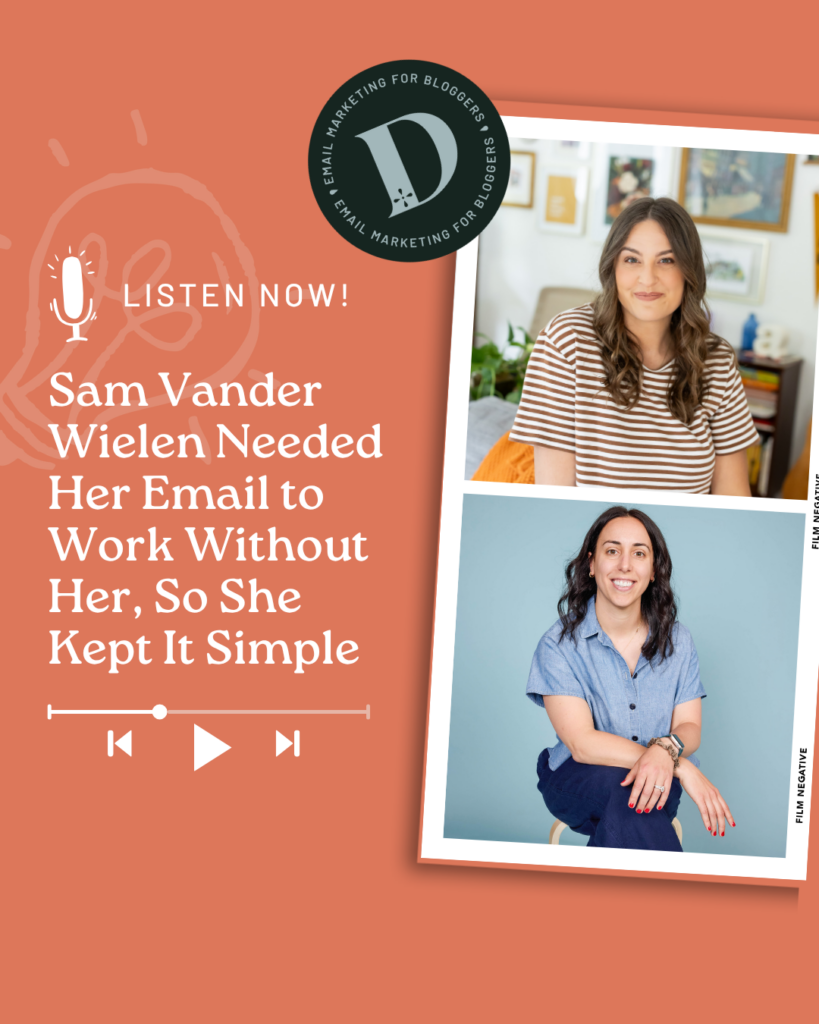
Sam Vander Wielen is an attorney-turned-entrepreneur, author of When I Start My Business, I’ll Be Happy, and host of the On Your Terms® podcast. She built her evergreen funnel in a chemo room in 2018 while caring for her dad. Everyone online told her she had to go live first. She couldn’t — so she created a funnel that’s still supporting her business (and her audience!) today.
What I didn’t expect was how simple she’s kept everything since. Two audiences on one list, both bought in, both buying. A welcome that’s two emails long. She segments, and then mostly doesn’t act on it — and she’ll tell you exactly why. Her reason isn’t laziness. It’s that people change, and she wants room for them to.
None of it is her being behind. It’s a person who figured out what she could actually sustain, and then refused to make it more complicated.
In this episode:
- What Sam built when she ran out of time, and the one part she didn’t write herself
- What Sam sends a brand-new subscriber
- The email that fills her inbox every morning with replies from subscribers
- Her process for building an email, start to finish (and why she loves writing it so much)
- The two audiences who make up her list — and whether they get different emails
- How Sam keeps a pulse on what her people actually say — then uses that language in her emails
Connect with Sam Vander Wielen:
- Sam’s last free live legal class of the year, Monday, October 19
- When I Start My Business, I’ll Be Happy (Sam’s book)
- Sam’s Sidebar (Sam’s weekly newsletter)
- On Your Terms® podcast
- Sam’s Instagram
Episode Resources:
- Kit
- Manychat
- Free Duett Resources
- Join the Duett newsletter
- Check out Duett Services
- Book a FREE Discovery Call
- Instagram @alleagrummert
Subscribe & leave a review!
If you enjoyed this episode, you can show your support by leaving a review, subscribing, or sharing your biggest takeaways on your Instagram story! Just remember to tag me @alleagrummert so I can see it.
Subscribe on Apple Podcasts or Spotify

About Allea

Allea Grummert is an email marketing strategist, copywriter and tech expert who helps bloggers and content creators make a lasting first impression through automated welcome & nurture sequences. She helps her clients build intentional email strategies that engage readers, build brand loyalty and optimize conversions for sales and site traffic.
Allea is the host of the Happy Subscribers podcast, holds the coveted spot as the email marketing industry expert for the Food Blogger Pro membership community, is a Recommended Expert through NerdPress, a trusted Mediavine partner and recognized as a Kit Approved Expert.

Looking for more ways I can help you?
Book a free call with me (no-pressure zone, promise!) and we’ll chat more about what would benefit your business most in this season.

If you’re not welcoming new subscribers and pointing them in the direction of your best, most beloved content — or you feel like the one you have isn’t doing the trick — it’s time we fix that. Use this free 5-part framework to make a meaningful & lasting first impression as you write your first welcome sequence for new email subscribers!
Is Your Welcome Sequence Making a Lasting First Impression?