Oh hey there, I′m glad you're here!

Turning Your Email Content into a Live Workshop with Jake Wysocki

Click here for transcript
Allea Grummert (00:00:12):
Hi there. Welcome to Happy Subscribers, a podcast that explores how bloggers and content creators can create more purposeful relationships with your audience through email marketing. I’m Ali Grimmert, email marketing strategist, copywriter, email platform expert, and founder of the Dump for You email marketing agency, Duet. I started as a personal finance blogger in 2016 and have since helped hundreds of bloggers and creators like you maximize your email marketing for more impact, more traffic, and a better connection with your subscribers. Be prepared for some advanced email talk, as well as tactical tips to help get your valuable content into the hands of your audience faster and easier. I’m excited you’re here, so let’s do it. We can create a deeper, more meaningful connection with the community you love and serve through email. Jake Wysocki helps experts build workshops. Their clients love attending and that they love to deliver, all stemming from his experience training hundreds in workshop facilitation at a Fortune 200.
(00:01:11):
He loves that world to come be in the creative space and teach us what he knows. So we actually met over email through Dan Cumberland, who’s been on the podcast. If you haven’t listened to his episode, please do. And because Dan and I met at Crafton Commerce, come to find out Jake was there as well and we didn’t meet until 20 minutes ago. Hi, Jake.
Jake Wysocki (00:01:31):
Hey, Alec. Nice to meet you. Thanks for having me.
Allea Grummert (00:01:33):
Yes. So yeah, we were able to shoot the breeze, get to know each other a little bit. So not absolute strangers. I always like to
Jake Wysocki (00:01:40):
Get a little- We go way back, actually. I feel like we’re old souls. Yeah.
Allea Grummert (00:01:45):
It probably helps that we match. People can’t see, but we’re just rocking the winter vibes.
Jake Wysocki (00:01:50):
Yes. Got the red winter holiday vibes. It’s good.
Allea Grummert (00:01:54):
Yes. Well, yeah. Well, welcome to the show, Jake.
Jake Wysocki (00:01:58):
Thanks for having me. Can I jump on the craft and commerce thing for second? Please. Were you there this past year, 2025?
Allea Grummert (00:02:04):
Yes.
Jake Wysocki (00:02:05):
So were you there at the closing of the whole show or whatever, where Nathan was asking people in the audience to share some stuff on mic?
Allea Grummert (00:02:13):
I might’ve been taking a nap, to be honest. Oh,
Jake Wysocki (00:02:15):
You might have been taking a nap. Well, let me tell you a brief story. Please. So I’ll try to keep it brief, but a lot of people knew me because I was the last person to go and I said all these words that didn’t make sense to me at the time, but apparently a lot of people were like, “Oh, you touched my soul.” I feel that.
(00:02:32):
And I’ve been there twice and basically my message was, and this is basically a free pitch for craft and commerce essentially. Go do it. It’s awesome. But I went last year and I found my people, none of my normally friends who were in corporate understand what it’s like to be an entrepreneur. And now I came back and I feel like I’m part of a community. And that was basically the gist of it, but I’ve rambled a lot more, kind of like I am now. And the fun thing was, just one other shout out that I love sharing is it’s all about relationships and this will tie in with a lot of the stuff I talk about anyway. It’s all about the people because I had met Haley last year and then talked to her again this year. And I said, “Hey, I heard Thomas Frank, who’s like the notion guy is at the show just as an attendee, can you introduce me?
(00:03:13):
” And so when she saw that I was going to be speaking at the end, she said, “Hey, can we get the lights up in the back? Hey, Thomas. Yeah, Thomas, this is the guy I was telling you about. ” I’m like, “What is happening right now?” It was awesome. Also, my hair was blowing back and it just felt so seen. So anyway, it was a lot of fun. So if you weren’t there, I was hoping you’d be like, “Oh yeah, I remember that. That was you. ” But since you were taking a nap, you’re probably like, “I have no idea what you’re talking about or telling me the story for, ” but there you go. Well,
Allea Grummert (00:03:39):
You’re probably like, “Why? Why is she taking naps at conferences?” Because I go hard. I go hard and I’m like, “I need to retreat for 30 minutes.” So I go and I close my eyes, not because the conference is boring. I love craft and commerce because I’m like, “I need to go take a nap and come back in time for the evening party. If there’s going to be a DJ, I’m going to be dancing.” And so, sorry, I missed that, Jake, but that’s such a-
Jake Wysocki (00:03:59):
That’s okay.
Allea Grummert (00:04:00):
Such a great moment. And Hailey has called me out from the kit stage before as well. She’s like, “Does anybody know Allie? I met her at a conference and now we’re friends.” And I would say craft and commerce, I think I’ve gone two or three times now, I’ve said it’s the least pretentious event for all of the big wigs in the online space who go there, nobody walks around like a big wig. So normal. They’re so approachable. So yeah, well, thank you for expanding
Jake Wysocki (00:04:30):
On that. So human, I would say.
Allea Grummert (00:04:31):
Yeah. Well, I am excited to get into our topic today, which dear listener, you’re going to be like, didn’t see this coming because I’m always just talking about like, what are you currently doing with your own email? But Jake is going to teach us what we can do with our email to take our existing content, the valuable content that you already write and produce and email out to your list and turn it into a live workshop.
Jake Wysocki (00:04:55):
That’s right.
Allea Grummert (00:04:55):
Ooh, there should be sound effects. If I could do Jazzy and pass out
Jake Wysocki (00:04:59):
A board. It’s probably coming. They already do the hand raised in Zoom, so that’s coming soon.
Allea Grummert (00:05:07):
If I could have something, something with my jazz hands, because I do do them a lot. Whenever I talk about the duet debut, it always comes with
Jake Wysocki (00:05:14):
Jackie. You need a twinkling or something like that.
Allea Grummert (00:05:16):
Oh, like a little bill. That’s so sweet. Well, okay, so we know that you worked in corporate, but lead us, just how did you get to where you are now and how did live workshops rise to the top?
Jake Wysocki (00:05:29):
Yeah. So let me share a few beats of my backstory, if you will. So I went to a school for engineering. I’m a mechanical engineer. Then I went into sales. I always like to mention this because I’m really proud of it and I think it’s really cool and I like to brag a little bit just to put this out there. I quit my job after I got married to my wife in 2015 and we traveled for a year. And then we can talk about that if you want, but I know this isn’t the travel podcast, but I’ll just earmark that for later. And then we came back. I came back to the same company, mostly by chance. That’s a historian of itself. But I came back in a product management role where I learned about design thinking, which I’ll explain that in a second. And then I joined a design thinking team within my company to teach other people how to do design thinking.
(00:06:09):
So for those of you listeners who don’t know what design thinking is, it’s basically a capital D designer, like someone who went to school for design. It’s their toolkit and like mindset. So the mindset I usually sum up as human centric. And then toolkit is typically like the sticky note exercises, but it doesn’t have to be literally sticky notes. It’s more of a structured approach to solving problems and helping people think through things. And what I love about that, and I’ll stop you off in a second, is it’s this meshing of like the process side that’s like the systemic piece that I love from engineering mixed with the human side that I really love. And it’s these melding of the two that really, I realized this is like the perfect mix for me and that’s why I loved my job. So actually when I quit, I actually was really sad to go, but I wanted to do my own thing for reasons I can’t totally articulate.
(00:06:58):
We could get into some of the reasons if it matters, but mostly it was, I want to try something different and might as well do it now, kind of like when we quit to leave for our trip around the world. Why don’t we do that now? So there’s a bunch of stuff I just dropped there. Happy to pick any more up, but that’s kind of the gist.
Allea Grummert (00:07:12):
I love that because, so it sounds like there’s some left brain and some, I don’t even know if human centric is considered right brain or it’s just like-
Jake Wysocki (00:07:20):
It’s like empathy and
Allea Grummert (00:07:21):
Flesh and bone.
Jake Wysocki (00:07:22):
Intuition mixed with systems and process.
Allea Grummert (00:07:26):
Yeah. So, and I’ve talked about it on the podcast briefly, but we use this all the time in our own work about jobs to be done. That’s a methodology along these lines, right?
Jake Wysocki (00:07:34):
Yes.
Allea Grummert (00:07:35):
So it is kind of like, what is the role of the thing that you’re doing? What is the job that it’s providing for the listener, for the reader or whatnot? And then how can you continue to support that goal? Like you’re not necessarily selling a product, you’re selling a solution. Yes. And so I’m excited to dive in. Yes. Well, yes. Yeah. The transition into being self-employed, how did you know what audience you wanted to serve?
Jake Wysocki (00:08:02):
Okay. So let me tell you a little bit more of a backstory. I know this connects with some of your backstory too. So I’ve been involved, if you will, more just interested in the FIRE community, financial independence, retire early. So my wife and I have been saving as much money as we can while still living … There’s a whole topic in and of itself. There’s a lot of criticism about the fire community, which is not what this podcast is for, but we try to find a good balance of saving and living in the moment. And that allowed me a really good cushion to just jump and try something. And the trigger point was actually my wife, I’d been talking about this in general, like, “Hey, I’m going to go do my own thing at some point. I don’t really know what that looks like, but it just feels like something that’s in the future.” And one day she said, “Well, when are you going to do that?
(00:08:44):
” I’m like, “I don’t know. ” Sometime in the future, she goes, “That’s not good enough. When are you going to do that? You keep talking about it. ” It’s like, why not now? I’m like, money, I’m scared. I mean, all those things are sort of true. She’s like, “Go run the numbers. You know that’s probably not true.” I’m like, “You’re right. That’s not true. I came back.” And we basically started the path and then six months later or so I had left my job. And so to connect the dots of what audience I was trying to serve, I actually wanted to help people do similar things to what I was doing in a meta sense. So my wife and I have done these state of the unions, we call them, which is like a mini workshop that we do to zoom out and look big picture at our life using the things I help people do now.
(00:09:22):
And I thought my other friends could use just a dash of this and they would be so much better off. My friends are great. I love you guys if you’re listening to this, but if you did a little bit … So my company’s name is Intention Craft and it still is, was at the time and still is because I think it’s so important to be intentional about where we’re trying to go so that we can actually get somewhere nearby where we’re trying to go,
(00:09:41):
Even if we don’t quite land there, but it’s being thoughtful about why we’re doing things. And I wanted to help other people do this with their life. So that’s where I started.
Allea Grummert (00:09:48):
That’s awesome. Yes. So with my background in personnel finance, I understand the fire community and just hoarding loads of cash. And
Jake Wysocki (00:09:57):
Then not being able to spend it. You’re like, “Well, I can’t spend it. ” It’s like, “But why’d you save it then?” Whatever.
Allea Grummert (00:10:01):
Yeah, but it’s also given you this position to create a new lifestyle for yourself that you otherwise wouldn’t have had. And now you’re in a position to create a whole new place of wealth with creating your own business that’s not always guaranteed when you work for
Jake Wysocki (00:10:19):
Someone else. From a position of strength, I didn’t want to do a side hustle because I have young kids and I didn’t want to work extra. I could have technically worked during my normal work hours because I was working remote, but that felt not what I wanted to do just because I loved my team. I loved what I did. And so this gave me the ability to make that transition from a position of strength, which allows me not to be desperate when I’m selling so I can actually serve people and then that snowballs into where I am today.
Allea Grummert (00:10:42):
I love it. So tell me, what’s the difference between a workshop and a webinar?
Jake Wysocki (00:10:46):
Yeah, perfect. Actually, I would love to answer that because that’s one of my favorite soapboxes, but let me just connect the dots. People have been thinking great. So are you helping people with their life or are you doing workshops?
Allea Grummert (00:10:55):
Oh, great.
Jake Wysocki (00:10:56):
People started asking me for help because they knew my background that I met along the way. I had a few people who were coaches and like, “Hey, I’m going to do some in- person events. I already committed to it, but now I’m freaking out because I don’t know what I’m doing. Can you help me? ” So I’m just helping some of my friends I’ve met along the way, like at Crafton Commerce the previous year and I realized how much I loved it and missed doing that kind of thing. That’s basically what I was doing in corporate. And so I decided to pivot about a year ago into what I’m doing now, which is helping coaches and creators build world-class workshops without winging it. So that’s kind of what I do now.
Allea Grummert (00:11:27):
That’s a snazzy phrase, Jake. Well done.
Jake Wysocki (00:11:29):
Thank you. I’ve done a lot of work on it with the help of people like at Crafting Commerce that I’ve met and all these things. So I haven’t done it myself, but it has been long coming. And as you know, it still evolves all the time. Kind of depends on who I’m talking to too, but I’m pretty proud of it. Thank you.
Allea Grummert (00:11:42):
Yes, you’re welcome. So how did you land on workshops versus in the online space there are, I mean the webinar funnel is
Jake Wysocki (00:11:50):
A thing. Okay. Workshops versus webinars. And I write about this, I think in my welcome sequence, I think I put it in my welcome sequence as one of my hot takes. Don’t do webinars, please do workshops. And let me define what these two are. So there’s always some overlap and I live in a world of nuance. So I understand that some people call webinars are actually what I might call workshop or part of a workshop, whatever. But the defining piece of a webinar for me is that the root is seminar, which is talking at people, not like getting and doing things. So workshop is doing work and you’re actually getting people to take some steps toward what they want to do, not just give them information. Got
Allea Grummert (00:12:27):
It.
Jake Wysocki (00:12:27):
So that’s the core of the difference for me and why I love workshops. So first of all, we’ve probably all been on a lot of bad webinars where it’s basically a sales pitch. There might be some value there, but it’s still truly a sales pitch in my opinion.
(00:12:43):
Again, there’s a nuance. There’s probably some that are in the middle and some that are further toward a workshop, but just to live in the world of the SIF, because only the SIF deal and absolutes for my Star Wars friends out there. If you do a workshop, you’re actually helping people take a few steps toward the journey you want them to take and that’s giving them even more value. And then they see the value that you can provide and then they want to work with you because you probably solved one problem for them if you’ve designed it well. So now they have the natural next step, which if you’re designing this well, you can help them with. And then they’re already primed to want to buy from you with as little information as possible. My pitches could probably be way more impactful if I was more salesy, but it’s basically like, “Hey, if you want to work with me, here’s how I work, let me know.
(00:13:24):
” That’s basically it at the end of workshops that I do. So does that answer some of your
Allea Grummert (00:13:30):
Questions? Yes. I love it. Can both be made … I mean, can a workshop be made evergreen?
Jake Wysocki (00:13:34):
A workshop could … That becomes more like a course. So I would say you could do a … So one of my lead magnets is a workshop wide, which I can talk about later, that I do live and I’m just now starting to test the waters with basically a mini course that walks through the workbook that I do. You can do it, but it’s not as good. I think there’s a ton of value, especially if you have a high ticket offer. If you have a high ticket offer, this becomes even more important. I think to do live work, because you’re probably doing live work with your clients anyway, so it’s given them a taste of how you actually work. And having that relationship built, that human element, I think is really critical and kind of the X factor that a lot of people dismiss. It’s like, well, it’s not scalable.
(00:14:19):
Well, that may be true, but it doesn’t matter if it’s less effective to do it a different way.
Allea Grummert (00:14:23):
Yeah. Well, because you also, when you turn things evergreen, you have a whole new system of operation that you have to learn and operate as well. So I’m like, might as well just make it live. I mean, I know Laura, one of our guests who’s been on the podcast, she runs a webinar or workshop every week. She does it live. And it really works for her and her audience. I love that. So which then sells a course on the backend.
Jake Wysocki (00:14:49):
Yes. So
Allea Grummert (00:14:50):
I am curious, Jake, because we’ve got listeners here who may not have any products to sell at this point, so it’s kind of just at zero. And then we might also have high ticket service providers who do have something to sell. So how do you approach workshops differently for different potential outcomes?
Jake Wysocki (00:15:12):
So I’m going to make a note of that. I’m going to come back to the answer, but sometimes I like to do the politicians thing where I answer it the way that I want to actually answer, which is before you even do that, I think you should take a step back. And this is actually, you teed this up perfectly a few moments ago and you didn’t even know it because this is how I use it too, but you want to start with the why you’re even considering doing this. And the phrase that I use, this is kind of like a mini exercise is I like to do fill in the blanks almost. So the way that I approach, why am I even considering a workshop of any kind? The job of this workshop is to blank so that my business can blank. And you want to know why you’re even doing it in the first place, and that will help answer some of these questions.
(00:15:55):
So I can go into an example of that, but does that make sense?
Allea Grummert (00:15:58):
Yes. Give me all the examples. I’m just going to sit back and take notes, Jake.
Jake Wysocki (00:16:01):
Okay, perfect.
Allea Grummert (00:16:02):
I’m now in my workshop phase.
Jake Wysocki (00:16:04):
Okay, great. This is your workshop era. Yeah. All right. So I would work backwards actually, even though it’s written the job of this workshop. But first, what are you trying to do with your business that makes you … If you’re listening to me right now and you’re thinking, I could use a workshop. I would say, why? Why do you even want a workshop? Kind of like to your point with, if you’re starting an evergreen product, that’s like a whole new workflow. So is a workshop or anything new that you’re doing creates new work. So you want to understand why you’re doing it the first place. So I would think about what you’re trying to do with your business. Are you trying to get leads? I mean, sure. We’re all trying to grow probably to a certain degree. We’re all trying to get leads probably to a certain degree.
(00:16:42):
But if you can try to pinpoint, I’m a big fan of Jay Papazan, who I also met at Kraft and Commerce.
Allea Grummert (00:16:47):
Yes. I know him.
Jake Wysocki (00:16:48):
Yeah. I love Jay. He’s awesome. And I met him at Kraft and Commerce and we’re occasional text friends and stuff. And so this is what we were talking about. I think offscreen, it’s so unpretentious. I think we might have been talking about this on- Yeah, we talk about- Yeah. This is what I’m talking about. I met Jay at lunch randomly just to do a brief aside and I didn’t even know who he was. And we were talking, he’s like, “Yeah, I wrote a book called The One Thing. I’m like, wait a minute. I looked at my phone and I had it in my up next on Audible.” I’m like, “This is the one thing?” It blew me away.
(00:17:20):
It’s just everybody’s so approachable and so friendly. It’s great. Anyway, so his whole thing is the one thing, obviously. And so that’s what I would think about here. So it’s obviously if you want to grow, but how do you think you’re going to grow? What’s the lever you’re trying to pull? And there’s no one way to really answer this, but just be as specific as you can, understand what you’re trying to do with your business. Are you trying to get more leads? And maybe it’s even one step down. How are you trying to get leads? Do you know where they’re coming from? You just need to give them something else or do you need to find them? Maybe a workshop doesn’t help you find them. Maybe it helps you convert them. Something like that. So if you were to say, I’m trying to get new leads for an existing offer or I’m trying to get more conversion from an existing offer.
(00:17:58):
So maybe it’s so that my business can convert an existing offer. The job of this workshop is to make those leads as hungry as possible so that my business can sell more of my existing offer. Something like that.
(00:18:13):
Don’t overthink it. It doesn’t need to be perfect, but it’s useful to just think for a minute because then that will frame how do you actually lead the workshop? What is it intended to do? How do you design it? Things like that. So that’s the first step. Start with your why. I’ll stop there. Make sense?
Allea Grummert (00:18:24):
I love it. Yes. Well, this is why I’m asking this question too, because we tend to hear a new strategy on a podcast or on threads or on Instagram or whatever and you get hit with ads, but the new work is still work. And so I just wanted to highlight that you said that because now this is not, I don’t know, like an aside of like, “Oh yeah, and then I’m going to do a workshop.” It’s something that will require a lot of time and focus. And so we just want to make sure we’re doing it for the right reasons.
Jake Wysocki (00:18:54):
Totally. 100%. And sometimes you might find out, you know what, that’s not the right move right now and that’s okay. And that’s why I love taking a step back and just zooming out because it’s better to decide, it’s not quite ready yet and have that realization even if you’re excited about it, just because you’re excited doesn’t mean it’s the right thing to do.
Allea Grummert (00:19:12):
Yeah. Okay. So talk about in the lens of maybe people who don’t have paid products yet, they could create them, but especially Jake and I were talking about this off of the call of most of my audience being food bloggers and food creators, and most of their revenue comes through traffic to their site or maybe affiliates, not all food bloggers promote themselves as affiliates. And so how does a workshop even work within a model like that, Jake? Can you brainstorm with me? Because it’s so outside the box of what food bloggers and food creators are typically thinking of.
Jake Wysocki (00:19:49):
So let me take a moment to define what I mean about workshop. I define the characteristics of a workshop, but when I talk about workshop, it’s kind of a general bucket of you’re taking someone from point A to point B on a journey to help them usually do some behavior differently than they were before. Usually it kind of crystallizes in behavior. Transformation, if you will, but it’s like they’re now doing something different is typically what I’m helping people do. So that can take a lot of forms. A 90 minute workshop, that’s probably what most people think of. But the same general approach I take applies to group coaching program, which is like a eight week, once a week accelerator, for example. That’s just a series of workshops or even an in- person event, which could be two days and then many things that you’re doing are often exercises and that’s just a series of workshops or just a longer workshop.
(00:20:38):
Doesn’t really matter how you define it, but the same ingredients. The analogy I’ve been using lately is it’s like Americanized Mexican food where stereotypically all the ingredients are kind of the same. They’re just packaged different. That’s how I view workshops. All the same ingredients are structured exercises, looking at the humans, how do we actually help them transform. So with that, that’s workshops in general. So are you familiar with John Meese? Yes. Yeah. He’s been
Allea Grummert (00:21:04):
On the podcast.
Jake Wysocki (00:21:06):
Great. I don’t know if I knew that. I think I might have actually. I’m in his program. I partnered with him on various things, met him at Craft and Commerce two years ago. And I think I agree with John on this. So if you don’t have an existing product, there’s no reason you can’t start with a high ticket offer if that is what you want to do. So a coaching program, for example. So I’ll just plug John Meese, go see John Meese tell him I sent you, tell Malia, Allie sent you, excuse me, I did the thing you told me not to do. Get your name right, Allie. And anyway, so John helps people become a sold out coach, but his take is you can start with a high ticket program. And a lot of times these lower ticket offers are good for filling those programs, not for making money.
(00:21:49):
Unless you have so many people on your list, maybe that’s a different aspect. So I know I’m getting kind of into like this, if this, then that, but if I just give you a blanket answer, it’s not going to be very helpful because it’s not going to be very accurate.
Allea Grummert (00:22:01):
Well, that’s super helpful because sometimes it really is kind of a numbers game. If you have a smaller email list, selling a $7 product to a handful of people every month is not going to be super … I mean, I don’t want to say profitable. Once you’ve created it, sure, it’s profitable, but then it’s like the work that goes into it, you don’t want to resent the work either.
Jake Wysocki (00:22:24):
Is it worth it? Is it moving the needle? Is it worth your time? Yes, correct. Okay. So I can’t dictate to everybody out there what they should do, but if you have an interest in a high ticket program, that can be a really high leverage way to make a lot of income if you have the right offer and all these other things. There’s a lot that goes into that. But just from a structural perspective, building it and thinking about it, if you are a food blogger and you want to help people, I don’t know, make a meal plan or something, that could be a several week program. It could be a three hour intensive. It could be something more substantial than just a 90 minute workshop. So if you’re thinking in terms of that, I guess let me ask you what your original question was because I want to make sure I’m answering your question now that I’ve gone on all these diversions.
(00:23:07):
So ask me your question again.
Allea Grummert (00:23:09):
Okay. So the idea of if somebody doesn’t have existing content, how could they use a workshop? Maybe even to define something that could end up being a paid product or the workshop itself being paid. I’m just trying to think of how our audience- How
Jake Wysocki (00:23:22):
Do they even start?
Allea Grummert (00:23:23):
Yeah.
Jake Wysocki (00:23:24):
Okay, thank you. So I would say let the data pick your topic.
(00:23:30):
And I use that with a little bit of an asterisk. I’m a big believer in intuition plus data. You don’t always have data about everything and you can use data in ways that are like, well, the intuition tells me that this, that’s data in a way. But if you have a blog, if you have a newsletter, you have information about engagement in some way. Now we can argue how perfect that is or how useful it is, but it’s at least directional. So there’s probably topics that either you’re naturally writing about a lot that speaks to data about your interest, that’s important. And probably if you have subscribers who are staying on, even if you’re talking about that, they’re interested in it, at least in that regard as well, or you can see your blog traffic and that can point you in the direction of what topics should I talk about.
(00:24:10):
So I would probably start there and just get a sense of what’s your gut reaction and then go validate, does the data support, like, am I getting responses? Am I getting clicks? Am I getting whatever on certain topics? Does that make sense?
Allea Grummert (00:24:21):
Yeah, absolutely. So I know that there’s kind of the lens of I’m so used to my own content. I don’t actually know what feels significant to my reader. How do you work through that when you’re like a team of one?
Jake Wysocki (00:24:34):
Yeah. Okay. So I’m going to … John taught me this also. The next thing … Okay, so you start with the hypothesis before, and I would say you can’t know until people actually pay you for it. So ultimately, and I dealt with this in corporate, people are like, “Oh, I need to build this new product. How do we know how much to charge?” I’m like, “We can guess we can look at comps, but ultimately it’s until someone gives you money, there’s really no way to know truly. People will say, Oh, I love that idea. I love that product or that whatever. And it’s like, okay, great. I’ve made it. I created the whole thing. Do you want it? It’s like, I don’t know. Times are getting tight or whatever. There’s always an excuse unless it’s really good. So my whole philosophy here, I have a framework called the 105099, and this is like my general development process,
(00:25:18):
And it corresponds roughly to percentage done. So 10% done, 50% done, 99% done. And I use 99 by the way, because it’s never going to be done, and that’s okay. 99 might even be too aggressive. Maybe it should be like 90% done, but I like the ring of 105, 99. So all you need to sell and to test this idea and see if you can … What I’ve heard in other circles too is like, it’s hard to read your own label. It’s kind of what you were talking about a moment ago. I’m really big about getting empirical evidence, do people actually want this? And so figure out what that 10%, that basic idea is for the workshop. So usually what that is, is what is the main promise? This is kind of where some of John’s teachings have kind of been assimilated into my own thinking on this, but it’s like what I say, which is I help coaches deliver world-class workshops without winging it.
(00:26:08):
If I were to say to you, “Hey, would you like my help delivering a world-class workshop without winging it? ” And you’re like, “Oh, heck yes. Where do I sign up?” And they’re like, “I have something. I have interest.” It’s like, okay, I’ll help you in this way if you’re interested. Here’s a signup link. And if they sign up, great. Now you have a signal that you have something of value that people want and now you can actually go build it. But before you get that, please, please, please listen. Dear listener, please, please do not build your workshop. Even if it’s a 90-minute workshop, do not build it. Do not make a single slide until people are paying you for it or signing up for it or whatever. You don’t have to necessarily pay for it depending on what it is. Do not build it until you validate that people are saying, “Yes, I want that thing.”
Allea Grummert (00:26:44):
Okay.
Jake Wysocki (00:26:46):
Another soapbox.
Allea Grummert (00:26:47):
That’s the sound of a mind blown. So why? Or how do we lock in that interest? How much interest?
Jake Wysocki (00:26:54):
How do you actually do that? How do you know?
Allea Grummert (00:26:56):
Yeah. So you mentioned that the 10% is the promise, right?
Jake Wysocki (00:26:59):
Yeah. So 10%. Okay. So I kind of skipped over some of that. So 10%, what you really need is you need to know the outcomes. So I would recommend, and this is what I do with my clients, figure out what the outcomes are for you and your business first, make sure that that’s aligned with the general direction you’re headed and you have clarity on that. Then what are the outcomes I’m delivering to my clients? If the 90 minute workshop that might be relatively small and narrow and really well defined, like think Alex Hormone’s like, what is the bleeding neck problem I’m actually solving right now? What is the whole problem I’m solving in a narrow way or whatever he talks about? Or what is the narrow problem I’m completely solving, I think. That’d be like a 90 minute attract workshop, if you will. If it’s a group coaching program, you might have a few, but there’s still one big promise.
(00:27:39):
I’m going to help you create an evergreen meal plan program that will last for years or something like that with minimal effort or whatever. And so those are the outcomes. And then the other thing that’s really … So that’s all you really need because what people are buying is that promise of transformation. They’re not buying the four week program. They are, but that’s not what they’re actually wanting and paying for. But it is useful to understand the delivery mechanisms so at least you have confidence. So I like to have a high level structure. So for a 90 minute workshop, it might be just, here’s the basics of I’m going to step them through this and then this and then this. 90 minutes, some time for Q&A, that feels achievable. Okay, that’s good enough. That’s it. You’re doing an agenda. You’re not building all the materials.
Jake Wysocki (00:28:25):
Yes.
Jake Wysocki (00:28:25):
For a group coaching program, it’s like, here’s the eight weeks, here’s the topics for each week that feels reasonable. And it might change. And when you’re selling it, especially for a high ticket, you’re probably doing one-on-one sales. It’s going to change what you’re putting into your bigger high ticket program anyway by your conversation. So you don’t want to have it all locked in because then you’re thinking, I can’t change it because I spent these eight weeks building this thing. So does that help?
Allea Grummert (00:28:48):
Yes. Hey, if you enjoy what you’re listening to and want even more of this, go to duet.co/happy for a few different free resources. And while you’re there, you can also join my email list, which is where I share so much valuable content that you really cannot get anywhere else. Plus you can reply back at any time to any email and it will go to my inbox. And if you’re curious about Duet and our services and how we work with clients, you’ll find links to that there as well. Go to duet.co/happy, and I’ll include the link in the show notes so that you can grab more. So it’s after you have the main promise that you’re selling, what does the 50 mean?
Jake Wysocki (00:29:31):
Okay, great. So 50 is then what I call the delivery guide. So a delivery guide is like a detailed agenda. It’s not just an agenda. It is obviously at a minimum, here’s the run of show. I don’t, for whatever reason, never loved that phrase. So I like delivery guide, but it’s here’s the things I’m doing, here’s how I’m doing and why. I’m understanding what I’m doing. If I was a competent or confident facilitator, I don’t really I need slides to go deliver this. I could probably do it, but I know I want some other things, but I’m not developing slides yet. I’m not developing online whiteboards if you’re using that, et cetera, workbooks. You don’t necessarily need those, but you know exactly what you’re going to do and why. And that’s the 50%. Very
Allea Grummert (00:30:15):
Cool.
Jake Wysocki (00:30:16):
And then the 99%
Allea Grummert (00:30:17):
By this
Jake Wysocki (00:30:18):
Point.You’ve already sold this. You’re not building that until you sold it or know you’re going to deliver it for sure because you have people signed up, et cetera.
Allea Grummert (00:30:26):
Love it.
Jake Wysocki (00:30:27):
And then the 99% is what I call deliver ready. And that’s where you’re building the slides, you’re building the online whiteboard, you’re building workbooks, whatever you may need. And you’re also practicing it. So you’re refining that 50% and you’re realizing even I’ve done this for years, but even I will go to the 99 and be like, “Oh, crap. I completely forgot about that piece. I’ll just work that in. I have to adjust this. ” And you’re just more prepared to deliver and you have a more refined plan basically.
Allea Grummert (00:30:53):
Awesome.
Jake Wysocki (00:30:54):
Yeah.
Allea Grummert (00:30:55):
So for our listeners, this first starts out with the empirical data looking at … And I love that you mentioned this. It’s not just what people are engaging with, but what you enjoy creating.
Jake Wysocki (00:31:06):
Yes.
Allea Grummert (00:31:07):
How do we find out what that narrow problem that you can completely solve would be? You mentioned intuition as well. Are you brainstorming a list? Are you testing out different content even before you kind of land on a promise?
Jake Wysocki (00:31:21):
So I would say you’re already testing out content right now. If you are a listener, you are probably already posting on threads or yip yab or whatever the latest thing is that I’m 40 now. I don’t know. I’m out of touch with the kids. But you’re probably posting stuff. You have a blog. You have a newsletter certainly if you’re listening, I’m assuming. You’re already creating things out there. And what I would do is I would probably use AI and I would take your top performing things and use that to say, “What are the kind of things I could teach based on this to give you an idea?” Now this, I wouldn’t ship that ever,
(00:31:54):
But AI can help you make sense of it and give you … There’s no reason for a blank page anymore. It’ll give you some ideas and then you can iterate off of there. I love my analogy, so let me share another one. This to me is like, I think we’ve probably all been here. I certainly have more times than I care to revisit ever. “Hey, group of friends, would you like to go to restaurant? Let’s go out to eat. Great. I’m in. Yeah. Where do you guys want to go? “”Oh, I’m easy.” I’m thinking, no, you’re not easy, but, okay, how about Mexican? Like, “Oh no, I don’t really want Mexican.” And they always have an excuse. And that’s okay. That’s annoying in its own way. But what I’m doing there when you’re doing that is you’re giving some concrete suggestion for you to bounce ideas across and it’s easier to edit or to change with something solid.
(00:32:38):
And that’s why I like working with AI for this. So don’t ever think it, come with a prompt. Dump in a few of your top performing newsletters or piece of content and say, “I want to develop a 90-minute workshop that helps people solve a specific problem. What suggestions do you have for me? Give me 10 ideas.” And then you can kind of pick from there. You can test some things by using … Or do you want me to pause? I have a bunch of thoughts. I’m going like a thousand miles an hour.
Allea Grummert (00:33:02):
You’re good. I’m listening.
Jake Wysocki (00:33:03):
Great.
Allea Grummert (00:33:04):
Do you want to continue?
Jake Wysocki (00:33:05):
I would. Yes. Yes. Thank you. So the thing I would do, and again, learn this from John Meese, it’s called a hand raiser. So if you have a subscriber, he probably talked about on your show, I would assume.
Allea Grummert (00:33:17):
Yes, but
Jake Wysocki (00:33:18):
Please share it again. Yeah. So the TLDR is using that kind of promise statement or just some simple statement where you’re just saying, “Hey, subscriber, pull it in from the metadata or whatever, use the liquid code or whatever you’re doing.” Say, “Would you like my help?” Promise. So would you like my help building a foolproof one week plan in less than 90 minutes or something like that, whatever it is. Thanks, Allie. And for yours, it’d probably say A- L-L-E-A parentheses A- L-L-I-E, but I digress. And then see if people respond. You’re just looking to see if people are raising their hand basically and saying, “Oh, I’m interested.” Or posted on, again, yip yab, threads, whatever threads, I don’t even really know. I think that’s TikTok for Instagram or something. I digress.
Allea Grummert (00:34:05):
It’s Twitter for women, really.
Jake Wysocki (00:34:06):
Twitter for women? Okay. Well, maybe that’s why I don’t know. I love it. So does that answer your question there on how you would kind of … And that’s how you start to test that. And then great, you have a signal, but you still don’t want to build it yet because now you need to get people to pay for it. And then it kind of depends on the scope. Maybe you have a landing page if it’s a smaller or you’re doing one-on-one sales, like the surf to sell, like John would talk about for a higher ticket program, and you’re getting a few people signed up and you’re still not building a slide, an agenda. You’re not doing any of that because as you’re doing that, you’re learning about what your users want and what they care about. And even if you’re doing a low ticket thing, I would still do some one-on-one calls because you’re going to learn a lot from that too, and then kind of push it to more of a asynchronous thing if you’re ready.
Allea Grummert (00:34:50):
So this has me thinking. I got my thinking. What a sweet way to also engage your audience in a really unique way.
Jake Wysocki (00:35:02):
Yes.
Allea Grummert (00:35:03):
So especially, I’m always thinking about my food blogger clients and that industry, if you will, and how much content there is there and how much AI is creeping in on things. But what if a workshop, what if the purpose was to build relationships with readers full stop?
Jake Wysocki (00:35:22):
Yeah.
Allea Grummert (00:35:24):
What if it was a $20 workshop, but they got to spend time with you, you get to know some individuals and thinking about if it wasn’t necessarily because, oh, I’m going to have this big funnel, but you do want to provide … I don’t know. I know during the pandemic there were cooking classes and things like that, but what if it was around, let’s create your meal plan for the summer
Jake Wysocki (00:35:44):
And
Allea Grummert (00:35:45):
The gang does it together and you’re crowdsourcing and figuring out dietary needs or anything along those lines. And I think that we, as online creators, if you’re listening to this, we’re so used to what we’re doing that we don’t realize the value it is to somebody who’s not in the blogging space or in the service provider space.
(00:36:07):
So for you saying, “We’re actually going to plan out how you are going to live out of an RV this summer with your children and what you’re going to eat,” to them, they’re like, “Please just tell me what I don’t know. You’ve already done this. What am I missing? What do I need?” You can really solve their problems and that could be it. That could be something that you offer a few times before the summer begins or maybe spring break prep or getting your kids to help in the kitchen over spring break or teach your kids to cook over spring break. You can kind of figure out all sorts of different angles, right?
Jake Wysocki (00:36:40):
Yeah. I mean, I could think of even more ways to do this, not to throw more ideas out there too much, but I’m going to pull that thread, not in the women’s social media that we talk about, but a literal hypothetical thread. If you have a list, which you probably do, what if you just sent an email and said, “Hey, I’m going to do a live workshop on something. I want to know what you think would be useful for you for me to teach you live. Just let me know. I’d love to just hear from you. ” Something simple like that. And people might even tell you, listen to the signal that people are giving you, kind of like when I made my pivot because people were asking me for something and maybe people are already asking you for things anyway and you can say, “I’m thinking about some of these ideas or tell me anything else and just see what comes back and then just try that.
(00:37:27):
” I mean, it might be as simple as that even.
Allea Grummert (00:37:31):
Yeah. One thing that always comes up for me when we leave things open-ended is that it was at Henry Ford that was like, if I had asked people what they wanted, they would’ve asked for a faster force.
Jake Wysocki (00:37:40):
That’s true.
Allea Grummert (00:37:41):
So having some sort of elements that maybe you’re teeing up priming the pump, if you will, getting them to think about this in a particular way.
Jake Wysocki (00:37:50):
Okay, but let me interrupt you for a second, if I may. I agree with that. But if they want that thing, there’s a difference between selling them what they want and giving them what they need. And so if you hear that thing that they want, you can maybe go a little deeper or just assume that’s what they want, but then do the, not a bait and switch, but do a switch, be like, “I’m going to help you get this thing that you want, which is a faster horse, but I’m actually going to teach you why this thing is a better than a faster horse. I’m going to get all the things that a horse gives you without having to clean up the poop or whatever or whatever the pitch is. ” And they’re like, “Oh wow, I’m so glad I showed up because I came for this thing, but now I realize I want this thing.” So I think that’s, you’re right, you don’t want to just give them what they ask for all the time, but that might be what brings them in.
Allea Grummert (00:38:32):
Yes. Or I mean, thank you for pushing back, Jake. I know you’re my new friend, but I appreciate that so much. You’re like, “But what if? ” But then it also means that you as the creator get to do what Jake has mentioned, right? What is the empirical data and what’s in your gut and taking the information you receive and you get to craft it from there. It’s not just like, okay, so I guess I just make meal plans. It’s like, or am I going to create an app or am I going to create a system or am I going to teach them my system? You get to think outside the box versus like, well, I guess I’m just going to do the same thing everybody else does.
Jake Wysocki (00:39:06):
Yes.
Allea Grummert (00:39:07):
But it totally depends on what your audience is asking for and your own expertise and your own kind of framework for getting things
Jake Wysocki (00:39:15):
Done. Yes. I know we’ve been talking a lot, but I have a lot more, I have some tactics or philosophy I can get into. Would you like me to get into some more of those for how they approach this?
Allea Grummert (00:39:23):
Permission to approach the bench. Yes, totally everything.
Jake Wysocki (00:39:27):
From the gentleman in Milwaukee in the snow, permission granted or whatever they say.
Allea Grummert (00:39:33):
Proceed.
Jake Wysocki (00:39:35):
So let’s talk philosophical first. So I’m really big on iterations, the compound effect and all this stuff. You do not need to do everything perfect the first time. You will not. And I feel like everybody knows this, but we still pretend that no, just a little more work and this will be so great. Make sure it’s good enough, certainly. You need to have a minimum bar, but know that you’re going to do this again and again and again, or assume that you will. And kind of like what you were mentioning before, someone who is going to go on a road trip and wants their meal plan from someone who knows how to do it, they presumably don’t even know where to start. So if you just know a little bit more, you’re already adding a ton of value. You don’t have to give them the 18 steps beyond that value.
(00:40:21):
In fact, that can work against you. You just need to help them, like give them a hand up mentally speaking, you’re just helping them at least a little bit. And then maybe there’s some things that you layer on the next time you deliver it and then the next time things get better. And so I would encourage you to start somewhere, don’t overthink it. And that also ties in with the 1050 99 because it’s like, I want you to put as little work into this to see if somebody wants this and then make it great or make it great enough and then deliver it and then you can make it even better and better and better. So that’s how I approach it psychologically. Please trust me, you don’t have to make it amazing. It doesn’t have to be amazing when you start or rather, it doesn’t have to be amazing from your expert perspective.
(00:41:01):
It will probably be amazing from their perspective because they have a different vantage point. So that’s a big thing. Yeah.
Allea Grummert (00:41:07):
So can I get a little vulnerable, Marsha? Yes,
Jake Wysocki (00:41:10):
Please.
Allea Grummert (00:41:11):
Permission
Jake Wysocki (00:41:11):
Granted.
Allea Grummert (00:41:12):
Thank you. I started my business in 2018 and I have yet to have a super simplified way of explaining how I do what I do for clients. And when I had onboarded you for this call, you had mentioned the idea of nuance. And this just kind of made me think of it because it’s like I don’t have this polished, like here are my 18 steps to exceptional emails. I don’t have a framework to follow, but that doesn’t mean my business hasn’t been successful or people haven’t been able to follow. So just hitting on that humanity piece of getting started with what you have is great. And the way that I explained things six years ago around content calendars seems to stick with people. I’m like, I should really turn that into some sort of quippy framework or pillars, but I never have. Can you just kind of speak to that as far as giving ourselves permission to just start with what we have?
Jake Wysocki (00:42:08):
Yeah. So okay, a few thoughts. Let me pop read this for a little bit. So first of all, it’s never been easier to come up with a fancy framework. And I honestly am a little, this isn’t really a soapbox. People talk about get your signature framework, get your framework. And I think there’s value in that because it communicates that you have a plan. I think that’s the most important thing that a framework gives you, but there’s other ways to communicate that you have a plan, like teach them live and show them that you’re stepping them through a structured process. And like, I don’t really care what the things say, because I know people have frameworks. I never even remember what they are anyway, and most people don’t either. It’s just more important that you have a plan, but it doesn’t mean it needs to be dialed in.
(00:42:48):
So what I would say is, and okay, can I have permission to be vulnerable for a moment?
Allea Grummert (00:42:53):
Absolutely.
Jake Wysocki (00:42:54):
So I don’t have any fancy frameworks. I have a process. I know I’m really good at what I do. I have high confidence I can get you from point A to point B because I’ve done it before, but it changes sometimes. I’m changing things regularly. I’m learning, oh, that didn’t work very well, but it still worked overall.
(00:43:13):
And I don’t know the way to give someone this … It’s kind of like you have to try it to believe it. So if you’ve learned anything from me, I’m a nice Midwest guy. I’m an Eagle Scout. You can trust me when I say you can try something, it can not be perfect. And actually, I’ll give you a bonus to this in a second and it will work great and it’ll give a ton of value and then you can make it better. And if you have a fancy framework later, all the better. There’s not really a downside to that, but don’t let that stop you. And if you are super dialed in and perfect, it actually gives people less permission on live calls to feel like they can show up as being perfect either or as themselves, not trying to be perfect all the time also.
(00:43:59):
Does that make sense?
Allea Grummert (00:44:00):
Yeah. I was thinking about this kind of reflecting on the year about how many times I could be embarrassed by things that I’ve said on this podcast or how I’ve said them. And can I tell you something about my show? I’m just a bit of a weirdo and that could really turn people off or … And I guess I’ve just kind of learned to embrace that kind of nuancey weirdness. I don’t know. But I was a kid who was bullied in school. If anybody wanted to stay out of the way and not give anybody a reason to make fun of them or shame them, it would be me. So I’ve kind of had to grow out of that in a sense of be who you are. You will find the right people who want to follow along. And so that being said, there’s a whole lot around perfectionism when it comes to showing up online, and I haven’t touched that in a long time.
(00:44:49):
I’m just like … And let me tell you, dear listener, it is freeing. So when Jake is sharing, you don’t need a fancy process to get started. If you’re like, these are the six steps I use to create my seasonal meal plan for my family so we know we’re going to eat over the month, just break it down into simple steps and you’re walking someone else through it who cannot wrap their mind around it. Same thing, when I go to the gym, when I had a personal trainer, I was like, “I want to give her a bouquet of flowers every time.” I’m like, “You aren’t telling me what to do. I literally don’t know what to do with this machine. I don’t know what form to use where my arms go. ” She’s always closer to your ears, Allie. And I’m like, “Oh, okay. You tell me.
(00:45:32):
” And so everybody has their area of expertise and you might not feel like an expert, but you absolutely are.
Jake Wysocki (00:45:38):
I love that. I have a few thoughts. First, what you’re describing is the classic magnet metaphor. Magnets repel as much as they attract. So if your weirdness or whatever you want to call it, your words, not mine, I think you’re delightful. But if that pushes people away, great. They’re probably not a good fit for you anyway. And I mean, we have this conversation about niching down is scary because then you’re excluding people. And I have so many thoughts about this and I actually am going to … Ape is not the right word. I don’t know. I’m going to get my thesaurus out live here. I’m going to pay homage to one of my favorite authors, Priya Parker, who talks about The Art of Gathering. That’s her book. She’s an expert on bringing people together and she talks about generous exclusion. And so it’s actually useful to exclude people who aren’t a good fit because then the people who are there are going to get along better.
(00:46:34):
This is going to feel like their kind of place. It’s going to be a better welcoming place for those specific people. So I would say lean into that stuff for sure.
Allea Grummert (00:46:40):
Yeah. Well, and everything that you’ve shared, it’s kind of like if you also don’t have a huge general audience, if it is more niche down and they like your voice and you get to show up the way you are, it makes your messaging a lot easier to create because you’re not like, oh, but it needs to sound professional or I need to sound like so- and-so. You don’t just sound like Jake sound like Allie.
Jake Wysocki (00:47:02):
They’re here for you already. You need to change it.
Allea Grummert (00:47:05):
You don’t need to change it. And so that’s what I love about, I shared with you before the call writing welcome sequences for people is that we get to front load the experience. If you’re a bit of a goofy person, there can be a goofy photo or if you’re more serious or if you like to tell stories or whatever, you get to present that to folks and then they get to say, “Yes, I’m choosing to stick around. This person’s intriguing to me. ” You don’t have to give away all your life secrets or share your most embarrassing moments. Save that for people like me who can’t help it, but there’s so much for having freedom in how you show up. And so- If you’re one
Jake Wysocki (00:47:43):
Of those weirdos who uses Sarafont still, you can do that and you can rock the Sarah font life. You know what?
Allea Grummert (00:47:49):
It’s just easier to read, Jake.
Jake Wysocki (00:47:51):
That’s what they say.
Allea Grummert (00:47:52):
That’s what they say. It’s like newspaper font. I actually studied journalism, so I’m like, “Don’t gocomto.”
Jake Wysocki (00:48:00):
I don’t really have a vendetta against Sarah Font. I just like to pick on the … I didn’t know you were a font nerd. I like to pick on the font nerds.
Allea Grummert (00:48:07):
Well, yeah. What do you
Jake Wysocki (00:48:08):
Think about the avatar logo? Don’t even get me
Allea Grummert (00:48:11):
Started. I don’t even know. I’m not that specific.
Jake Wysocki (00:48:13):
Well, there’s a whole joke about the avatar logo is just Papyrus and it’s like a Saturday Night Live skit with Ryan Gosling. Y should check out. It’s pretty fun.
Allea Grummert (00:48:21):
I should look that up. There was actually back in Lincoln, was it one of the advertising or marketing associations put on a volleyball tournament and the teams were Serif and San Sarif. The two teams competing.
Jake Wysocki (00:48:35):
Oh, wow. Font Nerds Unite
Allea Grummert (00:48:37):
Is great. Font nerds unite. Yep. So a designer was behind that and we all support it. I have a few more questions for you as we wrap up. How do you see live workshops evolving perhaps?
Jake Wysocki (00:48:51):
Okay. So you mean in the age of AI or whatever, maybe not explicitly, but just … I feel like that’s the big disruptor and everybody’s like, “Great, am I going to be out of a job?” Dear listener, you could just type into ChatGPT, which I prefer Claude, but that’s neither here nor there. You could just type into your AI of choice and say, “Build me a program,” and it will do a job. I don’t think it’s very good yet. So I’m not worried about losing my job yet, but it is coming for us ever, ever more. However, what I will say, and I will repeat what they talked about at Craft and Commerce, which is why I love this conference so much. I’ll just plug them again. I need a- We need an affiliate code. Code or something. Yes, exactly. But they talked about being human, especially in the age of AI, even though they’re talking about these AI avatars and stuff in one hand, some of the speakers, and then they’re bringing it back to human.
(00:49:44):
I think the live calls are inherently human. Sure. Maybe one day my video could be all made up by AI probably sooner than I’d like to think, but it still is going to miss that human element, and that’s what people are going to crave more and more and more. So I think, I forget specifically how you phrased it, but I’ll just use, how do we evolve, how are workshops going to be evolving or how are we going to be looking at these in the future? I think they’re just going to be more or less the same, but they’re going to be more and more important. And even more important, if you can do live experiences, which is a whole nother ball of wax, there’s just something, I don’t even know how to describe it. There’s just something about being with a group of people that resonate with you and it’s like, I don’t use this word lightly.
(00:50:26):
I am very hesitant to use this word, but I’ll use it in this case. There’s something magic about bringing people together that even live, there’s an element, but in person it’s even more amplified. But as we get more and more digital, things will continually head more digital, I feel like. Bringing people together as humans will be more and more impactful for your business and just your own sanity, I think. I
Allea Grummert (00:50:47):
Love it.
Jake Wysocki (00:50:49):
Yeah.
Allea Grummert (00:50:49):
That’s a solid soapbox, Jake.
(00:50:51):
And I’m with you. I’m with you. And I mentioned this earlier, that having this personal element that where you get to be on a call with other people, things are so asynchronous these days. And so to have something like that to really help move the transformation forward, to be able to ask questions. I used to host a monthly round table for like two and a half years. So dear listener, if you want to go dig those up, they’re there. They’re on YouTube. But yeah, I agree with you. I agree with you, Jake. And I like to see that evolving as an option for creators to explore beyond Facebook Live or Instagram live. What does it mean to actually create a space and invite people to it that gives you something to yap about and promote and have a time and place where people can actually meet up versus passively engaging with something that’s been recorded?
Jake Wysocki (00:51:42):
Yes. So I know you like to sort of wrap up on a soapbox per or pre-work. I got a few tactics I can kind of sprinkle in here at the very end.
Jake Wysocki (00:51:52):
Sure, please.
Jake Wysocki (00:51:54):
So two tactics you should do. I have three things. I have one thing I didn’t mention before that we were talking about, I forget exactly the context, but what I wrote down was you want to give people your opinion. So you were talking about people, I just show up and you tell me what to … Your trainer, you’re like, “I would give her a bouquet every day because I show up and she just tells them what to do. ” People don’t need options. They want your opinion. They are paying for you or coming to you for your opinions. That is why they trust you. They want your opinions, especially in, again, the age of AI where you can get an answer for anything, but who knows if it’s good. I type in some to AI and I go, “Oh, okay. Well, what about this? ” “Oh, you’re totally right.
(00:52:34):
I was completely wrong.” I’m like, “Yeah, but you weren’t completely wrong. Now you’re just telling me what I want to hear.” It’s like I never trust the opinions generally that I’m getting, but from a human that I trust, if I had a question on a welcome sequence, if Allie tells me something, I’m going to trust it a lot more than just ChatGPT. So give your opinions. People want your opinions. So that’s number one. It’s a little more philosophical, but let me get into the … Oh, this is why I thought about it because I was starting to get wishy-washy again and give you … Well, my super nuanced take is you don’t have to always do this. Here’s what you should do for every workshop. You should start with hopes and fears or some version of that, and you should end with takeaways, which are biggest takeaway.
(00:53:12):
I write about this on my welcome sequence, which we can talk about and plug in a minute, but I’ll tell you briefly what these are. Hopes and fears is a really great way, no matter what you’re doing. I do this for all my clients. I recommend they do it in all of their workshops, whether it’s a big thing or a small thing, because it helps you understand who the specific people are that are in your live experience, what they actually care about. And hopes could be, let’s say it’s meal planning for whatever, a three month trip around the West or whatever. And you’re like, “What are your hopes about this trip as it relates to food?” And then you’re going to just hear what they have to say and some things might be obvious, some things might not be, but you’re probably going to learn something and certainly hear some of the things that you need to address that maybe you’ve already planned to or maybe you need to plan for.
(00:53:58):
And then what would disappoint you most about how your meal planning turns out or what are you most concerned about with meal planning? So you can use hope and fear or some analog of those.
(00:54:09):
And that’ll just give you a ton of information. But bonus, here’s a bonus, here’s my weird Z coming out. You can also bring that back, especially for a longer experience. So if your 90 minute workshop, this probably doesn’t quite work as well because you don’t have as much time, but if you have like a cohort program, the last cohort program, bring those things that they said back. So whether you’re having them document it in some way, maybe in the chat, make sure you save that or if they’re saying it out loud, grab the transcript, whatever, bring that back and say, “Okay, here’s what you guys said your hopes and fears were. How do you feel now?” And that’s a great way to highlight the transformation that if you’ve done your job well enough, which you will because you’re wonderful listening out there, you will do a good job.
(00:54:48):
They will have so many things to say like, “Oh, that fear never came true.” Or, “Yeah, look, I have now completely different hopes and fears and those things that I started with are now completely like, I don’t even know why I was worried about that after having done this for you, whatever.” And that leads to even better testimonials, by the way. It helps them translate what they actually learned from where they started. So hopes and fears in a nutshell, that’s what it is. And I can talk about takeaways if you want as well.
Allea Grummert (00:55:15):
Hit me with it.
Jake Wysocki (00:55:15):
Yeah. So takeaways really quick is what’s your biggest takeaway? So at the end of every call, what was your biggest takeaway? And if you don’t have a lot of time or you don’t want to have everybody jump on mic, it can be in the chat, but that does a few things. One, it makes them pause and actually cement that stuff that they learned
(00:55:29):
Like, oh, I did have a takeaway. It’s not a jiu-jitsu mind trick. It’s not like a Jedi mind trick. You’re actually just having them pause and reflect briefly. It gives you feedback. When I design most people’s, I actually will use, when I help people design their workshop, it’s usually some element of what are the takeaways you hope they have. Maybe it’s not explicit, but it’s in there. And so you can see if it’s landing and then you might learn, oh, that thing, and we kind of talked about this without calling it this, but it’s the curse of knowledge, those things that are easy for you, but difficult for other people. You might just have a throwaway comment and they might say, “Yeah, my biggest takeaway was that thing.” I’m like, “That thing? That thing was a big takeaway? Oh, okay. Wow. Yeah, I forgot how far I’ve come.
(00:56:11):
I’m at level 18 and you’re at level one. That’s like a level three thing and it was huge for you. Now I can build that into my messaging or my program or whatever.” So that’s why I love that question. And then those also can often become testimonials as well. And you can just follow up and say, “Hey, would you be opposed to me using this to promote my workshop or whatever.” Big fear.
(00:56:30):
There’s some tactics. There you go.
Allea Grummert (00:56:31):
What was the third thing?
Jake Wysocki (00:56:33):
Oh, the third thing was the principle of give your opinions. So not a tactic. In your
Allea Grummert (00:56:38):
Opinion, is hopes and fears separate than takeaways?
Jake Wysocki (00:56:41):
Hopes and fears is separate from takeaways. Yeah. Okay. Two separate exercises. Got it. I think about them in terms of like Lego blocks. You kind of building a workshop with Lego blocks of these little pieces. Yeah.
Allea Grummert (00:56:50):
Love it. Thanks for checking. I just wanted to make sure. I’m taking notes over here.
Jake Wysocki (00:56:54):
Yeah. Trying to vacuum all the stuff out. Yeah, no problem.
Allea Grummert (00:56:57):
Well, what’s your biggest takeaway from our conversation team?
Jake Wysocki (00:56:59):
Ooh, that this was wonderful and you are not weird at all. I think you are delightful and yeah, this has been fun. Yeah.
Allea Grummert (00:57:05):
Oh my gosh. Well, I’m so grateful that you spent time with us. Where can listeners connect with you and learn more about your work?
Jake Wysocki (00:57:12):
Yeah. So the best place to go is workshopy.com and that’s like the word WHY. That’s where you can, at the time of this recording, you can get a live one-on-one call with me and I’ll help you develop that why that we talked about at the beginning. And there also will be or is a workbook that you can do with a video, kind of like a mini course that you can do it yourself. So if you don’t want to talk to me for whatever reason, I’m wonderful as you can tell. Yes.
Jake Wysocki (00:57:34):
And
Jake Wysocki (00:57:35):
I might not do those because I’ve been getting a lot of interest and it does take a lot of time, but it is … I’m probably talking way too much for the call to action piece, but I’m just going to keep going for a second. It is like exactly what we’re talking about. This is relatively new for me, breaking this piece off. So I’m still kind of in testimony a little bit. I’ve done a bunch already and they’re going great. So anyway, workshopwy.com, WHY. And you can get the workbook or find time with me. And that’s also we’ll sign you up for my newsletter.
Allea Grummert (00:58:00):
I love it. What do people get when they’re on your newsletter?
Jake Wysocki (00:58:02):
When you’re on your newsletter, you get my crash course to start. It’s a seven-day welcome sequence. And that walks you through some of the things like we talked about high-low. Actually, probably most of the things we talked about, I go a little bit deeper on in there. And I’ll give you, for example, Hopes and Fears video with a download template in one of those. So my whole philosophy just to share really briefly is the age of information is gone. You’re not going to pay me for my services for just the information. You want my help solving your problems. So I’m trying to give you all of my knowledge. So if that’s enough and you can use it to build your program, great. I’m happy I’ve done my job, but there’ll probably be questions you have for me and that’s where you would then engage with an offer with me.
(00:58:43):
So I’m dumping as much as I can into my newsletter.
Allea Grummert (00:58:46):
Love that. Oh my gosh, Jake. Yap as we happen. I found my fellow
Jake Wysocki (00:58:50):
Yapper. I told you. I warned you. I said, good luck. We’ll see if we can. I don’t think we will keep it under 35 minutes. We
Allea Grummert (00:58:56):
Definitely went longer than expected, but it was worth every minute. Thank you so much, Jake, for your time. Thanks so much for listening to Happy Subscribers and our conversation about email marketing today. I hope you feel inspired to take action even if it’s a small change so you can more confidently share your valuable message with your community through email. Special thanks goes to my team who makes it possible to produce and share these episodes with you. Seriously, thank you guys. If you want to hear more email marketing tips, strategies, and success stories to help you develop deeper, more meaningful relationships with your email subscribers, be sure to subscribe to Happy Subscribers so you don’t miss an episode. If you have a few seconds, I invite you to share this episode link with a friend or post it on social media so your peers and community can benefit from it as well.
(00:59:46):
And if you have a few minutes, I’d appreciate if you’d leave a written review of the podcast since that helps more people hear about it. And I believe we need more creators sending more valuable emails to their audience with more confidence. If you want to reach out to me directly, the best way to do that is to join my email list through one of my top freebies listed in the show notes. You’ll get regular emails from me that are packed with value. And if you hit reply to any of those emails, it’ll land in my inbox and I can’t wait to chat with you there. Until next time, let’s do it.
Episode Summary:

Most creators are sitting on years of valuable content — blog posts, emails, social captions, podcast episodes — but rarely stop to ask:
“What content of mine deserves more attention?”
“How could I package my ideas into a new revenue stream?”
That’s exactly why I invited workshop strategist Jake Wysocki from Intention Craft onto the podcast.
This episode isn’t just about “how to run a workshop.” It’s about something bigger:
how to identify the content your audience is already engaged with, validate what they actually want (and could pay for), and use live connection to deepen trust.
Jake brings a thoughtful, human-centered approach — along with the data of your email stats and engagement — to help identify what your audience will remember (and respond to) in a live workshop event.
Tune in to this episode — even if workshops aren’t even on your radar — because you’ll learn how to:
- Mine your existing content (blog posts, emails, podcast episodes) for topics your audience would actually pay attention to.
- Validate ideas with your list before you invest time creating anything (whether free or paid)
- Use live connection (even in simple, low-ticket formats) to build deeper relationships with readers
- Choose ideas that support your bigger business goals — not distract from them
- Create a small, paid or free workshop that builds relationships with readers in a way a blog post or Reel just can’t.
About Jake

Jake trained hundreds in workshop facilitation at a Fortune 200, then left to bring that same methodology to the world of coaching. Now he helps experts build workshops their clients love attending and they love to deliver.
CONNECT WITH JAKE:
Book a FREE 1:1 45 minute session with Jake
Intention Craft
EPISODE RESOURCES:
John Meese’s Interview with Allea
The ONE Thing: The Surprisingly Simple Truth About Extraordinary Results by Gary Keller & Jay Papasan

Subscribe & leave a review!
If you enjoyed this episode, you can show your support by leaving a review, subscribing, or sharing your biggest takeaways on your Instagram story! Just remember to tag me @alleagrummert so I can see it.
Subscribe on Apple Podcasts or Spotify

About Allea

Allea Grummert is an email marketing strategist, copywriter and tech expert who helps bloggers and content creators make a lasting first impression through automated welcome & nurture sequences. She helps her clients build intentional email strategies that engage readers, build brand loyalty and optimize conversions for sales and site traffic.
Allea is the host of the Happy Subscribers podcast, holds the coveted spot as the email marketing industry expert for the Food Blogger Pro membership community, is a Recommended Expert through NerdPress, a trusted Mediavine partner and recognized as a Kit Approved Expert.

Looking for more ways I can help you?
If your a blogger or content creator and today’s episode sparked ideas for your email marketing strategy, let’s chat! Click here to book a free 15-minute strategy call.
Think of it as a quick strategy boost — we’ll talk about the #1 thing for you to focus on moving forward so you’ll walk away with clarity on where to put your attention to make the biggest impact for your business.

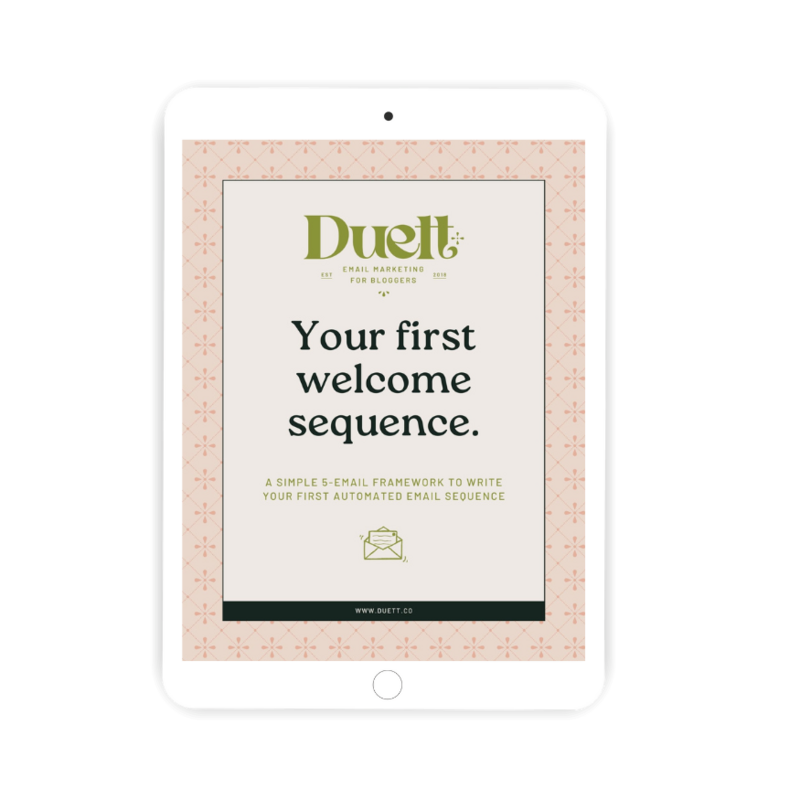
If you’re not welcoming new subscribers and pointing them in the direction of your best, most beloved content — or you feel like the one you have isn’t doing the trick — it’s time we fix that. Use this free 5-part framework to make a meaningful & lasting first impression as you write your first welcome sequence for new email subscribers!
Is Your Welcome Sequence Making a Lasting First Impression?