Oh hey there, I′m glad you're here!

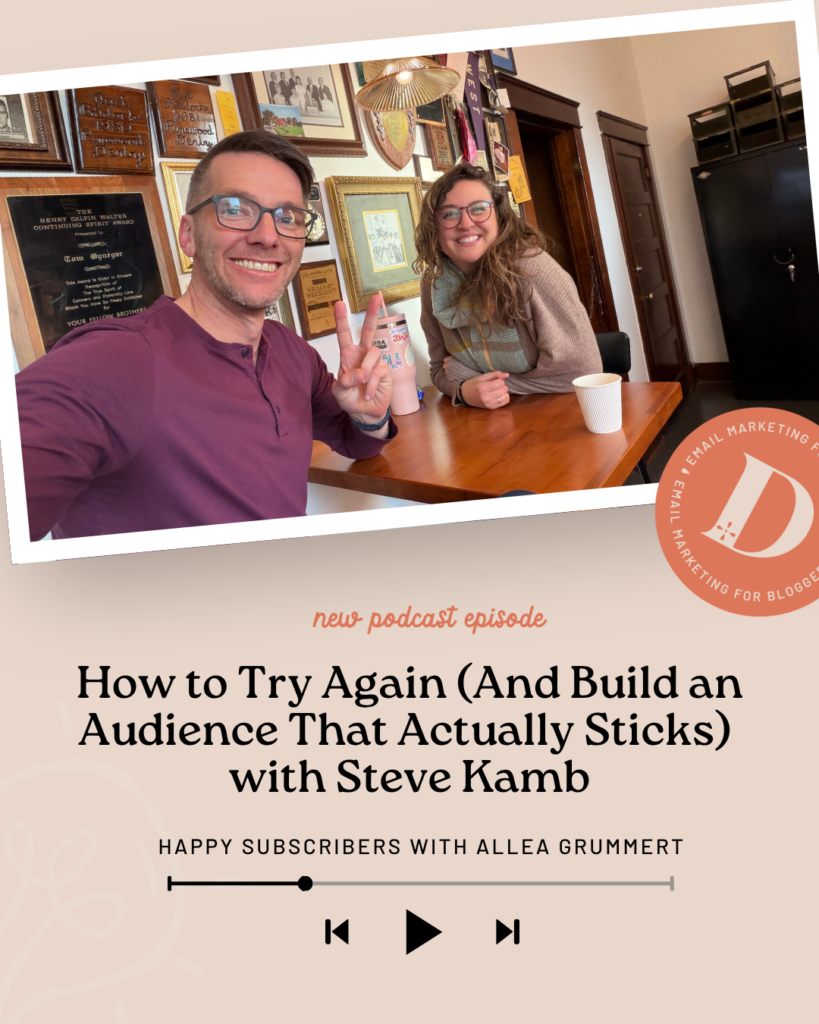
How to Try Again (And Build an Audience That Actually Sticks) with Steve Kamb

CLICK HERE FOR TRANSCRIPT
Allea Grummert (00:12)
Hey there, welcome to Happy Subscribers, a podcast that explores how bloggers and content creators can create more purposeful relationships with your audience through email marketing. I’m Ali Grimert, email marketing strategist, copywriter, email platform expert, and founder of the Done For You Email Marketing Agency, Duet. I started as a personal finance blogger in 2016 and have since helped hundreds of bloggers and creators like you maximize your email marketing for more impact, more traffic, and a better connection with your subscribers. Be prepared for some advanced email talk as well as tactical tips to help get your valuable content into the hands of your audience faster and easier. I’m excited you’re here, so let’s do it. We can create a deeper, more meaningful connection with the community you love and serve through email. If you’re curious about Duet and our services and how we work with clients, go to duet.co slash happy for a few different free resources. And while you’re there, you can also join my email list, which is where I share so much valuable content that you really cannot get anywhere else. Plus, you can reply back at any time to any email and it will go to my inbox as well. Go to duet.co slash happy and I’ll include the link in the show notes so that you can grab more. Steve Kamb is an author and the founder of Nerd Fitness. Since 2009, he’s helped busy people get stronger, live healthier, and build heroic habits. He’s published a thousand articles backed by scientific research and full of nerdy references that have been read by tens of millions to level up their lives. Steve writes a weekly newsletter at stevecam.com, which is read by 100,000 plus superhumans. That’s an amazing number. and he’s lectured at Google, Meta, and Vanderbilt University, his alma mater. And he currently resides in Nashville, Tennessee, where he plays golf decently and music poorly, and where Steve and I became friends, like in-person, real life friends. ⁓ and so I’m really excited for y’all to get to meet Steve as well. He has written a book that I’m so excited for you not to just hear about today, but go and read yourself. I have read it. ⁓ and so I’m really excited that you’re here, Steve.
Steve Kamb (02:25)
Allie, thank you so much for having me. ⁓ I thought this was gonna be a Taylor Swift ⁓ fan club meeting, but we can maybe have we’ll have that one after this. ⁓ in the meantime, we can talk about tomor okay, yeah, I had the calendar mixed up. So this is great. Thank you. ⁓ I’m I’m so thankful for your friendship and also couldn’t be happier that you took the time to to read my book and and say nice things about it. So thank you. You’re a great person and I’m glad to be here.
Allea Grummert (02:34)
Time.
⁓ well I’m excited to tell everyone about the book. Why don’t you just share a little bit like what is it? What is your book? What’s the premise of it?
Steve Kamb (02:57)
Yeah. I think a lot of people or a lot of books are how to be more productive, how to be more efficient, how to write a better plan, how to have more how to have smarter goals. I wanted to write a book about like the exact opposite of that. What happens when all of those things go wrong or you have pesky challenges like a job and family and kids and animals that you know throw up and a life to live and you can’t seem to follow through on the most popular, you know, ⁓ productivity advice. So I wanted to write a book for the days after those things don’t work out for you or some aspect of life does not go according to plan, which seems to happen more often than not. And that’s the book How to Try Again, which is like it’s exactly what it it’s exactly what it says. When something goes wrong, here is how to try again. Don’t just do the same thing over again. We’re gonna do something a little different. We’re gonna do it together. And we’re gonna work through it so that we can actually find a tiny bit of success, even while life is absolutely chaotic.
Allea Grummert (04:02)
I love this book. And I’m somebody who like, if if you give me a robust topic that maybe like it could just be like it could be seen as boring. Like, I don’t know. I read like Mike McAllowitz about profit first, and you’re like, okay, who’s gonna read about business boring business things? And then you’re crying laughing while reading it. Like that to me is a gem. Steve, reading your book, guys. I texted him because like we’re legit friends. I texted Steve and I was like, it feels like like I’d never read any of his writing, which is a shame on me ’cause you’ve been doing it for like fifteen years. But then I’m reading it and I’m like, This is my friend Steve. This is like everybody else gets to meet Steve the way that I know him. And so I’m really excited.
Steve Kamb (04:45)
Thank you. That means I I I think I responded and said like that meant the world to me. It’s it’s I spent I spent three years of my life and demoted myself twice in my own company to just write like just to focus on this book. And it’s a very solitary kind of weird act, creative act to to write a book. Nor normally you’re writing an email, you hit send and it goes out and you see how it does that day. I’m writing things and not knowing the response for three years. So to get that text from you and knowing that it comes across as just pure Steve, was exactly what I was going for. So I’m thank you for that.
Allea Grummert (05:25)
Yeah. And the other thing that I love is that it’s and you mentioned this in the book, it’s like it’s not just like try again, it’s how to try again. Like you’re giving like a formula, ⁓ or a framework of like what are the steps involved without like to not just try harder in the wrong direction. Like wait, wait, wait, wait, wait. What if we what if we pause, which is the first letter? ⁓ and y’all when I tell you like these concepts, we’re gonna talk about briefly today. But the stories in the book will make you like your jaw drop. Like, and here Steve is telling like a half story. He’s like, come back to the ending later. And I was like, get to it now. And I’m just like reading feverishly. I’m like, what happened to the man in the ocean? And like you realize, ⁓ yeah, with those kind of visuals, you’re like, Wow, how many times am I rowing in the wrong direction? ⁓ when it comes to things just being hard and being like, I can just do hard things harder every time. And Steve’s like, What if you actually took some time to pause accept the reality, change something, and then try. But all of it is it all seems so doable, Steve.
Steve Kamb (06:31)
Well, thank you for that. And the fact that ch you just rattled off the the framework of the book it it stuck. That’s ex perfect. Perfect. So ⁓ you know, I’ve I wrote the book I I went through a really challenging personal and professional ⁓ few years while writing this book and ended up writing kind of the book that I needed myself and I so it’s it’s like ⁓ it’s both deeply personable or t personal and then also I think pretty applicable for just like a normal person who is struggling with something, whether it’s their their their online business and they’re trying to gain traction or they’re trying to they’re trying to make some aspect of their life work and it just doesn’t seem to work. And we all know that saying it’s like, you know, if it do first you don’t succeed, try, try again. Maybe. But like also if you’re doing the wrong thing and you’re you’re then just trying harder at the wrong thing you’re wasting so much precious energy that could eventually be used on the actual right path. So like you said, there’s a framework in the book and I thought about it from the perspective of making a pact. So as you said, it’s pause, accept, change, try. And I think pause is the step that a lot of people miss. They are so excited or so eager to just get right back up and keep going on on a goal that maybe they picked a few years ago or they’re trying a strategy in their business because they thought they were supposed to try that strategy and they just keep doing it repeatedly and it doesn’t work and they beat themselves up. They think it’s their fault or their problem and they’re not trying hard enough. And instead, they need to be asking the question, then pausing and slowing down and saying, Do I actually want this thing? If this works and that path works, is that actually where I want to be going? And oftentimes we find out that we’re on the wrong path or we’re chasing the wrong thing or we’re swimming in the wrong direction. And in that case, like the next best step we can take is actually to not move anywhere. So like tread water and stay where we are and take a lay of the land and get to figure out like what’s actually going on in my life. What are the signals life is trying to show me and tell me? What’s the business trying to tell me? ⁓ and then based on those things, I can then chart a better course in the right direction, accepting all of the things that are currently happening in our lives.
Allea Grummert (08:53)
Yeah. Well that’s the one where you were like I mean like me being left alone with my thoughts, huh? Hmm And I was like, I felt it. But we live in just being in the online business space, there it’s so chaotic. It’s just it’s noise. And to you know, as my friend Katie Day said on her podcast, she’s like, our brains were built to search for berries and hide in caves. Like we are just we’re trying to take on
Steve Kamb (09:01)
yeah.
Allea Grummert (09:22)
so much. and and so like for us to be actually be able to step back and just pause, do you have any like practical advice for like, right, we have like, you know, maybe weight loss isn’t working or your workout plan or your diet and like those are kind of things that maybe crop up and say, Okay, I need to assess this. But if we were actually to look at like our lives or our business, is that something you would do as like like an annual retreat or twice a year where you actually sit down, or is that something you do every week where you’re like, How am I feeling about this? Like, how do we get past all the noise to even know if we need to shift direction?
Steve Kamb (09:59)
Sure. So this is something that we we’ve done at so I started a company at this point literally 17 years ago called, as you mentioned in the the beginning, called Nerd Fitness. I’m a huge nerd. There’s a Captain America Shield on the wall behind me. I grew up playing video games, but I also like fitness. So I just started writing to help nerds get fit. And this book pulls a lot of concepts from the things that we’ve taught to, you know, tens of thousands of one on one coaching clients and then through my writing, hundreds of thousands, millions of people. And there’s one tactic that we use pretty regularly with coaching clients and have written about. And I think it works really well outside of that space as well. We call it zoom in, zoom out. So you know, a big part of the ⁓ the we have packed, we have pause, accept, we get to change and try. So change is like if you don’t if you just do what you’ve always done, you’ll get what you’ve always got. We have to do something different. And I think of change from the perspective of an experiment, like we’re a scientist, right? We’re trying something different. Now, when you’re conducting an experiment, there’s a time frame to it. You say, I’m going to try this for 30 days. And for us in the fitness space, I’m very vehemently. I don’t know if I pronounced that rightly, but I’m very opposed to like detoxes and cleanses and things of that nature. Instead, I’m thinking of this from the perspective of, hey, let’s try an experiment. We’re gonna try something different, but we’re gonna do it for the next 30 days. We’re gonna write it out, and then we’re gonna zoom in and not worry about the results. We’re not gonna worry about what’s coming later. We are just gonna focus on this experiment that we’re conducting for the next 30 days and our only job not the results. Our only job is to do the thing. And if we do the thing, bam, that is a success. After our 30 days are up, you then zoom out and take a look back at those 30 days and say, D did I like it? Could I follow through with it? Regardless of whether or not you followed through with it, that’s still a completed successful experiment. ⁓ there’s a funny term in like old school, I think it’s like task failed successfully. I think it was like a typo in old Windows things. ⁓ but in this instance, great. I found a strategy that does not work for me and I couldn’t follow through on it. Often that nerd fitness, it’s I tried a diet that was way too strict. Or I tried a couch to five K program. Turns out I hate running. Great. These are data points. Amazing. We can take them and then apply them to the next experiment. So that that giving ourselves permission to to zoom out, take a look at it without judgment. Take a look at it without judgment and then say based on the results we got here, what am I going to try again differently on the next attempt? And like I said, it’s not just fitness. This applies to it could applies to email marketing, it applied to how I wrote my book, it applies to ⁓ like whether you’re volunteering or building something or whatever it may be, like taking that time to zoom out and actually, you know, put something in your calendar to say, zoom out and ask, do I want to keep doing this? Is it working? And if the answer is no to both of those, great. We can now do something different and you can stop feeling badly about the fact that you couldn’t run a five K and you can move on to something else that you’re actually interested in trying.
Allea Grummert (13:21)
Yeah, it reduces so much of the shame and guilt ’cause you’re like, I’m just I’m just finding some data here.
Steve Kamb (13:27)
Not that any of us would shame or guilt ourselves.
Allea Grummert (13:29)
No one would do That’s not why we pay so much in therapy. but I do. I have my I have mine on Wednesday. Look at us. so the one of my first thoughts with this with email marketing is how many folks keep looking at the specific data of like open rate and clicker to such an nth degree when your list is like five hundred people or even like
Steve Kamb (13:34)
If therapy tomorrow. Great.
Allea Grummert (13:58)
I don’t know, like even 5,000 people. Part of it is when you look at every email you send, like there’s so many different variables and parameters. Like it could be a holiday weekend and that’s why people didn’t open it. Not because your content isn’t engaging or the format doesn’t make sense. Like, so I’m always encouraging people, like zoom in on as far as like consistently send an email. Consistently send send a weekly email or two emails a week. Then like after six months, zoom out and look at the whole picture. And also think about like, did you enjoy sending that weekly email? Does one of them feel easier than the other? Do you still need to do it in that way? ⁓ and maybe six months is too long. But I guess like there’s email often gets used as like seen as like the back burner marketing pl channel. Like if you were to do it a little bit more proactively, maybe it wouldn’t ⁓ take, you know, because it’s always like, well, it’s just like the last thing I do. And I’m like, as much as I’d love, you know, let’s not I like I don’t like that priority. I don’t like the list of priorities and I’d like to see email up higher for so many reasons and I can cover that in another podcast. But this idea of zooming in, zooming out, and like what is what’s the one variable you’re changing? And maybe it is I’m gonna try sending out second weekly email for the next thirty days.
Steve Kamb (15:12)
Well, not only that, so I I I’ve been doing email marketing, although I guess I’ve never called it never really called it that, but today we’ll call it that. In my head, I’m just like, I write a newsletter to people that like my writing and then they reply to it. I think there’s a lot of people that love setting up automations and tags and everything is automated. Now, geez, we have AI where everything is written by AI and you don’t have to interact with anybody. I went pretty hard in the other direction. I don’t have an autoresponder. I send an email out to 100,000 people and tell them, please hit reply and tell me what you thought. So my inbox is full of people who read my my newsletter and and share share their their thoughts and their experiences and which ones grabbed them. ⁓ in the section on try, I equate a lot of this to stand-up comedy. Like I’m a huge stand-up comedy fan, and I I kind of think of my newsletter almost like almost like ⁓ you know, like that Tuesday night late set at a at a comedy at a comedy festival or in a at a at like a you know, at a comedy venue. And I’m trying out material. And maybe that’s also happening on threads or Instagram and and those ideas that that seemed to hook people, those eventually became the kernels of stories that became the the the kernels of chapters, but it’s facilitated by feedback. So it is very unscalable to tell people, hey, read hit reply and I I literally read every every reply that comes in. I’m sure at some point, hopefully if things keep going well, although no promises obviously, if things can if it grows, there might get to a point where I just physically am unable to read them all. But I do read them all. I reply to as many as I can and it helps inform who the people are that I’m reading. And I think it’s really easy, whether it’s five hundred people or a hundred thousand, to forget that it’s an individual person opening that email and my job is to connect directly with them. So I don’t write about you all. I write about you, my reader. I thought of you when I wrote this and I hope you like it. And I really think of it like a craft. And I’m trying to have that direct relationship with them. And that’s how I’ve been able to be still doing this seventeen years later. It’s like I just I I really care. I I want to hear what they think. I want to know what they’re struggling with, how I can help them. ⁓ and I feel like that’s a one to one relationship it’s just that my writing goes out to significantly more people than one to one, but I think of it from that perspective. And it’s been really life giving and really informed quite a bit of this book is like I’m trying to help regular people that like that are struggling with this stuff. That’s my audience. Amazing. How can I help them with my writing?
Allea Grummert (17:54)
Mm. So, you know, for s there are some folks who email marketing is far down on their priority list, but it seems like it’s pretty high on yours. What ⁓ yeah, tell me about that. Why did you pick email marketing as this place for you to stay for so long?
Steve Kamb (18:09)
Gosh, I mean, I’ve been doing this for s for literally 17, 17 years. ⁓ and in that time, dozens, dozens of dozens of trends have come and gone and said, email’s dead. To this day, email is still the best and only way I think that you can directly reach your audience. You can’t post to everybody that’s following you on Instagram. Not everybody that watches your you subscribes to your YouTube channel is gonna see your video you don’t have to pay for I mean you’re paying for your email service provider to send the emails, but you have an audience of people and like the inbox is like the last like the the most sacred thing, I think, for most for a lot of folks. Yes, it it can get overwhelming, but people can unsubscribe if they choose. So just from day one, I think, really early on, it’s just been like the easiest way for me to reach people that like what I write and gives me an opportunity over the years to launch you know, there was ebooks back in the day, then it was courses, and then it was coaching. We’ve had in person events. ⁓ all of that. The only way it was able to succeed with each launch was because I had an email list to send it to. So it’s the most important thing I do each week. ⁓ not only from a idea generating perspective, but I truly enjoy it. That relationship is so powerful. And honestly, I think the the the it the book industry is pretty cutthroat. Yes, they want to have a r they want the publisher, you know, my book is traditionally published. You can now get it in bookstores everywhere, ⁓ which is still mind blowing to me. But the reason I was able to get a book deal is because they knew I had a built in audience of really dedicated, passionate people that really enjoy my writing. And those are people that buy books, those are people that sign up, those are people that are willing to support a cause or if I promote a charity, they’re the ones that are jumping on it. So email marketing is the most important thing I do, I think, every week.
Allea Grummert (20:04)
Yeah, I love it. I know Steve you and I at one point talked about how neither of us really wants to get good at Instagram. now I bring that up because we all only have so much time and we all only have so much energy. And honestly, while reading your book, I was like, maybe it’s okay. I haven’t picked up my guitar in ten years, even including a pandemic when I could have developed that skill. What part of the pact was it that w would have made me think of this? Like just like the acceptance
Steve Kamb (20:35)
⁓ possibly acceptance or I do have the chapter there’s chapter six is called the like how to pick the next thing to try and that’s all about like comparing yourself to others or you read or you watch a movie or you hear about a friend on Instagram. You know, I’ve authored friends that are really good on video and they’re unbelievable on Instagram. And then I’m sitting there thinking, gosh, no I have to like I gotta get good at short form video. Do I have to learn how to start dancing to whatever popular stuff, like I have to do, God. And then I just thought, like, is that a skill I want to add to my repertoire? Or I think in the book, the way I put it is like we all ask, like, is the juice worth the squee is the juice worth the squeeze? Like, do if I work really hard at this thing, do I want what’s on the other side of it? Or like, do am I proud of what I got on the other side of it? And I think the better question is like, do I even want that juice? Right? Like, if I got really good at Instagram. Or, you know, the reason I told you I I fired myself twice from my own company because I realized I was on the wrong path. Like I had to pause in both instances and say, if this works, do I want to be what the person is on the other side of that? And it’s like, if I’m really good at Instagram, that means I have to keep doing Instagram. And I’ve tried like seven, eight times in the past. I’ll get really excited about Instagram for a month, very much like the the person I’m trying to help in my book and I give up after a month, I’m like, I don’t like this. And then I beat myself up because I’m not good at Instagram. But we’re supposed to And R I’m supposed to be good at this. And like, no man, maybe it’s okay that you’re just not good at Instagram. But you love threads or you love you love posting little weird texts and maybe we can put that over a video of you doing Lego and like that’s fine. And like that’s the extent of you being good at video like
Allea Grummert (22:04)
Okay.
Steve Kamb (22:23)
Or YouTube, hey, let’s have fun with it. It’s the only goal of the experiment. Let’s start there before we start heaping all this extra pressure and expectation and guilt and shame on top of it. We just never ask the question like, if this works, do I actually want to be or have the thing that’s on the other side of it? ⁓ I think a lot of people don’t ask that question, and that’s how we end up going down a path that we’re not really thrilled with, or it doesn’t work. We burn ourselves out and ⁓ then we’re in even worse spot because we’re burned out and we have no energy to do the one or two things that we’re actually really, really, really good at.
Allea Grummert (22:58)
Yeah. And so in your case, you’re a really good writer. And I don’t know if you were that good seventeen years ago or if you’ve developed it over time, but like how did you know that you wanted the juice?
Steve Kamb (23:10)
Great question. The writing deep. Yes. I love it.
Allea Grummert (23:13)
Yeah.
Steve Kamb (23:16)
Yeah. I don’t know. It just the things that feel easy to and I’m such a people pleaser. I’m conflict avoidant. I’m you know, it’s like, ⁓ I I’m I’m afraid of asking for help and other things about I’m like, well that doesn’t really feel like work, so that can’t be the thing I should be doing. That’s too easy. I should be doing these other things ’cause they feel hard and that’s what successful people do. Like, that’s not true. That’s not how this works. For me I loved I like I discovered it say my mid twenties discovered that I loved writing when I got to write about things that were interesting to me.
Allea Grummert (23:55)
Mm-hmm.
Steve Kamb (23:57)
I’m not like I I like helping people and I like making people feel accepted and welcome and ⁓ make them feel less bad about themselves. And I just so happen to discover like, I kinda like fitness. I’m a nerd and I Googled nerd and fitness and nothing popped up. So I was like, all right, well just start writing. And I wasn’t a great writer back then. But like a stand up comedian or like you’re you’re iterating, you know, it’s ready, fire, aim. You are trying something, you’re sending it out you’re gathering feedback and you’re just improving on it. And it was truly because I enjoyed the craft of writing. Some people love video. Some people are natural on podcasts. Some people are natural in other areas. And it just comes to them so much so that they’re willing to go through that that experimentation phase of trying and going down interesting paths and seeing what they get out of it learning from that and then improving upon the craft. So for me, I just I always loved writing. And then I think as soon as I got that first random reader, his name was Evan. Like I literally remember the first guy. His name was Evan, who read Nerd Fitness that wasn’t one of my friends or my mom. His name was Evan and he I read an article about some video game that I and I I and then Evan told another guy named Tony and Tony messaged me on Instagram like a week ago. This is 17 years later. So like I remember these things and I find that to be really powerful. And it’s like you’re not just sending an email out into the void to sell a product. For me, I’m desperately trying to create a connection with somebody to make them feel less alone. I want my writing to hopefully help them. And then occasionally, yes, I have something to offer. And in this case, it’s a book that I dedicated three years of my life to. And I’m hoping that people are willing to spend twenty bucks. twenty five dollars or whatever it is to put it on their bookshelf because it looks really cool and read it and hopefully tell somebody else about it.
Allea Grummert (25:49)
The cover says how to try again and again and again and again. And it’s yeah, because well, and that’s like this concept isn’t like a one and done thing. Like we are going to be having like having to make these choices to like, do I keep going in this direction? Do I pause? Do I shift? Like, we’re gonna be making those decisions for a really long time. And what I enjoy about the book, and I’m sure your audience has received this from you for for years, is just this like permissionships.
A permission slip of grace for oneself. And one of my favorite things in the book that I read was just this idea that, like, ⁓ I’ll do that when life gets back to normal. And it’s just like over and over and over again, it’s like normal normal’s not a thing. Like normal includes chaos. Like normal includes my cat yakking on the carpet in the middle of the night. Like, you know, so it’s like, yeah, you’re not always gonna get a great night’s sleep. And ’cause you gotta like tent her. I always seem like
Well, honey, are you okay? I’m always just so concerned with her. ⁓ and then she’s like, I’m fine now and I’m like, Cool, cool, cool. Can we go back to sleep? ⁓ but just that like normal might include a sick kiddo home from school. But instead of like waiting to hit play on something or to make a like a plan, I don’t know if plan is the right word, but like an expectation for your life based off of like perfect means you’re always going to be disappointed.
Because things will always happen. You’re gonna have a flat tire. You’re going to have not filled up on gas the night before. You know, like things are going to disrupt your life. And so accepting the n normal is chaotic was like life changing for me, Steve.
Steve Kamb (27:32)
Thank you. Yeah. I as a as a recovering insecure overachiever, I
I really struggle with perfection expectation and I I should be able to do this thing or I must be able to ⁓ the plan isn’t good enough now and I must be better, but then eventually I I can work really, really, really hard, but then after that, then I can go back to normal and and slow down. Or ⁓ I don’t really have time to do any of my project this week because things are crazy. But next week things are get back to
normal. And like you said, like normal is such a fallacy. ⁓ when when this happens on a weekly basis, like congratulations, you’ve actually found your normal. It is the chaotic, it is the chaotic part of life. And the challenge there is that you just consistently hold yourself up to some unrealistic expectation for the future. And you’re beating yourself up and you’re withholding feeling enough to be able to make progress on something now or to make a change now or to do the tiniest bit.
Now, because you have this magical opinion or this magical belief that in the future we think normal equals predictable. And we think normal is going to be the thing that as long as soon as we get there. And we’ve been saying it for years and normal just doesn’t seem to show up. ⁓ especially with today’s online environment, normal is gone. ⁓ the environment outside of the internet in real life, that is also no longer normal. Congratulations. We did it. We’ve made it to chaos.
We are here. This is normal. And we have to learn how to operate within it. And that comes with, like you said, grace for ourselves, kindness, self-compassion is something I’ve really had to work a lot on. but in doing those things to bring it back to comedy, it’s like, yes, we yes, life is chaotic. And, you know, here’s what we are going, here’s the thing that is still within our control that we can do. and and then giving ourselves like a
break when life happens again, which it will next week. Like that’s the only guarantee. So we can stop beating ourselves up about it. Yes. And we can then get back to figuring out what’s the tiniest thing that we can do within these within these chaotic times.
Allea Grummert (29:52)
Yeah, I can tell you right now our listeners are high achievers. Like anybody I’ve met in the blogging space is like, but I can be so productive. And I know because I’m one of them. and I was telling you before we recorded, I went through two injuries last year. I just first of all, last January, slipped on the ice, chipped my patella, basically couldn’t do any like floor workouts forever. ⁓ I know. I was feeling it through July, guys. It just one knee, just out of commission.
Steve Kamb (30:02)
yeah.
Allea Grummert (30:21)
⁓ then August first, I pulled my back by simply existing. I got out of my car and then I was like, I can’t move. And I couldn’t move really for two weeks. ⁓ for a good four days without saying the F bomb. ⁓ so the day that I stopped saying that as much, I was like, Am I healing? Like I’ve never given birth to a child, but I cannot imagine it being much worse. Like that’s I was in so much pain. And I’m still like around the end of the year meeting with my chiropractor and like all these s shifts I have to do to like
Do some like at home PT and just being so frustrated that I’m not better yet. And now I’m at the place where I’m like, Yeah, you could probably start lifting weights. Like your knee’s not hurting anymore. But it’s that like moving into it just feels like such a hurdle. ⁓ but I’m in this place right now. Like just yesterday I was like, You can do it. You can take a twelve minute walk to the end of the street and back. Just start there. but yeah, I like making those incremental changes. I don’t know why I felt the need to tell that story. But
Steve Kamb (31:19)
No, kinda. I was gonna say I I think so I I have a whole chapter in here called What to Do When Life Kicks Your Ass. And ⁓ I’m sorry, I didn’t know this last year. Otherwise I would have sent you this chapter ⁓ while you were going through your six months of of not being able to to exercise and move. ⁓ I think I’d call it declaring expectation bankruptcy. ⁓
Like thinking of like like remember like Michael Scott in the office when he walks in and he says, I decl he literally yells, I declare bankruptcy. Like you kept beating, ⁓ God, I I’m not able to work out yet and I’m falling further behind and ⁓ I can’t do this and ever like declare expectation bankruptcy. Congratulations. This is where we are starting from moving forward. This is the new this is your new baseline. ⁓ old you ⁓ pre
Chipped patella ain’t coming back. No pr acceptance. Great. And we’re gonna there’s a lot of work on that. ⁓ but now, okay, you’ve you’ve weathered that storm, you’ve treaded water, you’ve you’ve got on the other side of it. ⁓ and now you’re interested in what that first next step is. And like you said, like a 12 minute walk is that’s amazing. Like that’s a great start. Fantastic. Like everybody’s like, if you don’t actually if you’re not drenched in a puddle on the floor, like no, that’s not how this works. Like you’re go for a walk. Congratulations.
That’s amazing. Let’s start there. And then we can we can s we can add some some additional challenges on top of that and start to build out some more, you know, agency and belief that, hey, maybe I can do some more stuff. And ⁓ so I’m proud of you for taking your twelve minute walk and navigating last year. twenty twenty five wasn’t great for a lot of people. and let’s see, you know, kind of what we can do, what we can do this year.
Allea Grummert (33:05)
Yeah, thank you. ⁓ part of me wants to play a game. How do we apply declaring bankruptcy to email marketing? Like Yeah, hit me with it.
Steve Kamb (33:17)
Well, ⁓ so like I said, I think, you know, it’s declaring expectation bankruptcy. So this is the four people that are doing email a certain way that they hate because they saw in a class or a course that that’s the way they must do it because that person succeeded in that way. Just like there’s a thousand ten thousand ways to exercise, I think there is a lot of different ways.
To email market your product or service or ⁓ you know, your coaching business or whatever it may be, there’s a way that you can have fun with it. And I think in this world of like just AI slop is only gonna get worse and everything is gonna become more generalized and ⁓ just become more of the same, like go the other direction. How can you ask yourself like, how do I actually have fun sending my emails?
Like you’ll be able to tell, like Allie, I would I would like laugh while I’m writing my book and like cackling to myself, saying, like, that is so dumb. You know, like a joke that I’m like, that is so corny, but it makes me happy and it made me want to keep writing. And that’s how I built NerdFitness from the beginning was I was like, I have to find a way to make writing about push ups fun. Okay. How do I make this entertaining? ⁓ wait a second. What if I use little Lego photos of a guy doing a push up? that’s pretty cute and fun and
Allea Grummert (34:35)
Yeah.
Steve Kamb (34:44)
Very much me? Cool. How do I make this topic about eating vegetables? Like clearly I need a I need gifts from the office of Michael Scott shoving broccoli into Kevin’s mouth. Like great. Like how do we have fun with this? And I think so many people are used to receiving just boring, generic cookie cutter emails. So they then stumble across my newsletter ⁓ or they they stumble, yeah, they find me somewhere.
And then they jump on the newsletter, like, I feel like I deeply understand this weird Steve guy. And I don’t even care about this topic, but I want to keep reading. ⁓ so I think people can relinquish themselves and declare expectation bankruptcy around I must do email this way because that person said it, and recognize and acknowledge that there are so many other paths to creating an audience of people who love and want to follow you or your company.
And then when you have a product or service, like I can’t tell you how many people have bought stuff from me saying, I don’t even need this. I just want to support you. And I was very deliberate. I never had ads on nerd fitness because I didn’t want people, I don’t promote supplements. I don’t do any of that stuff. It’s just like I want to write stuff that makes you h like helps you live better. So people then if I hey, here’s a course on how to get how to power lift or do a handstand, they’d be like, great.
I have no plans on doing a handstand, but I like you, Steve. And I’m gonna buy your ebook. Take my money because there’s no other way for me to support you. And that turned into a business with dozens of employees and you know, a bootstrap company that I’m really proud of, and it’s still a team of coaches serving a big audience around the world. Like I’m still really proud of it. And it all kicked off because of email marketing done in a way that made me really happy, ultimately resulting in getting a book deal.
And writing a book that is now sitting on bookshelves. ⁓ that is like it it it started with email and it was finding a way to make it my own and have fun with it. And I think that’s something that people probably forget or don’t give themselves permission to do.
Allea Grummert (36:49)
a man. Okay, because I want to point out a few things. We will hand raise. ⁓ because what this tells me, and like I’m not at all surprised that you figured it out, but I how I have folks, you know, always asking like, how do I build in more personality? How do I do whatever? How long should my email be? How short should it be? How many whatever? And I’m all like, first of all, find the way that you enjoy creating and the things that you enjoy talking about and the way that you want to present your content.
And the right people will stick around. So, like what I love about your story, Steve, is you’re like, I’m a nerd. Here are some Lego. Can I say Legos at that point? Plural Lego.
Steve Kamb (37:29)
Yeah, yeah, well it’s Lego pieces technically I think, but if you want to say Legos, everybody does. I think I don’t think the Danes will be Yeah, the Danish I don’t think they’re gonna come after us.
Allea Grummert (37:38)
I’ve crossed a nerd once who’s told me it’s like them. and I’m like, okay, it’s puzzles, that’s what I know. but like you’re like, this is what I’m into. This is how I want to write and how I want to present myself. Cause I’m like, if it’s long form, as long as it’s helpful, people will read it. Or if you want to be quippy, like I include GIFs in almost every email. It’s still fun for me. I will be the cringy millennial.
For who knows, you know, I don’t know if I’ll ever be not cringe. But like when you kind of pick your lane, it’s more about just like keeping your head down on your own paper, creating in a way that’s fun and helpful, and you’re really not comparing it to other people. And I think you’re you’ve done a great example of that.
Steve Kamb (38:23)
Well, thank you. Yeah, like said, that’s a perfect example of you’ll zoom in to do the things that are really exciting for you. And then yes, you can listen to the readers, check the signals from the people that are coming back at you. But especially if you’re early on or figuring out what your voice is. Like people don’t know and people are so busy with everything else that like if you find a way to make it worth your while. ⁓ I’ll give you two quick examples. I love the show The Bear. I think it’s so fun and stressful to watch.
But it’s about this, you know, Michelin star chef that moves home to Chicago to take over his brother’s sandwich shop. And I don’t ever want to run a restaurant. I was a I worked in a restaurant back in, you know, back in high school for you know during my summers and it was it’s it’s all really, really hard work. But that show is such a love letter to the craft of making food in Chicago that like it makes me want to go to Chicago.
Because of how lovingly they talk about the city and the details and like they’re hyper specific, you know? And I’m sure marketers somewhere are saying, No, you need to appeal to the widest possible audience. It’s like, no God, like we need passion and we wanna know the things that you care about that you wanna nerd out about so much that like you can’t your excitement will show through in your writing. Like Allie, if you all of a sudden you had to write about Taylor Swift, which I’m sure you do all the time, ⁓ if you had to, like, you could
You can do it and people will know, like, ⁓ okay, that’s Allie’s girl. Like, we got it. I think that’s real I think that’s really special. And then there’s this YouTube channel called like We Built a Ruin. I don’t want to fix up an old house. It’s this couple from Scandinavia fixing up a house on the Amalfi coast. And they bought this five hundred year old ruin, but they’re doing it with such attention to detail and care and specificity and they’re having fun with it that I’m like, I’m in. I’m I’m here for this journey.
I’m invested. I want to go on this journey with you because you care about this thing so much that you are nerding out about it. Like that’s I think what people want to latch on to. It’s not the broad general advice that ⁓ you know, or must be applicable to everybody. Like, no, no, no, no, no. It’s very obvious who this is for and how it’s going to help them. ⁓ I think that passion is what will pull people in that maybe don’t even care about the particular topic.
Allea Grummert (40:47)
Yeah. man. Not that email marketing has that wide of a reach. But I mean I’ve been writing about I’ve been writing about email marketing for almost seven years. And I still have plenty more to talk about and allows you to go deeper in some certain areas. well, Steve, I think I have one more question for you. Kind of a little soapbox. I mean we’ve covered it, but if there’s anything else that’s like, ooh, but I want to get my claws on this and tell everyone about it, but
Steve Kamb (41:06)
Boy. Okay.
Allea Grummert (41:14)
T when it comes to trying again.
Tell people why does this work matter? Like the internal work that people experience, what you’ve what you teach, this idea of trying again, how does this impact people’s lives and their work?
Steve Kamb (41:31)
I think we are so hard on ourselves, and we live in a pretty amazing time. Unfortunately, that time also exposes us to the outliers, the the best of the best, the richest, the happiest, the thinnest, the healthiest, the whatever. And it’s really easy for us to.
In the book, I call it the doom loop. We beat ourselves up and we feel less than. And then we see somebody doing something amazing. And we say, ⁓ if that’s how that’s that’s that’s what I need to do, okay, fine. And we go all in on that thing for like two weeks. And then life happens. And the way I talk about it is, you know, if we’re all or nothing, that very quickly becomes all then nothing. And I think
At the end of all then nothing, we end up back at the beginning of that loop was feeling less than, and we beat ourselves up because we couldn’t follow through with this plan that wasn’t ours to begin with. So what I want to help people with is if you failed at something, welcome to the club. The first chapter of the book is about failure. I literally went to a museum called the Museum of Failure and studied some of the world’s biggest failures. So when you feel like a failure.
Reading that chapter, I promise you, will make you feel like you’re part of the s special club of humans that have failed at things, which is us.
Allea Grummert (43:08)
The normal the normal clan. That’s all of us.
Steve Kamb (43:10)
Clus,
yeah, that’s that welcome to the club. That’s all of us. Your fan club t shirt is in the mail. ⁓ so it’s okay that you have failed at something. Welcome to the club. However, before we get right back on that doom loop and go all the way back around again and go all in on something that we know is not gonna work, take a pause, ask ourselves if the thing that we’re doing or the expectations we have for ourselves are out of line with the actual normal life that we’re living.
If that’s the case, congratulations. We can accept it. We can accept that we just had a kid or we’re taking care of an ailing parent or we are dealing with an injury or our brain we’re neurodivergent or our body works differently. Awesome. Let’s accept that. And then based within those things, what is something that we can do differently? And we can do so without piling so much expectation on that next attempt. Let’s get started. Let’s zoom in, give it our best attempt. If it works, great. If it doesn’t,
Also great. We found something that doesn’t work. We now can cross that off the list. We can pause, accept, change, and try something different the next time. So ⁓ I hope people check out this book. Like I said, I literally rearranged my entire life and went through hell, personally, professionally to to to put it while writing it. and I’m hopeful that people can dip their toes in, get to know some of the lessons and and frameworks and stories that I
I was really excited to write about and then hopefully use this as like a further step for them on being kinder to themselves and ⁓ learning a bit more about the things that I think will help us navigate this just completely unknowable future that we’re all walking into with AI and robots and who knows what else is coming. So ⁓ this might help us stay afloat during whatever this chaotic hurricane is headed our way.
Allea Grummert (45:04)
Yeah. Well, and I y’all, I encourage you to buy the book. Not only could you read it in a day, I feel like you will reference it again and again. I can already tell you that I’m referencing it again and I just binged half of it in a day. And I was like, ⁓ okay. And it it is already reframing how I’m thinking about things, but ⁓ it is so fun to read. It’s a fast read. I don’t read often, y’all, but it’s like having a conversation with my friend Steve. And as you’ve just met, he’s fantastic and talks as fast as I do.
So I just you can imagine that his writing style is also like clippy and just like, yeah, you’re gonna enjoy it. Steve, thank you so much for being on the show and for introducing yourself to everyone. Y’all go follow Steve at Steve Kamb, K-A-M-B, like Lamb with a K, and get on his newsletter. And you can follow him on social at Steve Kamb. Thanks, Steve, for being here.
Steve Kamb (45:35)
Can’t help it, I’m too excited.
Thanks, Allie. And yeah, go to how to try again.com. That’s where you can get the book. There’s bonuses. I r I read the audiobook, which was also really fun for me. So if you like this chaotic energy ⁓ and you want to hear me read the book, please go for it. If not, then just read it. That’s also totally acceptable. I will not be offended. ⁓ I know I’m not everybody’s cup of tea, and that’s perfectly fine.
Allea Grummert (46:21)
I’m pretty sure you’re everyone who’s listening to this cup of tea because they’ve stuck around with me long enough. ⁓ well yeah, there’s more where this came from. So go to how to try again dot com. Did I say that correctly? How to try again dot com. Grab the book and go DM Steve with your thoughts. Go tell him how great it is.
Steve Kamb (46:38)
Please do. I would love to hear from you.
Allea Grummert (46:40)
Awesome. Thanks so much, Steve.
Steve Kamb (46:42)
Thanks, Allie.
Allea Grummert (46:48)
Thanks so much for listening to Happy Subscribers in our conversation about email marketing today. I hope you feel inspired to take action, even if it’s a small change, so you can more confidently share your valuable message with your community through email. Special thanks goes to my team who makes it possible to produce and share these episodes with you. Seriously, thank you guys. If you want to hear more email marketing tips, strategies, and success stories to help you develop deeper, more meaningful relationships with your email subscribers, be sure to subscribe to Happy Subscribers so you don’t
Miss an episode. If you have a few seconds, I invite you to share this episode link with a friend or post it on social media so your peers and community can benefit from it as well. And if you have a few minutes, I’d appreciate if you’d leave a written review of the podcast, since that helps more people hear about it. And I believe we need more creators sending more valuable emails to their audience with more confidence. If you want to reach out to me directly, the best way to do that is to join my email list through one of my top freebies listed in the show notes. You’ll get regular emails from me that are packed with value. And if you hit report
To any of those emails, it’ll land in my inbox, and I can’t wait to chat with you there. Until next time, let’s Duett
What if building a loyal audience isn’t about sending more emails…
or optimizing click rates…
or trying the latest marketing tactic?
In this episode of Happy Subscribers, I’m joined by my real-life friend Steve Kamb — founder of Nerd Fitness, author of How to Try Again, and longtime newsletter writer — to talk about what it really takes to build an audience that sticks.
It helps to share that Steve has spent over 17 years writing to his email list.
- He doesn’t chase every platform.
- He keeps email as his marketing home base.
- He’s built relationships over years.
- He cares more about depth than scale.
Just showing up. Writing emails. Testing ideas. Reading replies. And trying again.
And when he launched his book, his audience jumped at the chance to buy! Not because of sheer hype or fancy marketing tactics, but because they trust Steve.
Then, we discussed Steve’s new book, How to Try Again, and talked honestly about what happens when you ghost your list, feel behind, or question whether your email strategy is actually working. 😬
The answer actually isn’t to burn it all down and start over.
It’s simply to try again.
Episode Resources:
- How To Try Again
- stevekamb.com
- https://nerdfitness.com
- Steve’s Instagram
- Join the Duett newsletter
- Check out Duett Services
- Book a FREE Discovery Call
- Instagram @alleagrummert
- Free Duett Resources
Subscribe & leave a review!
If you enjoyed this episode, you can show your support by leaving a review, subscribing, or sharing your biggest takeaways on your Instagram story! Just remember to tag me @alleagrummert so I can see it.
Subscribe on Apple Podcasts or Spotify

About Allea

Allea Grummert is an email marketing strategist, copywriter and tech expert who helps bloggers and content creators make a lasting first impression through automated welcome & nurture sequences. She helps her clients build intentional email strategies that engage readers, build brand loyalty and optimize conversions for sales and site traffic.
Allea is the host of the Happy Subscribers podcast, holds the coveted spot as the email marketing industry expert for the Food Blogger Pro membership community, is a Recommended Expert through NerdPress, a trusted Mediavine partner and recognized as a Kit Approved Expert.

Looking for more ways I can help you?
Book a free call with me (no-pressure zone, promise!) and we’ll chat more about what would benefit your business most in this season.
More like this!:
Sam Vander Wielen Needed Her Email to Work Without Her, So She Kept It Simple
The Welcome Page: Introduce Yourself To New Subscribers (Even Before They Get Your First Email)
Daily Emails and Doubled Traffic with Ned Adams of Dutch Oven Daddy
How to Use Segmentation to Personalize Your Marketing and Increase Email Open Rates

If you’re not welcoming new subscribers and pointing them in the direction of your best, most beloved content — or you feel like the one you have isn’t doing the trick — it’s time we fix that. Use this free 5-part framework to make a meaningful & lasting first impression as you write your first welcome sequence for new email subscribers!
Is Your Welcome Sequence Making a Lasting First Impression?