Oh hey there, I′m glad you're here!

Create Meaningful Content Using AI (Without Losing Your Soul) with Dan Cumberland

Click to Open Transcript
Disclaimer: This transcript was generated by AI
Speaker 2 (00:12.066)
Hey there, welcome to Happy Subscribers, a podcast that explores how bloggers and content creators can create more purposeful relationships with your audience through email marketing. I’m Allie Grimmert, email marketing strategist, copywriter, email platform expert, and founder of the done for you email marketing agency, Duet. I started as a personal finance blogger in 2016 and have since helped hundreds of bloggers and creators like you maximize your email marketing for more impact, more traffic, and a better connection with your subscribers.
Be prepared for some advanced email talk, as well as tactical tips to help get your valuable content into the hands of your audience faster and easier. I’m excited you’re here, so let’s do it. We can create a deeper, more meaningful connection with the community you love and serve through email.
Speaker 2 (00:59.886)
Dan Cumberland helps overwhelmed founders reclaim their time and sanity through AI and smart systems. A minister turned serial entrepreneur, he’s launched multiple SaaS companies with two successful exits. Through the Meaning Movement, he’s connected with millions of people via his podcast, writing and newsletter, bringing a unique blend of psychology, personal development, and AI to help founders and creatives build lives in companies they truly love. His work has been featured in entrepreneur magazine, inc.com, Fast Company.
and the morning brew, among others. And his newsletter is read by teams at Uber, Salesforce, Microsoft, Meta, Google, and me. So these days, when he’s not helping clients optimize their businesses, you’ll find him trail running somewhere in the Pacific Northwest, crushing weights and his ego at CrossFit, exploring Mexico, where he lives with his family, sharing insights on LinkedIn, or geeking out over the latest AI workflows and apps he’s built.
Dan believes you have something meaningful to say and he’s here to help you find the time and energy to say it. I love that. I also believe you have something meaningful to say. Dan, welcome to happy subscribers.
Thank you so much, and I’m just so excited to be here with you.
Well, thank you. So Dan and I met at Craft and Commerce, which is Kit’s annual conference. And you could say we became best friends. Do you agree?
Speaker 1 (02:22.374)
yeah. Yeah, well we had this dinner that we affectionately called Trauma Club. Yep. Because we just went deep fast, you know, a lot of stories and a few tears, and it was beautiful.
Yep.
Speaker 2 (02:35.63)
It was beautiful. have a photo of that afterwards. We’re all smiling, but we call it Tramma Club. That’s what happens. You experience the trauma and then you’re like, it’s fine. I’m moving on back to the conference with my new friends. So, Dan, is there anything that you want to share that I didn’t share in your bio that would be helpful for listeners to know about you?
Yeah. Oh, I love that. Since I sent you that bio, have a new website. Dan Cumberland Labs is the home of all things AI for me on the web. And so that’s just super exciting. It just went live this week. So dancumberlandlabs.com. can go and see my smiling face on my new website. That’s the only update that I have.
Yes.
I love it. We’ll include that in the shout out so people can dive in there. And so this is a kind of a new exploration, if you will, outside of your main brand, which is why it has its own website.
It actually is the main brand now. It just has been emerging for some time. So I can maybe just give a little bit of… Please. Yeah, the backstory. the entry you mentioned, the SaaS company in 2018 took a pivot from… was running the Meeting Movement, which was like career coaching into software. Ran a software company for a private equity team for a couple of years.
Speaker 1 (04:06.026)
sold that company for them and started a venture studio building software with a couple of business partners. Did that for a few years till partners and I were just going different directions, sold one of the companies that we launched, the Venture Studio models, like we had a core team launching multiple products. And then for the last couple of years, I’ve been a fractional CMO for software companies in the five to 20 million range. And that coincided with
AI, chat CPT coming on the scenes in particular, AI has existed for much longer. With the Venture Studio, we built some light AI features. But as I was venturing out on my own as a fractional CMO, I was pretty burnt out from the Venture Studio experience, holding this team together, trying to hold this team together. Sometimes felt like it was crumbling. Sometimes just felt like we were just running around, running different directions. So I leaned heavily into AI just to see how far could I go.
with AI and just be super, super lean. So was just me. I was a fractal CMO, but on the front end, but on the back end, I was an AI supported agency and learned a lot. think my experience as a, even a minister, a grad degree in theology and psychology, I think brings a very interesting lens to work with AI. where do we draw that line between
the human work and the robot work. And that, I think, really enabled me to go get really far, really fast. And soon thereafter, I started helping friends build their businesses, build AI into their businesses, and really start moving towards being AI-first businesses. And so that’s kind of been emerging over the last year and a half or so. But it hasn’t ever really had a home. I had a personal website that was like, Dan Cumberland, know, CMO.
But I’ve been really wanting to figure out what’s the next thing that I can really scale, start to build out a more, like a better product ladder and kind of sell it up high offerings rather than just kind of general purpose marketing support, which is what I had been offering before. So all of that is to say, really now Dan Cumberland Labs is the main brand and even the meeting movement still exists. It’s kind of like a playground of testing AI ideas sometimes.
Speaker 1 (06:25.186)
But that’s really, think of it now as really being underneath the umbrella of Dan Cumberland Labs, along with my other AI offerings, the cohorts that I run, the done for you workflows that I build, all those kinds of things.
Yes. So it really has kind of, it’s now in the forefront. It’s at the front of the stage. This is it. I love it. So can you expand a little bit more? Like what led you to AI? I mean, there’s time and capacity, but why technology versus hiring a team?
This is it. This is it.
Speaker 1 (06:53.836)
Yeah, yeah.
Speaker 1 (07:03.246)
Yeah, many reasons. One is like, I’ve always loved technology. did building technology. And so I guess I think of myself as a bit of a technologist. So when the new tools came out, the new toys came out, I wanted to play with them and see what they could do. so I think that was kind of the first step. And the next step is, let’s see how far, like I said, how far we can get.
How far can I push these tools in ways that would allow me to have more flexibility and not need to hire as quickly, know, jobs that I might need, you know, in the past, even at the venture studio, we’d have a VA or a researcher or, you know, a data data analyst, you know, these kinds of roles that we would hire for or, or have a contractor that we’d bring in for these specific things. I could just do that with, with AI and it’s faster.
takes much less time turn around by the time you find the right person, get them on board and give them all the context and then get them off and going. But I have spent the same amount of time that would just take me to do it myself with AI. So I think that’s really what started that journey. And then really started leaning into just the capabilities, automations, and how you can build workflows that can support all aspects of your business.
Also, so fun. But you can’t you can’t leave that out. It’s just really fun.
It’s fun for some people, Dan, which is why you do it. I have such a fear of breaking things, like…
Speaker 1 (08:41.038)
this is interesting. Tell me more about
In anything. Like, first of all, I bruise easily in real life. Like, me walking through a doorway is dangerous. But then I’m like, being on a WordPress website, I’m like, you kidding me? So sometimes with technology, it’s just like, could go really, really wrong. But I also, you know, wasn’t until I hired an air table specialist that I even knew that there were workflows on the back end and automation. So part of it is like, I’m so focused on the work that I’m doing right in front of me that…
You know, it makes me really glad that people like you who are out there trying to figure out what it can do can pass that on to us. To the rest of
Totally. Totally. Well, I think that part of it for me too is that like, I just love optimization too. Like I love it too much. And part of it I think is like, I have ADHD and like a little bit of like ADHD brain of like what’s possible. Like I will spend sometimes like an hour building like an automation that could like replace something that would have just taken me 10 minutes just do, you know, but it’s like, I think I could just do this and do that. And then, and then I built this one thing and like,
now it’s done. And if I had just done the work, then it would have been done a lot faster. So I think it also scratches that curiosity itch for me of like, can I build this and how far can I go and how far can I push this thing? instead of it just being for me, like I get paid for it. And I get to help other people do it in their businesses, which is just way just so much fun.
Speaker 2 (10:11.468)
I love it. I would love to do kind of a broad strokes, just getting clear because it is like speaking another language in my case. I’m I’m over here like workflow, but where Dan, where is the work? Does it live in a code somewhere? So let’s break it down for me. before we dive in too far, because I also want to get into some concrete examples and the ways that you’ve helped clients and the problems that they get fixed. But let’s start with your.
the tech stack that you work with. Walk me through this, the movie that I, I mean, I’m a chat GPT girl and I’ve dabbled in Claude. That’s where it ends.
Yes.
Speaker 1 (10:53.774)
OK, well, those are great starting points. And I know everybody loves ChatGPT. Sometimes I can be a little bit of a downer on ChatGPT, because I think the other tools can be much more interesting. But I use ChatGPT all the time. So I’m going to start at the common tools and then get to the less common tools. And then maybe try to parse out a little bit about how they function. So ChatGPT, Gemini, and Cloud, I’m using those three tools all the time. Gemini is Google’s.
product. And for different reasons, I often use CHIP GPT honestly like kind of a replacement for just search, like just query something, looking for something, finding information. I often go to Gemini for processing lots of information as a very big context window. It means it can hold a lot of information in one question at a time.
And Claude is just really great at writing. Not that the others aren’t, but I just appreciate the way that Claude can turn a phrase. also Claude’s models, they also are really great at coding, scripting, and not that the others can’t do those things. But when you have more advanced problems, Claude seems to solve them faster. So that’s like level one is those tools. Level two.
I use Whisper Flow all the time, which is a text, a speech to text transcriber that works in all of your apps. just like in ChatGPT, if you push the little mic button and you can talk and then it writes in, except you can do it everywhere, even on your phone, which is just super cool. So it just allows me to move faster instead of having to type, especially long, long things. I use Typing Mind. Typing Mind is a
UI for all of the major models. So let me say that differently. It’s like one workspace where you have, you can have all of your chats, but in those chats, you can connect to the different provide model providers. So I could have a chat with, you know, working with chat GPT, and then I could switch over even in that same chat to Claude. and it also has a few other more advanced, like organizational features that are somewhat similar to
Speaker 1 (13:20.994)
like the projects in Cloud, in Chat GPT, and like kind of custom GPTs. But you can call them into the chat with just, by mentioning them like with an at sign. Similar to how you can Slack, would mention someone else. So I could like be working on something and I have, let’s say, I want to work on just my call to action on a piece of content that I’m creating. I have a…
They call them agents. Agents is not the right word for it. But you think of it like a custom GPT that’s just trained up on how to make a really good high converting CTA in the style that I like to write them. So I call that into the chat and have it brainstorm a bunch of options for me. So it just makes a very dynamic and seamless creation experience, which is very, very cool. All of those connect. And this is the next layer. That tool.
And the same thing with Whisperflow. Behind the scenes, it connects to these models via API. And API is a big, concept for some folks who haven’t spent as much time in the tech world. But an API is basically just how one piece of software communicates with another piece of software. So instead of typing mind using, connecting to my paid subscription with ChatGBT,
I said you set it up with API keys that just you only pay per use. And so that’s kind of unlocks that kind of the next layer of these tools. And that’s really how all these tools first emerged before like the chat interface even existed. These AI tools were developer tools to be built into software. So anytime you’re using an AI feature in a piece of software, it’s likely using either chat dbt, clod,
maybe Gemini, and maybe there are a handful of many other models that exist, but likely it’s one of those. So if you’re in a, like I was in Xero, my accounting software, and they have a new AI feature, it’s not that new. But I guarantee you behind the scenes, it’s just using ChatGPT or Cloud or Gemini, but they don’t call it that because it’s their branded thing.
Speaker 1 (15:42.466)
Without getting too technical, let me just go one more, one more level. Level four! Do I need to take a breath?
I’m breathing. I’m breathing.
Listen, I hope you’re with me. We’re almost to the end. We’re almost to the bottom of the rabbit hole. The tool that I use absolutely the most and and Ali, no one has ever asked me this question before. So I love I love that get to talk about this because it’s kind like my secret, my secret weapon. But it’s like a super geek secret weapon is a product called Wind Surf, Wind Surf, like, you know, surfing. It’s very similar to another product called Cursor. They are both
IDEs, which stands for Independent Development Environment, which is a tool that’s made for developers, coders, to write code. So just by nature, by category, you know that this not going to be very fun tool to look at, It’s like, are you hacking into the matrix right now?
I had a feeling it wasn’t going to be as pretty as the others.
Speaker 1 (16:46.67)
But its capabilities are just next level. And so what they all do, and there’s others as well, they have this kind of three panel interface. So on the left side, have all of your files that it can, folders and files that it can see. In the center, you have a canvas where you are editing something. these tools are designed for building, for writing code and scripts and things like that. But you can also use them for copy. You can use them for, you
outlining things, you use it for whatever. But I do a lot with copy as a a marketer or marketing first AI consultant. I also do some coding, but that canvas I can write on. But then also on the right panel, I can chat with an AI and the AI can see all of the files and it can see the canvas and it can also edit the canvas. So now instead of needing to copy and paste something from chat.
into a doc and then have to go to a different custom GPT to have it do a different thing. like all this copying, pasting between all of these things, we have one workspace that we’re using. And then we’re calling in, you can use workflows and have like kind of saved prompts and things like that in these tools. But it’s all happening in one document. And in that right sidebar where you have your chat, you can also choose which model you want to use. So you can use
You can use Cloud, can use Gemini, you can use all of them. And they’re all right there in that same tool. So that is like the super geek next level tool that not a lot of people are using still for these kinds of purposes, but it is a big unlock. you can tolerate the technical feel of it when you first take a look at it, it can be a little overwhelming.
would like to suggest that this is why people pay you, Dan. No, you’re fine. mean, it’s super intriguing and it is a landscape that we need to learn the language of, we being in the online space. Even if, I mean, even if you were to hire someone to help you with something to know kind of the layers involved and API, I know what that means. That’s, and that is where I tapped out on
Speaker 1 (18:44.43)
That was lot, wasn’t it? I’m sorry.
Speaker 2 (19:08.844)
You lost me going forward. No, that’s so great with. So do you want to talk about how you work with clients? Because I’d like to able to ground this in some real life examples. But what what are the problems that business owners or founders or creators are most coming to you with that you most frequently solve for them?
Yes, that’s great. Yeah. One of the biggest problems there kind of starts in one of two ways. One is they’re at an inflection point where the founder or the founding team is feeling spread thin and having a hard time really tending to the overall voice and brand consistency across communication channels. And I create some done for you workflows.
to help support them in that. It all starts with a brand document, brand artifact that really can be put into any system in order to help it know how to communicate on brand for that company. And then we layer on top of that more specific outcomes to create workflows. So for example, one client, they do insurance billing for private practice therapists, medical space,
chiropractors, that kind of thing. And they have a podcast, they do a lot on LinkedIn, they have a lot of education resources. And they wanted to be able to create all of their resources, all this different kind of content much faster and have it, you know, speak in their style. They use a lot of game analogies, but not sports analogies. And that was one of the challenges that they had with AI is like, the AI kept talking about football and they didn’t want it to talk about football. And so
I built this, started with this foundational document that we loaded up there and they use Gemini. So I use the tool that they’re most comfortable with, loaded up into a Gemini, it’s called a GEM, which is like a custom GPT. That’s, kind of like their kind of multi, know, Swiss army knife of content creation. So it could create anything that, you know, and have it sound on brand for them. But then we layer on top of that, like very specific output. So if they want to create their show notes for their podcast, we have another,
Speaker 1 (21:28.334)
a again, like a custom GPT that’s specifically for podcast note, you know, a show note or newsletter, you know, creation, where they would input the transcript of the podcast, it would know how the brand communicates because it has this, this document, and then also has another document that teaches it how to specifically format for that output being
their show notes or their newsletter. And then we multiply that times all the different outputs, their LinkedIn posts, their blog posts, their education resource posts, etc. So that’s like one one one place that we often end up starting is especially in the marketing world. And often I end up talking a lot about marketing. One is because I, you know, I’m a marketer, but also because it’s like the common thing like everybody if you’re
We’re going to post on LinkedIn. We kind of know what that’s going to look like. It’s going to be so many characters or less. It’s going to have words and it might have a picture or a few. But on the back end, a deliverable to a client from a consultant could look like a million different things. And that’s another thing that I do. I’ve worked with teams of consultants building out workflows to support their scaling. So there’s a team that
I can name them because they’ve given me permission, level up creators. They people build businesses, mostly in the creator economy, service-based businesses. I’ve helped them build out the backend of all of their client deliverables. This great process they have that they lead clients through, I’ve built these very similar structured workflows on the backend where they can input all the things that they need to input from client interviews or maybe their customer interviews on behalf of their clients.
and all the other data collecting that they’re doing, use the AI to help process it to create these deliverables that are really laying the foundations of these businesses that they are building. And it’s taken their team, these reports that could take a whole week for them to create is now done in a matter of an hour or two. So it’s like, they still have to do like the front end of doing the interviews, collecting all the information, those kinds of things. And they also, you still go over it.
Speaker 1 (23:40.046)
Proof it, also make sure that it’s good, add extra insights where they need to. But it’s taken that big chunk, 80 % or so, I don’t know what the percentage is, out of the middle that is just so much faster for them. And in their words, they’re able to run a consulting agency on software margins, which is very much unheard of because of systems that we’ve built. So that’s like on the done for you category. And as far as the things people are coming to me for, it’s either.
they’re stuck with their branding, their marketing, and their voice, or they’re at an operational bottleneck and they want to find ways to use AI to free themselves up. Sometimes it’s just a question of like, just not, I know there’s more I could do here, but I don’t know what it is. But those are kind of the main two questions. Related, the other way that I do work with people is I have a cohort.
the AI Mastery program, I call it, where I am educating people and more of a done with you format. So everyone’s building something in their own business with the idea that like, every business is different. So I can’t just like hand you a workflow and expect it to work for you. I need to know what matters to you and where the bottlenecks in your business are and teach you the basics. And then we do open office hour coaching where people are bringing the problems that they’re having with AI, the things they’re trying to solve. And then we solve them, solve them together.
I’m hearing Ice Ice Baby. Do you hear it? Got a problem? Yo, I’ll solve it. No? I was like, Dan, she’s over here like, come to office hours. I’ll solve that problem. That’s fantastic. And that’s what I love about working in emo marketing is that I also get to solve a lot of problems for clients, whether it’s on the technical front or the messaging and marketing. I did have one client I always tell this story about. We interviewed her audience.
I love you
Speaker 2 (25:31.918)
And the results came back and a lot of people didn’t know she had a cookbook. And she looks at me and she goes, we should really tell people I have a cookbook. I was like, yep, yep, we should. You know, we build that into the automation so that everybody learns that there’s a cookbook. But it was just this moment of like, think that you’re always talking about this thing or you released it two years ago, it’s not on your mind. You’re not talking about it. And you’re like, oh, this thing that I worked really hard on and can produce revenue, I should probably talk about that more. And so, yeah, we’re out of here.
can’t see the forest from the trees, right?
man, myself included. There are things where I’m like, if somebody could look at my business and be like, Ellie. So that’s not to cast shame on anyone. So can we talk about AI and email marketing? please. What are some problems people are facing regardless of industry when it comes to email marketing?
Yeah. Well, I mean, there’s there’s there’s a million different ways you can apply AI to email marketing. And so I think what might be fun is like, let’s just brainstorm. Let’s brainstorm some some some things right now. And I can tell you some things that I’ve done even just recently. I used AI to do a domain analysis of my email list to understand what industries my my subscribers are in.
about 13,000 subscribers on my list right now. And I want to just be like, who are these people? What are they up to? And so I downloaded my list. And this is an important, and this is a little bit techie, but bear with me. important move is instead of just dropping this whole email list that has too many emails for AI to be able to understand and parse, I asked it to write a script to…
Speaker 1 (27:20.686)
parse those emails into just the domains. So I didn’t want the whole list of all the people with, know, I have like 3000, 4000 people with it at gmail.com. I just want to know how many people are at gmail.com. So I wrote a script that then ran, that I dropped into terminal and it ran and made a list of like, here are all the domains with all the numbers. And then I had AI create an in cloud. They’re called artifacts. could probably do, you could probably do it in other tools as well.
just to make it visual. Like, let me see, let me see what this looks like. So, because like numbers are, numbers are hard to like really understand. And so, I this really beautiful sunburst visual, like with all the colors for like business and .edu and government and personal. It was, it was super helpful. It was really, really interesting. So, there’s a lot of that kind of analysis that you can do. So that’s bucket number one.
Bucket number two, I don’t know how many buckets are going to go. I’m just going to keep listing and then we can. Yeah, yeah. We’ll just just line them all up. Bucket number two, I’m a big fan of just using it for optimization. One thing that I’ve done is take a look at all of my subject lines and open rates and send times and use AI to tell me what my list likes.
thread then. Yep.
Speaker 1 (28:44.448)
What are the words that should be in my subject lines to get the most open rates? When should I send my emails to get the most open rates? And just to find all these correlations that would take a really long time to really dig into, because my open rates are pretty consistent. There’s not huge spikes and dips, right? But it can parse out all the numbers to know, yeah, when I talk about, when I have AI in the subject line,
people open those emails more than when I don’t. Okay, well, let’s put AI in more subject lines. And like it said that I should send on Wednesday mornings. I feel like I never send emails on Wednesday mornings. But when I do, they get more open. So like, that’s interesting. So stuff like that. That’s super easy. I’m in kit. I did this via API, but you don’t have to do it via API. Just like go to your list of all your broadcasts just like select all the text.
and paste it into your AI and do that for a few pages. You probably also want to tell it not to index off of emails that were sent to us, a really small segment, right? Like, I have 13,000 emails, I sent one email to 50 people and it got a huge open rate. We don’t want it to be like, yeah, that one was so great. They all wanted it.
Read the room? Yes. I did that recently for a launch, when I launched something over the summer and took all of the data, actually copied and pasted all the send data from subject line, open rate, rate, total clicks, send date, all that in to Google Sheets. And then I actually saved each of the emails as a PDF.
and uploaded all of that to chat GBT at the same time. Cause it was like, do you see? And what would I, what can I improve next time?
Speaker 1 (30:37.068)
Yes, yes. And what did you what did you find out?
It was it wasn’t like, here’s a glaringly obvious thing, Ali. So that was nice. I wasn’t like, did I just drop the ball? What did it I’d have to go back and look down to be honest. That was once ago. But it gave me.
Yeah, it basically was like, these are your two strongest emails. I appreciate you telling me that. think it was like, what if you add it, because it was like, do you want to add in more story? Do you want to try something out as much stories? And just gave me things to think about versus like, here’s how I would exactly change it. And that was encouraging. Just because like when that launch didn’t go very well, it’s also June. Who am I? Why am I launching anything in June? No one’s behind their desk.
Come on
You know, it was worth a shot. It was worth a shot. You know? And so, but it was like, okay, what would it look like if I ran this at a different time of year? It gives me things to think about when I do it the next time.
Speaker 1 (31:37.678)
I love it. I love it. I’m a big fan of like when you get these kind of insights, like one is like just great insights. think AI can be such a great mirror for us. But then another step that you can do is take those insights and turn them into a tool. And so what I’ve done, even with the insights that I gathered from my open rates and everything, is I’ve made an email optimization guide. So I asked AI to print all of the insights about how to like when to send, what to send, who to, know, whatever, all of it.
into a text file. now anytime I’m working on another email, getting ready to schedule it, I reference that text file and ask AI to help me optimize this. like, your subject line doesn’t say AI. I’m like, yeah, I should say AI. And it’s like, you’re planning on sending this on Monday morning. But Wednesdays are better. I’m like, yeah, good idea. I’ll send it. I’ll do it on Wednesday morning. Just stuff like that that’s like,
I just forget it. There’s just so many, so many things that you have to think about when you’re, you you’re just thinking about the content. You’re so close to all of it to like step back and like, okay, what works best for my list? So not only getting that insight, but then packaging that insight so that you can help your help AI help yourself use AI to get resurface those insights for
you. That’s what I was thinking too. Like, help me help you. asks me help you. Oh, okay. So what are some of the other buckets we’ve got? Yes. Analysis,
Yes, yes, yes. help you, help AI help you.
Speaker 1 (33:15.852)
Yeah, yeah, I think there is a big piece around, specifically with email, around how you connect best with your audience. know something you were talking about recently on one of your episodes is about how powerful stories are and how easy sometimes it is to forget to tell a story. And to even just have a checklist that, again, could…
What, man, I cannot find a word right now. What does your best possible email look like and create a tool for AI, an AI, think of it like a custom GPT that gives you like a score based on your own set criteria of what success looks like. So then you’re like, okay, here’s the email I just wrote and here’s the score. And one of those could be again, like,
What?
Speaker 1 (34:15.554)
Does it it tell a story? So that’s one thing. That’s still kind of the optimization realm. But another place that you could go is make a tool that helps you find more stories. And there’s a bunch of different ways that that could look. But you could you could have a tool that’s that’s specifically like just to interview you, ask you questions. And so maybe you give it an email and you give it email like, hey, I this email. It’s really great. I forgot to tell a story. I don’t have any ideas right now. Ask me some questions. Interview me.
And then maybe put on voice mode and go on a walk and just like talk. You’ll find something.
I did that with a presentation. I’d written out all of the script and then I was like, how do I level this up a bit by telling a story to really connect with the audience? And so I just shared, I don’t know if I, I think I also downloaded the slides with the script, gave it to ChatGPT and she gave me a few examples and two were awful. And one I was like, oh my gosh, this is fantastic and hilarious. And I can incorporate a photo from my home. It was about like how my family, we do Thanksgiving and Christmas, we eat out of crock pots.
There is no, there is no sit down at the same time at the Grummert household. And I’m like, that is so uniquely Grummert. I think it was maybe the example she’d given me. was like, no, no, no. I was like, no, no, Kathy, we eat out of crock pots. She goes even better. She’s like, you’re like hosting guests. And I was like, no, we host ourselves. But
It was great because then she also, I was like, okay, now help me tie that into like into the presentation. What does that look like? And she was like, what if, because you’re talking about quarter four, what if you were telling other people like, you get to be the host that you want to be, pick host mode that is comfortable for you. So I’m like sharing in my story. like, if I had to wear pants with buttons, I don’t want to go to your Thanksgiving.
Speaker 2 (36:06.868)
I am so trained in how my family has done Thanksgiving for years that I’m like, please don’t expect me to dress up, let alone wear shoes. no. And so in the story, I was like, everything I share with you today, take what feels good. Like you get to be the comfortable host. If you love putting on a party, go for it. I know. I’m like, just you’re welcome at the house. That is the party. How what you see when you get there and how you eat it is none of my business.
What a great story. It’s so specific. That’s just beautiful. beautiful.
And I wouldn’t have lived there had I not asked chat GBT. I was like, help me think seasonally, help me think in terms of this. And then it was cool. then I was, went and found a photo of my parents’ house in rural Nebraska with a field behind it. I’m like, who else gets to put that story at the front of their presentation? No one. No one else is from a town of 99 people. And Dan, can I tell you, there was one year my mother
98 other people as they answer that question.
There was one year I didn’t incorporate this but there was one year my mom learned about cayenne like learned about it and there was cayenne in every crock pot and that was the year I barely ate anything because I have a spice tolerance of zero of zero I was like even the green beans Jan and the hash brown casserole everything had cayenne so but yes digging up stories even of your own it’s like they don’t have to be really be fabricated you just need someone to brainstorm with you.
Speaker 1 (37:33.226)
someone to brainstorm, someone to ask you questions, someone to push you to dig deeper. All of that. So good. So good. I think there’s a ton of power in using AI, having AI interview you for that purpose. The opposite of that is to use AI to be as a story log. if you have, let’s say you have a podcast, you tell stories on your podcast. But do you remember all the stories you told? No, but you could.
feed those transcripts through AI, ask it to create a log for you of your stories, tagged with the kinds of topics that you often write about, talk about, so that then when you’re like, I need a story for this, I don’t have time to go on a walk and ask my, and have a heart to heart with Chetty Cathy, my AI assistant, drop in your story log and ask it, are there any stories that have to do with the holidays?
that we could drop in here. And if you’ve told those kinds of stories, now if you did that with this podcast, it would know your Crock-Pot at Christmas story. So that’s like another way that can add just extra color. And really, and this is where it feels backwards, right? It can actually help humanize our content even more, because we feel like AI is making us all into robots.
But I think that there are really smart ways to use AI that can actually help us connect more and connect deeper with other people. And so that’s another way that you can personalize your content.
I wish I had feedback from the presentation attendees if they liked that part. It’s the weird part about a webinar. You’re like, hello out there. Oh my goodness.
Speaker 1 (39:15.778)
avoid
Speaker 1 (39:19.246)
Type L in the chat if you’re laughing right now.
Please feedback. Okay, when it yeah.
We keep going because we have more I’m sure there’s I can go all day. How much time do we have?
I have more?
You could go all day. I do also want to make sure we save time to talk about the conflict, the ethical conflict of AI. But yeah, so I had asked you before hopping on the podcast, what is the content you share? And one of the things you shared with me is I help people scale authentically with AI without losing their soul. The fact that a soul has to be mentioned…
Speaker 2 (40:02.37)
Which same thing happens around sales and stuff too. Like why is it hard to sell? Like sell without losing your soul or being icky. Like that indicates that there’s something there that could feel icky, Dan. So where does that come from when it comes to AI?
Yeah, yeah
Speaker 1 (40:18.572)
Yes. Well, it’s really easy for us to be on this podcast and having this conversation and talking about all the great things that AI is doing for us and saving us all so much time and helping us do so much more. there is truth to the fact that there are jobs that are being replaced by AI. are companies, large companies that see this just as another way to
within their workforce to put more on the plate of the people that they already have. And so there is real pain at some part of this conversation that I don’t want to gloss over. remember reading, this was probably almost a year ago now, I forget when, but McDonald’s announced some initiative to have AI drive through.
as you’re going through the drive-through to order your happy meal or whatever. You’ll talk to an AI now instead of a human. My wife in high school, she worked the drive-through at McDonald’s and it was like, as far as a high school job, she’s like, was just so much fun. You’re just like always going, you’re talking to the car window, then you’re talking to the customer, then you’re doing that. It’s just like who she is. She’s a music educator and a choir conductor.
She’s built to be in charge. And so she just owned that drive-through. And she was like, I just feel sad. People aren’t going to have that experience of doing the drive-through. And so all that’s to say, maybe with some levity, there is actually a lot of, there can be a lot of pain and maybe replacement that is a part of what’s happening in this technological shift. And so I think that’s where a lot of this
this comes from is from the fact that like, yeah, AI can do a lot, but also like it can do a lot of things that some people like that’s their livelihood. That’s that’s like the stuff that they maybe they even even enjoy. And so like, so that’s that’s one one category. The other the other category, I think I’ll give three categories here. The other category is like, we just see on the Internet, like people posting stuff that just like smells like AI. And it’s just like
Speaker 1 (42:40.782)
I don’t want to have to read this. I don’t think they even thought about this. After they prompted AI, they copy and pasted it onto the internet. I’m supposed to think it’s cool and interesting. It feels, I think, dehumanizing in some way. I’m supposed to care about your AI. AI slop is a word that’s being used a lot. There’s a study not too long ago, about two or three weeks ago now, that I saw it.
that said like 40 % of knowledge workers are spending more time cleaning up and waiting through AI slop than they are actually like saving time and having a meaningful like AI is having a detrimental impact on 40 % of people’s work lives because like this because we’re like moving too fast and not actually giving enough care and consideration to what we’re creating.
So that’s the second category of why I think this is why I need to say like you can do this without being soulless. And the third is that think there is an ethical consideration of like these tools use energy. I really want to make sure that I’m leaving this planet in as good of a shape as I can for my kids. I have three kids for future generations and not just like burning bigger holes in the ozone so I can
make my LinkedIn post today. And so like, are ethical concerns, I think, in all sides. So that’s, I think that’s, that’s where it all, where it all comes from. Is that resume?
Yeah, so what do we do about that Dan? Especially the second one. And so maybe that’s the one where we can hang out. Is that what does it mean to create and still care about what you’re creating and publishing and putting out into the world? Because it’s, we are not building the Sistine Chapel here. We’re asking what? To like review the blog post or the images or give a better prompt.
Speaker 1 (44:36.717)
Yeah.
Speaker 1 (44:49.068)
Yeah
What’s what’s kind of a filter we can go through as we’re using AI to create things?
Such a good question. think that is like just the fact that you’re asking the question, right? Like, I think that’s the place I’ve started is like, ask that question. And I see it all the time, you know, as an AI consultant, like I have an extra sensitivity to it when people like, AI is ruining the internet. I’m like, no, people are. Like, it’s not like the AI is doing it on its own. It’s the people that are pushing publish on garbage that are ruining the internet, not AI.
but to your, to your question, I think there’s, there’s so many, so many things to do. First is like, just slow down. And I think that like AI has us addicted to speed. They’re like, this, you know, LinkedIn post used to take me to, it to take me an hour to write. Now I got it done in five minutes. Let’s go. And I can do the next thing, but like, maybe it should take you 15 minutes instead of five minutes, you know, like, and, and actually like thoughtfully, thoughtfully engage.
I like to your think critically about your process. We talked a little bit about workflows. Like what is the workflow that you’re going through when you’re creating something and everybody has a workflow. We’re just often aren’t aware of them. Everything that you’re doing has a start, a middle, a finish and steps along the way. And so I just mentioned LinkedIn posts. Let’s talk about LinkedIn posts.
Speaker 1 (46:18.348)
What are all the things that you’re doing to create a LinkedIn post? You’re coming up with an idea. Maybe you’re pulling an idea from some other piece of content that you had. Maybe it’s a news article that you read, have some inspiration. Then you’re drafting that, finding your point of view. Then you’re refining that into some coherent thought. Then you’re developing that into something that might fit well in the syntax of LinkedIn. Then you’re formatting it so it looks pretty. Then you’re making sure there’s no spelling errors. And then you’re, you
putting it on the platform and adding an image with it. And then you’re hitting publish. What often people do is like, OK, here’s an idea. AI posts. Like, can we still own parts of that process, but then use AI as we go to increase the quality or increase the quantity and also increase the velocity, but to still be intentional about what we’re doing instead of just like, all right,
AI’s got it. Let’s go. It’s important, I think, to think about our role with AI as like the the thought leader or I think about like we’re the chef, right? And we have a restaurant. And AI is the sous chef. It’s going to do the things that we ask it to do. But you’re not going to turn it over and be like, all right, go make a meal for people at the restaurant. It’s like, no, like, here are the four things that are on the menu tonight. We’re going to make those.
here’s how you make them. like, so giving AI like real parameters and giving yourself parameters for how you, you know, how you engage with it and bringing intentionality to it, I think is a really important part of the process. Yeah, that’s how I start to answer that question. But I feel like this is like, it’s like the
Yes.
Speaker 1 (48:09.538)
the question of the moment. there’s like warring factions, like AI is ruining everything and everyone else like AI is the best. I I feel like I’m just like in the middle, like no, AI is just another tool. It’s a tool that’s changing us. It’s reshaping the way that we do work. And it’s also like changing like what’s possible, making more possible for us that wasn’t possible before.
Yeah, I feel like, I mean, if anybody’s listening to this and they followed along with me for any time, that’s that’s the space I like to be in. How are we thoughtfully contributing to what’s showing up online, how we communicate with people, how we share our stories, how we connect with people? I wrote down a few things and not that we have to elaborate on it. I want to be respectful of your time. But part of what came to mind when you were sharing that is the idea of pacing to because.
You can create a bunch, but are you engaging with it? You can create a bunch. Are you sharing it? Are you sharing it to the right places? Like there are just so many other things that come to play versus just quantity. And then the other thought I had is like, if AI is supposed to save us time and energy, are we then taking that saved time and energy and resting?
Question!
Let’s bring some like touch grass to the situation right because I think when we have machines that work like this that are incredible and can do incredible things we then think that we are made of titanium and Can just do whatever and just keep working and I always tell my team this too. I’m like we are human resources Humans, so just because you have a machine that allows you to create more and faster
Speaker 2 (50:01.314)
doesn’t necessarily mean you have to work more and faster. What if you just let it do the job, the job was done well, you look over it, you support your work, and then you shut your laptop and you go for a walk.
Yes, I love that so much. I, well, I am all about work life, know, work life balance, like living the life that you want to live right, right now, because like, it’s all you have. I’ve had too many close calls in my life to know that like, like nothing, nothing is guaranteed other than like right now. I feel like though, like, the challenge is when it comes to tools like AI, like, yeah, it can save us time. And you should, you know,
Hopefully, know, use some of that time to like take some space and like go out and enjoy life. But the caveat to that is like capitalism is just going to keep right up with it. And that’s where like, you know, it’s like I hear people talk about, you know, pretty soon we won’t even need to work anymore because AGI is going to save us all. like, no, it’s not. We’re going to find more ways to make more things to keep the capitalist wheel like, you know, spinning as fast as possible.
And so I know, I just feel like there’s this dose of realism too of like, you take advantage of these tools and use them. And I know this isn’t totally to your point, but I guess I look at it in the context, especially of large corporations and how they are using these tools, just to keep turning the crank on their teams to extract more value out of them. I don’t know how to respond except it’s
It sucks the soul out of out of work. I guess we come back come back to that that soul piece.
Speaker 2 (51:48.782)
It very well could. And so this is just a cautionary reminder that just because things can be done faster doesn’t mean you have to do more things because the internet is always going to be there to tell us to do more. It’s the same thing with like why I don’t work on weekends because there will be work no matter what. Work will be there on Monday. There’s always more. So, what I think in all of
I just want to say like on the, I think on the speed thing, you I think you mentioned, you know, insights, like taking the time to have those insights. And I just, it feels like to me, like it kind of connects back to what we’re talking about before we hit record about like in the age of AI, like knowledge is cheap and like we’re drowning in knowledge. There’s information everywhere, but to like have like true insight is like so, so valuable insight into like what it means.
to be human, what it means to be a person in your specific situation, going through the things that you’re going through wrestling with, the problems that you’re wrestling with. And I think this is why roles like coaches and consultants and thought leaders and podcasts are always going to exist because we want more contextual insights because AI can’t give us that. AI is a predictive algorithm. is choosing the next word.
to go in the sentence in the same way that your chat interface on your phone is giving you three words across the top that you could select to come next, except it’s way more sophisticated. It can line up words to make sentences and sentences to make paragraphs and paragraphs to make chapters or blog posts or newsletters or whatever, but it can’t make meaning. And that’s what only we can do.
We need to lean into that and use AI to accelerate that as a tool to help us lean into our zones of genius and do the only the work that only we can do. And that’s where I think the opportunity lies. And that’s what gets me excited about doing what I’m doing, having these kinds of conversations in this moment. What a wild time to be alive.
Speaker 2 (53:51.224)
Truly. I’m so glad we’re going to end on that note. just, I felt like I saw fire emojis come across my screen watching you lined up. I love us a box, Dan. Thank you. Well, as we wrap up, where can listeners connect with you and learn more about your work? We’ve got DanCumberlandLabs.com.
out of sub boxes.
Speaker 1 (54:11.95)
Totally. Anywhere else. Dan Cumber in Labs. have this guide called the AI Training Guide dot com that teaches you how to build a training document. You can think of it the foundational like brand artifacts like I was talking about that I built for clients. teaches you how to do this for your brand, for whatever it is that you want to do to help your AI sound more like you and do the things that you want it to do. And you can get that at AI Training Guide dot com.
Awesome. We’ll include that in the show notes, anywhere on social, LinkedIn, we go.
Yeah, LinkedIn is great. went viral on LinkedIn twice last week. had one post. 200,000 impressions. Who knew that was even possible on LinkedIn? So that’s.
Emoji
Speaker 2 (54:57.3)
viral indeed yeah okay well now i’m gonna have to go check out that post i’m gonna go find it
But yeah, I post viral posts on LinkedIn. You can find me in Dan Cumbriss. Most of my posts are not viral, but they are. I try to be heartfelt and give you good AI insights.
I love it. Thank you so much for the work that you’re doing, Dan, and for spending time with me today and to talk about all of this with me.
Thank you so much for having me. You’re the best. And this was so fun.
Speaker 2 (55:29.944)
Thanks so much for listening to happy subscribers and our conversation about email marketing today. I hope you feel inspired to take action, even if it’s a small change, so you can more confidently share your valuable message with your community through email. Special thanks goes to my team who makes it possible to produce and share these episodes with you. Seriously, thank you guys. If you want to hear more email marketing tips, strategies, and success stories to help you develop deeper, more meaningful relationships with your email subscribers,
Be sure to subscribe to happy subscribers so you don’t miss an episode. If you have a few seconds, I invite you to share this episode link with a friend or post it on social media so your peers and community can benefit from it as well. And if you have a few minutes, I’d appreciate if you’d leave a written review of the podcast since that helps more people hear about it. And I believe we need more creators sending more valuable emails to their audience with more confidence. If you want to reach out to me directly, the best way to do that is to join my email list.
through one of my top freebies listed in the show notes. You’ll get regular emails from me that are packed with value. And if you hit reply to any of those emails, it’ll land in my inbox and I can’t wait to chat with you there. Until next time, let’s do it.
Episode Summary:

“AI can predict the next word in a sentence but it can’t make meaning. That’s our job.” – Dan Cumberland
This episode of Happy Subscribers features my friend Dan Cumberland, founder of Dan Cumberland Labs.
And while we’re still new to the landscape of AI and it sometimes feels like a foreign language, Dan helps creators use it to improve their work and expand their impact in the world. One could even say he’s an expert at using AI with soul.
Listen in to my conversation with Dan and engage with it yourself by DMing me on Instagram or submitting a question here — as we dive into what inspires true connection with each other online.
In this episode, we discuss:
- Balancing efficiency and empathy as online creators
- Using AI to save time and still be creative
- How AI should be your “sous-chef,” not your replacement as the head of the kitchen
- A peek into the multiple AI tools he uses and how each works differently
- The ethics of AI (yes, we went there!)
About Dan

Dan Cumberland helps overwhelmed founders reclaim their time and sanity through AI and smart systems.
A minister turned serial entrepreneur, he’s launched multiple SaaS companies with two successful exits. Through The Meaning Movement, he’s connected with millions of people via his podcast, writing, and newsletter — bringing a unique blend of psychology, personal development, and AI to help founders and creatives build lives and companies they truly love. His work has been featured in Entrepreneur Magazine, Inc.com, Fast Company, the Morning Brew and more. His newsletter is read by teams at Uber, Salesforce, Microsoft, Meta, Google, and more.
These days, when he’s not helping clients optimize their businesses, you’ll probably find him trail running somewhere in the Pacific Northwest, crushing weights (and his ego) at CrossFit, exploring Mexico (where he currently lives with his family), sharing insights on LinkedIn, or geeking out over the latest AI workflows and apps he’s built.
Dan believes you have something meaningful to say – and he’s here to help you find the time and energy to say it.
CONNECT WITH DAN:
Website
Free Resource: AI Training Guide
LinkedIn
EPISODE RESOURCES:
Duett Free Resources

Subscribe & leave a review!
If you enjoyed this episode, you can show your support by leaving a review, subscribing, or sharing your biggest takeaways on your Instagram story! Just remember to tag me @alleagrummert so I can see it.
Subscribe on Apple Podcasts or Spotify

About Allea

Allea Grummert is an email marketing strategist & conversion copywriter who helps bloggers make a lasting first impression through automated welcome & nurture sequences. She helps her clients create strategic email sequences that engage email subscribers, build brand loyalty and optimize conversions for sales and site traffic.

Looking for more ways I can help you?
If your a blogger or content creator and today’s episode sparked ideas for your email marketing strategy, let’s chat! Click here to book a free 15-minute strategy call.
Think of it as a quick strategy boost — we’ll talk about the #1 thing for you to focus on moving forward so you’ll walk away with clarity on where to put your attention to make the biggest impact for your business.
More like this!:
Creating New Revenue Streams with Digital Products & Email Launches with Emily Baksa
How To Drive Sales With Email Marketing By Building Brand Loyalty | An Interview on the Culinary Cre...
Improve Engagement & Sales with a Carefully-Crafted Welcome Sequence
Which Email Marketing Tool is Best for Bloggers? A Review of Top Email Marketing Platforms

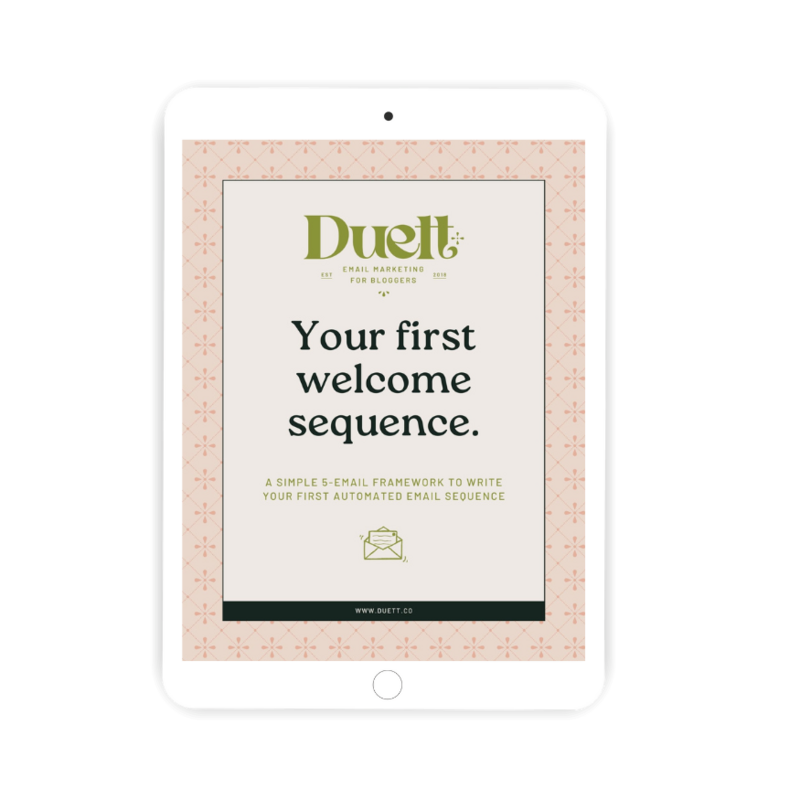
If you’re not welcoming new subscribers and pointing them in the direction of your best, most beloved content — or you feel like the one you have isn’t doing the trick — it’s time we fix that. Use this free 5-part framework to make a meaningful & lasting first impression as you write your first welcome sequence for new email subscribers!
Is Your Welcome Sequence Making a Lasting First Impression?