Oh hey there, I′m glad you're here!

Trust, Timing, and Email Touchpoints with Mike Nelson of Really Good Emails

Click here for transcript
Allea Grummert (00:12):
Hi there. Welcome to Happy Subscribers, a podcast that explores how bloggers and content creators can create more purposeful relationships with your audience through email marketing. I’m Ali Grimmert, email marketing strategist, copywriter, email platform expert and founder of the Dump for You email marketing agency, Duet. I started as a personal finance blogger in 2016 and have since helped hundreds of bloggers and creators like you maximize your email marketing for more impact, more traffic, and a better connection with your subscribers. Be prepared for some advanced email talk, as well as tactical tips to help get your valuable content into the hands of your audience faster and easier. I’m excited you’re here, so let’s do it. We can create a deeper, more meaningful connection with the community you love and serve through email.
(00:57):
Mike Nelson has done a lot, namely nearly 20 years of doing email. He grew his first company and sold it, got his MBA and started really good emails as a side project with Matthew Smith, who’s been on the podcast. Then he worked at Lonely Planet and a couple other companies running growth, taking them public and managing various divisions. Last year, Mike sold really good emails, but stayed on board full-time. He is a treasure trove of experience with email, and I’m excited today to get a small window, a small peek into everything he knows. Mike, thanks for joining us on Happy Subscribers.
Mike Nelson (01:33):
Thank you. I don’t think anyone’s ever called me a treasure trove before, so this is going to be fun. Let’s see what I can open up in the chest of treasures.
Allea Grummert (01:42):
I love it. Now that you mentioned it, it sounds like a ChatGPT thing, but that came from my soul. That came from my very own fingertips.
Mike Nelson (01:50):
What a trove looks like. What is a trove?
Allea Grummert (01:53):
I’m going to go with … I like the idea of the pirate’s chest. Yeah.
Mike Nelson (01:56):
Yeah, I can go and
Allea Grummert (01:57):
Check. I like that. It’s glittery. It’s got jewels inside.
Mike Nelson (02:03):
It’s got rainbows painted on the side.
Allea Grummert (02:06):
And when you open it, it glows.
Mike Nelson (02:08):
Worse, of course. Yeah.
Allea Grummert (02:10):
Naturally. Well, is there anything that I didn’t share on that you think would be helpful for listeners to know about you?
Mike Nelson (02:17):
No. I mean, you and I are both here in the Nashville area.
Allea Grummert (02:21):
Yeah, we are.
Mike Nelson (02:22):
Which we’ve never met in person, so I can’t wait until we actually do that. But I am also from West Coast. I grew up just outside of Park City, Salt Lake area, north of there. So the mountains call to me every winter. And so looking at this outside where we still … It’s cold, but there’s no snow and there’s no mountains, makes me sad. And then I lived all over, lived over in California, lived in Korea, lived in Arizona and Texas and here in Nashville now. But for travel, when I work at Loya Plant, I travel all over the world and love travel so much. So if anyone wants to shoot the breeze with me or travel recs and all that kind of stuff, we can spend some time doing that too. But email’s kind of the world I live in nowadays, but I’ve grown a lot of companies on monetizing websites and segmenting and trying to figure all that too.
(03:14):
So I think that’s where we’re going with this conversation, but we can talk about whatever you want. The
Allea Grummert (03:19):
Mystery is
Mike Nelson (03:19):
Aligned. I jam. It’s like not even 10 o’clock in the morning. I’ve got a can open.
Allea Grummert (03:25):
I’m on my second cup of coffee.
Mike Nelson (03:27):
Yeah. Okay. Okay.
Allea Grummert (03:28):
I’m jazzed and I’m at my standing desk. So just imagine how much activity could happen right now. I’m not confined to a chair. Well, tell people about really good emails because I’m familiar with it, but for those listening, really in the creator space, I don’t know if it’s really gotten out. And even in the food blogging space, what this resource is. And so I’d just love for you to share kind of whatever.
Mike Nelson (03:52):
Yeah, sure. So way back when, when starting with my first company, we grew it really heavily by email. And so I was out speaking at these conferences and people are asking like, “Hey, can you forward me the email that was on stage that you gave as an example?” And forwarding emails is great and all, but when you have HTML and all that kind of stuff, it kind of breaks sometimes. I don’t know if you forward an email, it’s like weird images don’t exist and it’s all … That doesn’t look good. Why would you use that? And so we created a website to essentially just put all those email examples on. And my first career was an SEO and PPC and email. So from an SEO perspective, really good emails is keyword heavy, like great domain. It’ll be searched a lot. It’ll be elevated. Went through with that.
(04:38):
And then off the races, it’s essentially just a Pinterest, if you will, for email marketers. So you can look at the code, you can look at the copy. There’s thousands and thousands upon examples of things we’ve curated. So it’s not like a full list of everything in your inbox we go through.
(04:56):
We accept only, I think it’s like 16% of all the emails are submitted now. And so you can submit now. So biggest brands down to the smallest brands you’ve never heard of, but there’s some element in there, which is like cool CTA or really cool copy or interesting examples or Black Friday. We’ve got them all. So hundreds of categories. We have over 400,000 registered users that just acquired last year. So yeah, it’s going, it’s fun.
Allea Grummert (05:25):
I love that. So can I sidebar, how do you monetize the site? Is it from ads or do you have other forms of revenue that come in from the site?
Mike Nelson (05:33):
Yeah. So in the past it was ads, events and a SaaS platform. So we use those three to diversify. So we’d have advertisers like MailChimp, who was our first advertiser, HubSpot, Constant Contact. Those companies come in and try to get people from our audience and have them make the emails that they’re like, “Oh, this is super cool. I want to build this. ” That kind of sound Italian to me for some reason. And it’s a meme about audio. I was like, Luigi is in the building. Yeah, you can do that too. And then, so that’s the advertiser. And then the SaaS was like, we have features that we blocked in case you want to give us money. And then we have events, which is called Unspam, which is our annual gathering of email Mecca. And you just go and you absorb all the good stuff that’s happening in email at the time and those three things.
(06:31):
And then when we got acquired, they’re like, “We don’t want to do much on the paid SaaS world. We want to make it all of it free.” So they took down all the gates and so now we just have advertising and events. That’s awesome. And so it’s really just more of a, what we make, we just put back into the community now.
Allea Grummert (06:50):
That’s great. What is your role now since the acquirement?
Mike Nelson (06:54):
Oh, I’m head of growth. So I run all of our growth team, trying to optimize those funnels and the flows and acquisition channels and churn and all that stuff.
Allea Grummert (07:08):
Yeah. That’s so fun. That’s the stuff where I wish I could just be a fly on the wall. I know so many people who’ve worked in growth and I’m like, “Can I just hang out? ” Apprentice just because I feel like … Well, I’ve always worked for small businesses, and so I feel like that leans more towards big business, having more resources and just seeing what you would do with that.
Mike Nelson (07:28):
I mean, kind of. I mean, our team’s pretty small. We only have six people on the team, but we have small business might only have six people in the whole company. So yeah, that might not work. But really good emails was a small company and I still kind of ran growth for really good emails, which was experiments, all sorts of stuff that we did there. So trying to make it more sticky, make it more attractive to Google Bots and constantly working on things on nights and weekends as a side gig.
Allea Grummert (07:58):
That’s so fun. Well, congrats on your acquirement. I actually don’t know the word I’m supposed to be using. That’s all that’s coming to my acquisition.
Mike Nelson (08:06):
But I love acquirements.
Allea Grummert (08:09):
I know. I’m just going to make up words on my own. Oh my gosh. Thank you, Mike.
Mike Nelson (08:16):
I’m cool with acquirement.
Allea Grummert (08:19):
It’s like when I watch Wicked and they just make up words, that’s what I just did. I’m just going to do whatever I want. Well, based off of … Oh my gosh, this is such a loaded question. Based off of what you know, what works with email, Mike?
Mike Nelson (08:35):
Oh my goodness. Take that as you will. Let’s dial this down. Talking about Shotgun approach. Oh my gosh.
Allea Grummert (08:44):
Well, we can narrow it down, especially because I mean, I work mostly in what emails get sent and what’s effective when it comes to an email marketing strategy once somebody’s on your list. Maybe we start there.
Mike Nelson (08:57):
Yeah. I mean, that’s a good place to start because emailing to people that aren’t on your list is also like can spam-
Allea Grummert (09:04):
Don’t do that.
Mike Nelson (09:05):
… legal style, like cold email where it’s probably going to burn your email reputation, IP reputation. So starting as like opted in is a great place to start, right? Yep. Based on the audience that we’re talking about today, which is like creators, right? These are the people that are running their own small publications and maybe other outlets to get their creativity out. Typically, you’re going to have an onboarding series, which is like, this is going to be the thing that sets the tone for the rest of your newsletter list. So if you’re funny, you got to put jokes in there from the beginning. If you are a serious person, I’m sorry, you probably won’t get any reads later on. I don’t know. That’s probably not true. It’ll still get me. You have values because there’s a reason they signed up.
Allea Grummert (09:59):
There has to be some sort of hook somewhere.
Mike Nelson (10:02):
There has to be a hook. There has to be a reason. And that first impression is like the thing. So if you ask and you always have to contain or contain, you want to always have a call to action so that people know what to do from that newsletter, from the first onboarding series, whatever it is, that it’s not just like, “Oh, cool. My name is Mike and hi,” and then you have nothing to do. You want to drive them back to the book you’re writing or the blog that you have, the recipe book you’re making, whatever it is. And that starts square one. So welcome series, and then you have a series, so it’s not just the first email. You want to have three to five touch points. And this is really important because over the course of somebody getting to know you, you need to have three to five touchpoints before they actually start to trust.
(10:51):
So trust is a really big part of marketing and Aaliyah and I, we’ve talked three times,
Mike Nelson (10:57):
We’re
Mike Nelson (10:57):
Already joking.
(10:59):
On that first meeting, I would’ve been pretty stiff, but by now we can make jokes about cats and all sorts of cool stuff. And so this onboarding series is really important to really set that trust and ask people to reply. I mean, it’s good to imagine that you’re so busy that you would never be able to reply, but actually the replies help your IP reputation, they help build that trust, build that one-to-one connection. And then you kind of move into more of a cadence. So like a newsletter cadence or a feature release cadence or marketing dates and activities and all that kind of stuff.
Allea Grummert (11:35):
Yes. I love that you kicked it off with onboarding because that’s what I do. And we haven’t known each other that long, but yeah, so that’s what we do. We do done for you welcome and nurture sequences for our clients. And one of the big questions I always get is people are like, “So are people getting your newsletter while getting your onboarding?” And I always say no. And those first three to five emails are where you’ve curated such an experience for someone, you really don’t want to distract them. I want you to be so proud of what those first three to five emails say that you’re like, “Nothing else should interrupt what’s happening here.” But I love hearing the stats behind the touch points. What are quality touchpoints? What does that look like?
Mike Nelson (12:23):
Oh-
Allea Grummert (12:24):
Or does it matter if it’s high quality, it’s just showing up in their inbox?
Mike Nelson (12:29):
I mean, you can go vanity metric style, right? So if you have a boss who’s like egocentric, this is great. You’re just like, “Hey, we got 65% open.” The only few people that open this email, that person is probably like, it’s usually a man, right? The egotistical man is like, “Oh, I’m so cool.” But from a vanity side, opens really don’t matter. And even today, clicks are kind of dropping down as the engagement score because there’s a lot of bot clicks in what’s happening today. So usually if you send to people at a large corporation, they might have a security screener that automatically goes and clicks on every link just to make sure that there’s not a fraudulent or a phishing scam or something. And so if you’re sending somebody with a big domain, big company, you can rule out those clicks pretty easily. And if you’re using an ESP that has human clicks versus bot clicks, it’s pretty easy because what human can click 65 links within two seconds, right?
(13:33):
Yeah. But from the other part of the engagement score is what they clicked on to what they actually did on your site. And that’s kind of the biggest engagement score that we use is traffic from the email to what your intended activity or action or event would be. So there’s a lot of event tracking, but if you’re using a simple blog or whatever it is, you can just look at your Google Analytics and it’ll tell you time on site or other things from your UTM sources and you can kind of gauge what that traffic’s doing, what other pages they visit, are they going through the checkout flow? So that’s like one big thing, but if you’re just trying to write and be funny and if your product is a newsletter or your product is content and that’s in emails your channel, then really getting reply rates and then you’re probably selling something because you don’t need to make money.
(14:26):
So it’s probably clicks to your advertisers or clicks to a course or transactions from the courses like that. So those are the kind of the elements. It just depends on what you’re trying to get
Allea Grummert (14:35):
From it. Man, I love that we’re busting out vanity metrics. We’re just like, “Get out of here.” Because that is such a … And I feel like I’ve just been in the game long enough that I just kind of don’t put a ton of stock in it, but I know our listeners are people who are like, “But I want my click rate to go up.” And it’s hard to know, especially we’re sending emails to tens, hundreds of thousands of people to visit your blog, but if some of those are bots or a lot of them maybe are in the education system, so you’ve got kind of firewalls checking everything and you’re like, “Cool, I have a minimum of 1800 clicks every time I send an email within a minute.” So that can kind of be discouraging, at least from the ESP’s vantage point, but you’re saying that if you set up correct UTMs and track that within Google Analytics, you’ll have a better picture?
Mike Nelson (15:27):
Yep. Yeah. You’ll be able to see what people are doing when they get to the activity. Or whatever your desired outcome is, the desired outcome should not be within the email. The desired outcome should be with outside the email so you can track it properly.
Allea Grummert (15:42):
Yeah, because you can, you can put a whole recipe in an email, but I’ve always said too, that’s not really the best experience for your subscriber. You want them on your site being able to look at the photos and images and the step by step and all of that. And then you get to earn the revenue from that page visit.
Mike Nelson (16:01):
If I were to put a recipe, first of all, it’s not going to be a good one because I don’t cook that well, or actually it might be a really good recipe, but then I wouldn’t be able to make it. But if it were in the email, my outcome I’d want to drive is probably social, like UGC. My subscriber made this recipe and then they posted about it. And so you can kind of back to the reply rate, it’d be like UGC posts based on what was contained inside there. So it’s harder to track and you’re probably going to have a lot fewer than what you’d expect, but that would be another thing you could track outside of the email itself.
Allea Grummert (16:37):
Yeah. Dear listener, UGC is user generated content. So having them share like, “I made the recipe and they posted on Instagram or something like that. ” That would be awesome. And you can still ask that, but that doesn’t … What Mike’s saying is it probably isn’t going to be your primary reason for sending an email, unless you’re running a campaign of sorts. Maybe you’re doing a giveaway for the number of folks who apply. Maybe they get a little something special or entered into a raffle or a giveaway. So that would be one strategy. Mike, in the creator space, I’ve been calling it just like email math, really it’s like in order to get more clicks to your site, so using that as the primary metric, you either need more subscribers, a quote unquote higher open rate and higher click rate, higher engagement with like a lower unsubscribed, there’s all these things, or you just send more emails too.
(17:35):
So what do you know about the correlation between sending more emails and perhaps ruining trust with subscribers? If that’s somebody’s hypothesis, what might you say?
Mike Nelson (17:48):
Yeah. I mean, this kind of goes down to segmenting. So I like to use the analogy of dating a lot in email. You start slow, you don’t want to ever go too fast. You want to text them … This is something like last week, somebody get arrested for texting somebody at 1200 times. I don’t know. I saw this, I may be fake, but it was like they met them on Tinder or something and then texted them 1200 times and then the person found them in their bedroom or something.
Allea Grummert (18:17):
I don’t know. Absolutely not. Unsubscribe.
Mike Nelson (18:19):
Unsubscribed. Don’t be that person. So you kind of want to do the same thing. If you’re sending email more than once a day, that’s weird, especially to a random stranger who just signed up for your newsletter. I can see that maybe around Black Friday we have a morning and possibly afternoon that’s still … But back in the day, that was like, okay, now it’s kind of egregious. So the frequency topic comes up a lot, which is like, can I send every day? Can I send …
(18:51):
Send every day is probably the maximum, but that you have to have really good content, really fresh content to make that work. So if you’re like a news aggregator, like the skim or the hustle that’s tracking the news, that might be a reason to do it. But if you’re probably a recipe person, unless you’re doing like, “Here’s your idea for tonight,” that could be on some work, but most likely people aren’t going to want maybe two to three max a week. So on the consumer side, which I worked in for a while in skincare, if you can tell I’m probably like 90 years old, but I look so much younger, we would send daily and the daily was mostly segmented. So I wouldn’t send to every single person every day. I would be like, “This is the people that buy this kind of skincare. These people buy this kind of cosmetic, this kind of people buy hair care.” And we kind of rotate because we don’t want to burn through the unsubscribes because if somebody’s just not opening over and over again, they’re going to just unswipe to subscribe faster.
(19:52):
So kind of have to tailor engagement with frequency and you can put people on different campaigns so they’re staged like, “Hey, this control group only gets two emails a week, this other group gets three emails a week or four emails a week.” And you kind of see what happens with the engagement based on those groups.
Allea Grummert (20:08):
I was just going to ask, how do we do it, Mike? How do we look and see? Because we’re marketers, which is always like test and see. And so that’s a really great way of doing it, of having a control group, creating two different segments or portions of your list and be able to track their engagement. I think that that’s my prediction for 2026 is that segmentation is going to play a much bigger role. We can’t just blast people with emails every day, but it’s hard because when you send an email and you see that traffic going to your site, you’re like, that’s literal money, but I think it’s also getting really harder to grow the list and that makes it even more important to keep the people on the list who you have.
Mike Nelson (20:51):
Okay. Let me push back a little bit. Why do you say it’s harder to grow a list
Allea Grummert (20:56):
Today? I’m seeing it across the board with creators whose list growth is stagnant. It’s happening big lists and small lists and so where their unsubscribes equal their new subscribers.
Mike Nelson (21:09):
Okay. The Delta is the Delta’s shrinking in terms of like new growth versus unsubscribes. Okay. So I can say that’s probably happening. I know we run our newsletter list or our list is about 280,000 people and I have seen unsubscribes kind of grow with Gmail adding some new features. Same with Apple, adding some new features to automatically unsubscribe. So you don’t have to go to the bottom of the footer anymore, you don’t have to put any information. It’s just like one click unsubscribe, which is great for a consumer. I think that’s awesome. And if they’re not getting value, give it to them, let them go. But I think from a acquisition perspective, it really comes down to your value and how people find you. So I think the original channels that people were looking at such as like Lincoln Bio. I think the Linkin Bio is not working that often anymore, but what is, is if you have another channel such as like a podcast or a website or something and you’re using popups or blatant like, “Hey, like Lee were on today, telling people to sign up for your newsletter in the conversation is a good way to boost from people who listen or watch on YouTube or whatever to drive them through.” I don’t know if you listen to the acquired podcast.
(22:35):
I don’t know if that’s one that you listen to. Nope. These guys can talk about really big companies and how they got acquired. And just recently they just started talking about their newsletter and like what you can get with your newsletter that’s outside of the podcast and their newsletter growth is starting to grow really quickly because they actually talk about it.
Allea Grummert (22:52):
Yes.
Mike Nelson (22:52):
So you have to show, you kind of have to tell what the value is outside of what the other channel is, but there are other ways to grow. Partnerships are a really big way. In this creator space, it’s usually like one creator versus another creator and they combine and they say, “Hey, we’re going to do a mashup and then we’ll join forces and then we’ll add more subscribers.” So I think there’s other ways to grow. Again, if the people aren’t getting the value, they’re going to unsubscribe. But I think there are, that’s why I want to push back because I still see a lot of people that are seeing growth in their newsletter or their email list.
Allea Grummert (23:25):
Yes. Thank you for pushing back. I’m not saying it’s impossible. This is something that I hear a lot from client leads, like people who are booking calls with me saying, and then this, like the value of needing to nurture and knowing probably in the back of their mind that they’re not doing a “a great job of that. ” And so I’m just hearing that a lot as a problem. Meanwhile, I’m friends with Ben at GRO and they have been just huge for list growth for a lot of creators. And so that’s where you see like comment recipe and it sends them to the website or it can send them send to email a request within the DM. And so there are lots of really great strategies there as well. But I think the idea of keeping your list happy, happy subscribers in order to make the most if you’ve worked so hard to get those subscribers, how do we give them a really good experience and not burn them out?
Mike Nelson (24:21):
Yeah. So what we talked about in the first call we ever had was about like the frequency and what frequency does. And we just talked about trust, right? So trust gets built off of frequency, it’s something called a mirror exposure effect in psychology. So if you see somewhere between six and eight impressions, so you’re walking through an aisle, there’s like a box of cereal there and you walk right past it. But when you walk past it eight or nine times, then it kind of sticks in your brain as like, oh, this is a trustworthy brand because I’ve seen it multiple times and stuck through multiple experiences over time. And so you’re trying to do the same thing with your email. Your email’s like the branding moment. Even if you aren’t driving sales from it, it will drive sales later. So you can have an impressionable email today or during April fools or like you’re not even calling people to go buy something.
(25:11):
It’s just like memorable in some way. And then that puts you in a consideration set. So typically people only fit like three to five brands in their brain at a moment. And so it’s like, “Hey, what’s your favorite chocolate?” You can be like, “Oh, M&Ms and K-Kat.” And you can probably list more, but what’s the top one that comes to your mind, Leah? What’s your favorite chocolate?
Allea Grummert (25:30):
I mean peanut butter M&Ms.
Mike Nelson (25:32):
Peep butter MMs. Okay. Yeah. Hands down, the best ever, right? Part of
Allea Grummert (25:35):
The best. Real quick, I was at a friend’s house and I was like, “Is that a jar of a glass bowl of peanut butter M&Ms?” She goes, “Yeah, and they’re
Mike Nelson (25:45):
Warm.” What?
Allea Grummert (25:46):
They warmed it up in the microwave, Mike. I was just taking it to the next level. I know someone’s holding them in their hands all day long. No, they warmed them up because you know how you have cold peanut butter cups, but then warm peanut butter M&Ms. I was like, “I’m sorry. Has my life just been altered in front of your face?” Absolutely.
Mike Nelson (26:06):
Continue. So of course that’s going to be top of your list right now. That just happened over Thanksgiving?
Allea Grummert (26:10):
Yes. Okay.
Mike Nelson (26:11):
So frequency, mirror exposure effect right here, right now. Something just barely happened, has elevated that brand to top of your consideration set. 100%. First comes to mind. So email does the same thing. Even if they don’t open it, they’re going to see you in the subject or in the from name. So they’ll be like, “Oh, Mike’s sending me an email again.”
(26:29):
And so again, you don’t want to email every day, but if you do this two to three times a week, it keeps you in that consideration set and it grows the trust. So when they do open it, they’re like, “Oh yeah, I’ve seen this brand before.” Then you can have that UGC we talked about, which it grows trust as well. There’s all sorts of things. But yeah, that is a big component of why email works and continues to work and why it hasn’t died off yet is because it allows people to build the trust with your brand.
Allea Grummert (26:55):
Thank you for sharing that. I wonder, the next question that comes to mind is something around consistency. How do we as marketers create good motivation knowing that it could be a longer sales cycle, that we’re sending out these feel good emails and not necessarily seeing returns right away?
Mike Nelson (27:20):
Well, man, this is another consumer psychology concept called reciprocity. So it’s like, I’m going to do something for you and in return, eventually you might do something for me. So I’m giving you value. I’m going to give you value. I’m going to give you value. Oh, would you like to click through and just look at this for a second? And they’re like, oh yeah, I can do that. You’ve done enough for me that I’m willing to do that for you. And in the creator spaces is really strong because there’s a lot of content that you’re giving inspiration and entertainment and you’re doing this week after week after week and yeah, you might be making money off of your advertisers, but then you hit them with an ask and it’s like, “Hey, I want you to buy my book, or I want you to buy my course, or I want you to go over to this partner where I can affiliate commission and buy that cool thing too.” And so you give and give and give for the one moment that you want to take, not take, but you want for them to give to you.
(28:12):
And so consistency is really important in that sense because you want to continually give value. So this is where a newsletter is really important. A newsletter’s perspective is really the branding and consistency and value driven event. Every week, you’re providing really value for no return. It’s like, here’s the cool thing you should look at. And it should never be like, “We did this this week.” Oh, I was at this conference or look at who I met. It should be like, “This is what you will learn because I went to this conference or this is who you should know because I met them last week.” So it’s really give, give, give, and then eventually you can take. So every week, send a newsletter, build that consistency, build that value.
Allea Grummert (28:54):
Oh, I have so many more questions, Mike, just my brain is. Okay. So because I see this a lot with in the creator space, people are really honed in on the number of clicks to their website. How do we disentangle the performance of email, having a direct ROI versus being part of the whole brand, keeping in mind that it’s not a cheap platform necessarily to keep in your tech stack as well.
Mike Nelson (29:28):
I
Allea Grummert (29:28):
Know there’s an anxiousness around making sure that email is used in a way that it’s quote unquote worth it. What would you say to that?
Mike Nelson (29:36):
Yeah, I mean, especially if you’re texting too. Text can get really expensive for … You want them to make an action if you’re doing that. Email itself, depending on who your ESP is, you can probably get some good deals if you have less than 2000, 5,000 subscribers. Once you get over that threshold, again, every time you send them is probably a little bit of money taken out of your bank account, hoping that you’ll get it back someday. Right. And so this is the concept of the brand marketer versus a performance marketer.You put them in a room and the brand marketer’s like, “Well, here’s our logo and this is the feelings we give you. ” And the emotion people will feel when they read this, it’s great. And then the preference marketer is like, “Cool, but that doesn’t make us money.” But really they do. You just have long-term strategy versus short-term strategy.
(30:23):
So the brand marketer is really kind of looking at if I do this today, what’s my outcome in three, six months? The performance marketer is like, “If I can get this click, can I get the conversion?” They’re both equally important, but you have to create a content calendar where you just give value. I don’t know. You’re working with content calendars, I’m guessing. Oh
Allea Grummert (30:42):
Yeah. Yeah. I’ve got a free one. Guys, I’ve got a free one. Okay, nice plug. Yeah, I think it’s at duet.co/happy. You can find it there. Free content calendar. Hey, if you enjoy what you’re listening to and want even more of this, go to duet.co/happy for a few different free resources. And while you’re there, you can also join my email list, which is where I share so much valuable content that you really cannot get anywhere else. Plus you can reply back at any time to any email and it will go to my inbox. And if you’re curious about Duet and our services and how we work with clients, you’ll find links to that there as well. Go to duet.co/happy and I’ll include the link in the show notes so that you can grab more. Go for it. So
Mike Nelson (31:30):
You have your content calendar and on your content calendar, you put in reasons like we’re going to talk about my cat or we’re going to talk about something fun. It doesn’t always have to be, just give insight of who you are. If people are following you, if you’re a creator on YouTube or Instagram, they’re going to have a better insight of your behind the scenes kind of view because creators are really good at that, whereas brand corporations really suck at that kind of stuff. And so this is an element that you can kind of bring in some more personality and really mesh with the reader. You want them to laugh, you want them to understand who you are. That’s the concept so that when you ask them in the future, it’s a stronger ask. So if you constantly ask, ask, ask, it’s going to diminish your returns.
(32:15):
So what you’re doing is you’re building up the bank of reciprocity with that continual brand marketing versus your performance marketing.
Allea Grummert (32:26):
How often can you ask?
Mike Nelson (32:28):
Depends on how big the ask is. So if I want somebody to get a $6,000 course, there’s got to be a lot of value that’s built up or a lot of pain and urgency within the individual that they have to be willing to strike when the iron’s hot. So that’s, again, a Mr. Beast could probably get that pretty easily because he’s somebody who’s just, give, give cool, cool, cool. Oh, do you want 10 million people to follow you within the first week? This is my playbook. And then it’s only going to cost $10,000. I bet you people would pay for it. That’s true. But if you have 5,000 followers, no one’s going to pay for a course like that. So it’s really, you have to prove who you are. So that’s a lot of the UGC stuff. You need to have a team or a … It’s not a vibe.
(33:21):
I hate that word. It’s like you got to have this vibe, but you got to be able to show that you’re worth what you’re selling for. So for us, our biggest thing we ask people to do is unspam, which is our annual conference
(33:35):
And conference tickets go anywhere between 500 and $700. So it’s not super cheap, but it’s also a conference. And then they have to pay for flights and they have to pay for hotels. So they’re like somewhere in the $1,500 range to do this thing. And so we only ask them, we build, build, build, and then we start asking them at the end of the year and we do it for two months and we always sell out. But most of the year it’s to build them up to like, “Don’t you want to come to this thing where we talk about email?” All the things we talked about in this email, we’re going to do it on stage, but with cooler people that aren’t full of themself like I am. And so we kind of are cheeky and we’re fun, but that’s essentially building up to that pain point.
(34:17):
But we have little things here and there like, “Oh, you can buy this thing from our partner or you can … Our parent company has got this Black Friday sale going on. So we’ll link to that. ” And if someone’s interested, they might click through, but that’s not the main ask.
Allea Grummert (34:29):
Yeah. What about the argument for low hanging fruit? I ask for my own newsletter, mentioning, you can book a call with me. Is that a hard ask? Or is that going to deteriorate trust by making sure that that’s in every other email?
Mike Nelson (34:47):
Depends on if you are … So we see this a lot in the SaaS B2B space where they’re like, “You’re on my newsletter, so book a call.” And it’s just like, “What have you proven to me that you can do and what’s the pain point you’re trying to solve for? ” So if you haven’t done that, if you’re like, “Hi, I’m Mike, book a call of me. ” And it’s like, why? What are we going to talk about? What’s the thing you’re going to sell for me? Why is that urgent? So you really have to hit what are those pain points until you can ask to book something. And so I wouldn’t put it in every single email. I’d be very strategic in the emails, but you always want to have a link back to reply if you have any questions or here’s a link to my Twitter account or whatever it is.
(35:33):
Twitter.
Allea Grummert (35:35):
I’m a threads girly. Find me on threads. Sign me on threads.
Mike Nelson (35:44):
I mean, you can, you can put it in every email, but it’s not going to have as much impact unless you really show the user or the reader what they’re solving for and what you can solve for them.
Allea Grummert (35:56):
Yeah. Well, and I’ve been coached for this too of not just saying book a call with me, but what’s the reason? Is it because it’s the end of the year and you’re making plans for 2026 and you want to get your email figured out, then that gives more of a reason to suggest booking a call versus like, “How are you feeling about it now?”
Mike Nelson (36:15):
Yeah.
Allea Grummert (36:15):
“Book a call to chat.” Awesome. And
Mike Nelson (36:18):
Actually for you,
Allea Grummert (36:20):
Because
Mike Nelson (36:20):
You’ve been welcome onboarding, all that kind of stuff, right? So the biggest subscriber gains happen in Q4 because a lot of people are purchasing things or trying to figure out what they’re going to buy, looking at influencers to figure out what can they do, whatever. And so after that transaction happens or that initial thing, this is the good period. They came, they bought, now what do you do with them? Whereas summertime is kind of like, they might read, they might not read, but this is like they’re reading for a purpose
(36:52):
And they have really time between now and January 28th, which is like return period and actually buy something better to really gain on that onboarding and that welcome series to make it hone and perfect. So I tell people, start working on your welcome series in September because you’re going to ramp up in October, November. And so you want to actually understand what’s going on. After people come home from the summer break, you have a month to two months of testing in there and then you continue to hone in and experiment during the holidays. And then that way next year is really strong with your welcome series.
Allea Grummert (37:27):
I love it. I love it a lot. Kind of going back to this idea of the brand marketer versus performance marketer, what would feel like a more appropriate rubric of KPIs if someone’s like, “How do I kind of map this out so that I don’t get so in the weeds that it’s discouraging or that I’m self-sabotaging?”
Mike Nelson (37:53):
Yeah. What’s
Allea Grummert (37:54):
Possible with my list?
Mike Nelson (37:56):
The three that I find best for creators is reply rate that again, there’s multiple reasons why that’s good. It helps your IP reputation. So it hits the inbox more often. If you’ve got this one-on-one relationship with somebody, it’s going to make sure it hits the inbox versus the other boxes, other categories, like promotional tabs or whatever. But that also it tells … So what you’re doing is you’re telling the inbox server like Gmail or Yahoo or whatever, that this is a reputable company. So it actually helps your sense in the future
Mike Nelson (38:33):
For
Mike Nelson (38:33):
People who don’t reply. So that’s a big one is like, “Hey, get as many replies as possible.” Even from that first welcome email like, “Tell me about yourself or what are you trying to get out of this? ” Or, “How can I help you? ” Or, “Tell me a joke.” Something like that. And just get those replies, tell me proof of life, give me a proof of life that you’re a real person. And then that way, so that’s number one. The other one is click to open rate. So of the people who open, how many clicked? And I wouldn’t look at this every single day. I look at this as an average over time. So if you’re sending within three weeks and then you see a huge spike or a huge drop, then you might know, oh, something clicked with somebody or that was really a big flop email.
(39:15):
So then you can learn from those things. But if you’re looking at every day and you’re like, oh, I increased by 0.8%, that’s also probably could be fluctuating by ClickBot or something. So you’re really looking for spikes here and there. So that’d be number two and then conversion rate offsite. So it’s like how many people drove, did you drive from the email to do the thing that you wanted either whatever you’re selling or whatever partnership you’re promoting?
Allea Grummert (39:41):
I love it. Oh, man. I’ve already kept you so long, Mike. I promise you we’d be done by notes, but there’s just so much good stuff here. Thank you for sharing it. If you had advice, I know you do, it’s in there. What’s one or two key strategies that our listeners could take away to consider or implement for themselves?
Mike Nelson (40:09):
I’m going to return that and say, what are the one or two things that you hear the most about
Allea Grummert (40:15):
When
Mike Nelson (40:15):
They ask you and then let’s riff on that?
Allea Grummert (40:19):
A lot of it is how often can I send emails?
Mike Nelson (40:22):
Okay.
Allea Grummert (40:23):
And so I already kind of know my answer to that and you’ve answered it as well. The other is retaining subscribers. That’s what I’m hearing at least the most pressing at the moment.
Mike Nelson (40:36):
Retention’s a big thing because if you churn, if there’s higher churn, you’re never going to … There’s like a rate of, if you lose less or more than 5% of your readership and you’re not gaining double that per month, you will essentially degrade or within six months. Your list will just continue going down and down. So really proving the value and having that. So I see emails in an entertainment factor. It’s much like social media. People are going to open it. Sometimes I’ll open it for a good deal during Black Friday or during President’s Day weekend or something like that. And that’s more of the consumer side. But for creators, it’s really long form. Are they going to enjoy the read? Are they going to resonate with it?
(41:23):
And so to me, the most important part of getting retention is actually proving that you’re going to hit that out over and over and over again. So there’s a lot of planning. You have your content calendar, you got writers, you got editors. So I’ve been writing our newsletter twice a week for 10 years. When we started, it sucked. I didn’t know what I was doing. I was just like an early marketer thinking I was funny. I offended a lot of people in the process during jokes that I thought were funny that clearly were not. Clearly. No. Or made mistakes by just being naive to the world. But you learn, you do it and you learn and you say, “Okay, that was not great.” And you kind of go on. But by the time you’re in a role of a couple months in to a year in, you kind of understand this hits well with my readers, either the format or the length or the images and people are getting pretty close to like, “Oh, that was just AI generated.” And
(42:23):
We could spend hours on M Dashes and I was a grammar nerd and English person and I love the M Dash and now I can’t use it ever again. I love the M Dash RAP to the M Dash. But the funny thing is when I read somebody else’s that I know has been in marketing for a long time or has been a good writer and I see it in M Dash, I’m like, “What? Why did they put this through ChatGPT? Why did they just put an effort in? ” And then I’m like, “Oh, actually I use M Dash.” So people are probably doing that for me. Anyways, they’re going to want to see this personality. So personality is really hard to emulate through a ChatGPT, your Chatty Kathy GBT that we were talking about earlier.
Allea Grummert (43:01):
She’s terrible at writing.
Mike Nelson (43:03):
I’ve actually trained mine to do a pretty good job in giving me good feedback on my writing, but then I have to go back. So I spend probably between three and four hours writing my newsletter for each newsletter. So I spend six to eight hours a week writing my two newsletters. They go out. And again, it’s really to drive that value to be memorable and give people the things. So we do a lot of giveaways, we do things like that just to keep them entertained and the value there so they don’t unsubscribe because eventually they’ll get something out of
Allea Grummert (43:36):
It. Yes. I love that idea of spending more quality time on the content that we are sending, just based on everything we’ve talked about too, as far as like if you’re sending fewer emails, spend more time on the emails that you are sending to be more intentional. And some of the intention behind that too is thinking through your subject line, like don’t just go with the first thing that comes to your mind, write down 10 and then pick one. But a lot of times we don’t, email tends to be this aside of like, “Oh, and whatever, and I need to send an email.” So you just kind of hit fend on whatever, but you can have a lot more intentionality around the subject line, preview text, and most importantly, the segment that the audience, who receives this email and who doesn’t, is also just another layer of thought versus just hitting send to all subscribers.
Mike Nelson (44:25):
Yeah. I mean, when I started at Lonely Planet, the mind was, oh, and then we have the email.
Mike Nelson (44:31):
Yes. But if
Mike Nelson (44:32):
You think about it, we had over two million subscribers. Those are people that would purchase from us frequently. They already knew the brand. And so we essentially changed our thought of, let’s start with email because that’s a segment that knows us the best. And then we go to banner emails and then we go to social and then we go, because those are people who don’t know us.
(44:52):
And so the fun thing is like, well, what if we did this huge splash billboard on the freeway and you’re like, yeah, from a creative environment that’s cool to think up and joke around with, but really that your own segmented users or purchasers or readers, they’re the ones who should be thought of first. So segmenting for those readers first and then everybody else should be second because those are the people you can get the most value out of. So I hate it when I hear emails like an add-on where you’re like, no, emails, you own this channel. So Google search rankings aren’t going to change. Your Instagram feed isn’t going to change. You own this channel. So anything you send to them is going to hit the inbox as long as you built up the reputation versus like Facebook now or LinkedIn making you pay up to get more reach or all that kind of stuff.
(45:41):
This is one thing that you own and that you can drive home.
Allea Grummert (45:45):
Yes. Here, here. A good
Mike Nelson (45:49):
Place to end?
Allea Grummert (45:50):
I think so. I do want to make sure that if anybody wants to follow along with what you’re doing, Mike, where can they find you? Where can they connect with you? Where can they find you?
Mike Nelson (46:01):
Sign up for the newsletter. It’ll be a popup or you go slash subscribe, really good emails.com/subscribe or you can look me up at Mike Nelson on LinkedIn. There’s only one of me in the whole world, there’s only one Mike Nelson. It’s such an uncommon name. Just like Mike Nelson, really good emails, I’ll show up at the top, but hopefully I’ll show up at the top. Maybe there’s another Mike Nelson really good email, so we’ll find out. But yeah, that’s me.
Allea Grummert (46:26):
Awesome. Well, we’ll include a link to really good emails and your LinkedIn so people can find you directly. We’ll put that in the show notes. Mike, thank you so much for your time.
Mike Nelson (46:36):
No,
Mike Nelson (46:37):
Thank you. This has been
Allea Grummert (46:37):
Fun. I appreciate it so much. I appreciate you being on the show.
Mike Nelson (46:41):
I appreciate you having me on the phone show. We just had Thanksgiving. I’m trying to be … Gratitude’s a really big thing. Right now, people are going through a lot of stuff in their life. They may have just had a fight with their family members over turkey dinner. Just be grateful you’re alive. You hopefully have a job. You have a reason to send emails to people, all that good stuff. So grateful for the time we spent today.
Allea Grummert (47:05):
Awesome. Thanks so much, Mike. We’ll talk later. Bye.
(47:12):
If you are interested in getting my help to grow your email list, send traffic back to your website and create a more meaningful relationship with your subscribers through email marketing, visit duet.co/happy to book a free call with me. I promise you’ll learn a lot even in the process just about your own business, your own goals, and what could potentially be next for you and the growth of your email marketing strategy. Go ahead and book a call with me. I can’t wait to meet you. Thanks so much for listening to Happy Subscribers and our conversation about email marketing today. I hope you feel inspired to take action even if it’s a small change so you can more confidently share your valuable message with your community through email. Special thanks goes to my team who makes it possible to produce and share these episodes with you. Seriously, thank you guys.
(48:11):
If you want to hear more email marketing tips, strategies, and success stories to help you develop deeper more meaningful relationships with your email subscribers, be sure to subscribe to Happy Subscribers so you don’t miss an episode. If you have a few seconds, I invite you to share this episode link with a friend or post it on social media so your peers and community can benefit from it as well. And if you have a few minutes, I’d appreciate if you’d leave a written review of the podcast since that helps more people hear about it and I believe we need more creators sending more valuable emails to their audience with more confidence. If you want to reach out to me directly, the best way to do that is to join my email list through one of my top freebies listed in the show notes. You’ll get regular emails from me that are packed with value.
(48:51):
And if you hit reply to any of those emails, it’ll land in my inbox and I can’t wait to chat with you there. Until next time, let’s do it.
Episode Summary:

This is officially a must-listen interview on the podcast.
Mike Nelson — co-founder of Really Good Emails — has nearly two decades of email experience (the kind I seriously envy). In this episode, we cover so much good stuff, including:
- How many touches (aka emails) it really takes to build trust with new subscribers
- The KPIs that actually matter when measuring email success
- The highly underrated engagement metric you can automate
- The psychology behind effective email marketing — from the “mere exposure effect” to “reciprocity” — and why sending more emails or asking for more sales isn’t always the best long-term strategy
Mike brings a rare mix of data-driven insight, years of email experience, and creative empathy to the conversation — converting them into clear, actionable takeaways for creators like us — about what matters, what doesn’t, and how to send really good emails that resonate.
About Mike

“I’m coming up on 20 years doing email. I fell into it at my first company (I was originally hired to do SEO and paid ads) and grew it to become our largest revenue channel, which propelled us into the INC 500 list. We sold that company to a private equity firm who ruined everything we built, so I went back to school to get an international MBA and started ReallyGoodEmails.com as a side project with Matthew Smith (which has been on the podcast too). When I graduated, I landed at Lonely Planet running global ecommerce and growth. That was all fun until COVID, when I joined a company called VTEX and helped take it public – and then onto a major publisher named VerticalScope, where I ran their sports and entertainment division. Last year, we sold RGE to Growens, and I joined them full-time as part of the sale. That’s my life story.”
CONNECT WITH MIKE:
Really Good Emails
LinkedIn
EPISODE RESOURCES:
Duett Content Calendar Airtable Template
Join the Duett Newsletter

Subscribe & leave a review!
If you enjoyed this episode, you can show your support by leaving a review, subscribing, or sharing your biggest takeaways on your Instagram story! Just remember to tag me @alleagrummert so I can see it.
Subscribe on Apple Podcasts or Spotify

About Allea

Allea Grummert is an email marketing strategist, copywriter and tech expert who helps bloggers and content creators make a lasting first impression through automated welcome & nurture sequences. She helps her clients build intentional email strategies that engage readers, build brand loyalty and optimize conversions for sales and site traffic.
Allea is the host of the Happy Subscribers podcast, holds the coveted spot as the email marketing industry expert for the Food Blogger Pro membership community, is a Recommended Expert through NerdPress, a trusted Mediavine partner and recognized as a Kit Approved Expert.

Looking for more ways I can help you?
If your a blogger or content creator and today’s episode sparked ideas for your email marketing strategy, let’s chat! Click here to book a free 15-minute strategy call.
Think of it as a quick strategy boost — we’ll talk about the #1 thing for you to focus on moving forward so you’ll walk away with clarity on where to put your attention to make the biggest impact for your business.

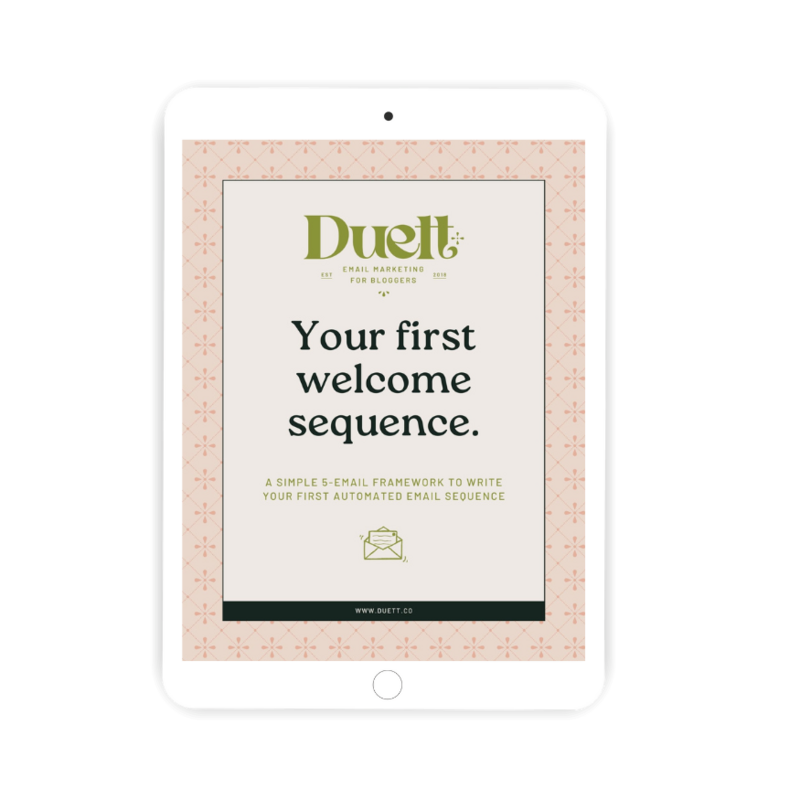
If you’re not welcoming new subscribers and pointing them in the direction of your best, most beloved content — or you feel like the one you have isn’t doing the trick — it’s time we fix that. Use this free 5-part framework to make a meaningful & lasting first impression as you write your first welcome sequence for new email subscribers!
Is Your Welcome Sequence Making a Lasting First Impression?