Oh hey there, I′m glad you're here!

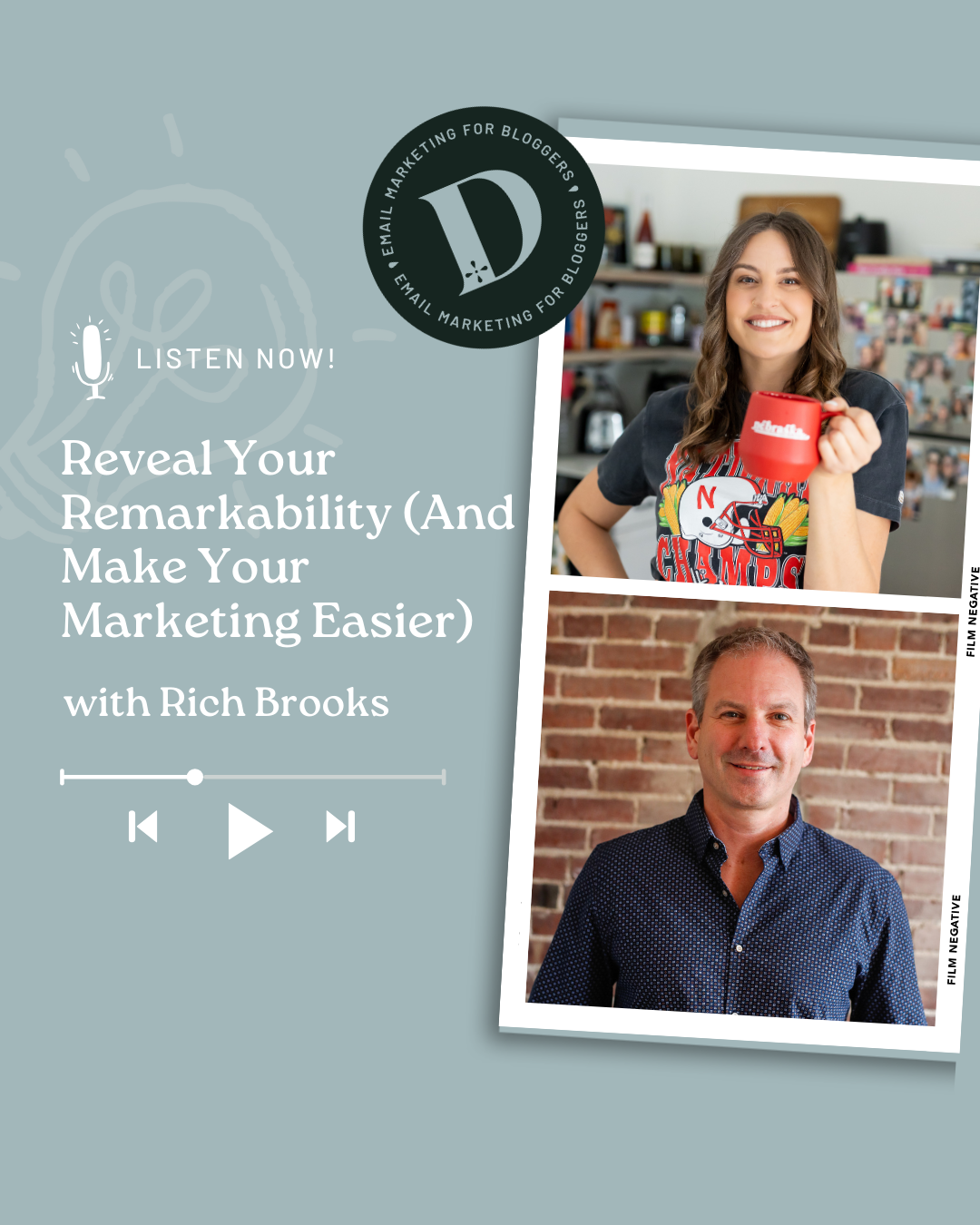
Reveal Your Remarkability (And Make Your Marketing Easier) with Rich Brooks

Click here for transcript
Allea Grummert (00:12):
Be there. Welcome to Happy Subscribers, a podcast that explores how bloggers and content creators can create more purposeful relationships with your audience through email marketing. I’m Allie Grimer, email marketing strategist, copywriter, email platform expert and founder of the For You email marketing agency duet. I started as a personal finance blogger in 2016 and have since helped hundreds of bloggers and creators like you maximize your email marketing for more impact, more traffic, and a better connection with your subscribers. Be prepared for some advanced email talk as well as tactical tips to help get your valuable content into the hands of your audience faster and easier. I’m excited you’re here, so let’s do it. We can create a deeper, more meaningful connection with the community you love and serve through email.
(00:56):
If you’re curious about duet and our services and how we work with clients, go to duet.co/happy for a few different free resources. And while you’re there, you can also join my email list, which is where I share so much valuable content that you really cannot get anywhere else. Plus you can reply back at any time to any email, and it will go to my inbox as well. Go to duet.co/happy and I’ll include the link in the show notes so that you can grab more. I met Rich Brooks at CEX, the Content Entrepreneur Expo in Cleveland last August, and unfortunately while the conference itself is shutting down, we met just in time. So today I want to introduce you to Rich. He is the founder and president of Flight New Media, a digital agency in Portland, Maine that’s been in business for over 28 years. They’re in their 29th year, and he has a nationally recognized speaker on entrepreneurship, digital marketing, and social media.
(01:57):
He’s the founder of Agents of Change, an annual conference and weekly podcast that focuses on search, social and mobile marketing. The Agents of Change, which will into the show notes as well, which is also the author of the Lead Machine, the Small Business Guide to Digital Marketing, a popular and well received book that helps entrepreneurs and marketers reach more of their ideal customers online, which is what we love and we want more of. So he regularly also appears as the Tech Guer in the evening news, which is so flipping cool. So it’s the News Show 2 0 7, which airs on the NBC affiliates in Maine. He’s also been in Inc. Magazine, the Huffington Post Fast company.com, so many other new sources and he’s here with us today. Hi Rich.
Rich Brooks (02:40):
How you doing, Allie? I love the enthusiasm. That’s fantastic. I appreciate it.
Allea Grummert (02:44):
Yeah, well, I love getting to hype you up. It’s not quite the same as the New Heights podcast. They do a lot more screaming, but man, I’m just excited. No, okay, good. Neither do I. It’s Monday morning, my cat is sleeping. So just really excited to have you here and to have your 29 years of experience on the show. Well, I shared with everyone that you run an agency, but can I get any more context or backstory of who are the types of clients you’re serving and work through with your agency?
Rich Brooks (03:14):
Sure. So our primary offerings fall into branding, web design and digital marketing. And we work with small to medium sized businesses on the low end. We have some solopreneurs we work with. We’ve also worked with major corporations, although usually just within a specific department within their offerings, and we tend to have long-term relationships with a lot of our clients. We just launched the fifth iteration of one client’s website who’s been with us almost since the beginning. So that’s always exciting when you have those kind of relationships that last that long and like everybody else, we’re finding that our roles and jobs are changing because of artificial intelligence, and so we’re in the process of adapting to that as well. So that’s pretty exciting and terrifying all at the same time.
Allea Grummert (04:01):
Yeah, well, I love that you work in branding and websites. That was actually my first marketing job in college, was working for a small business in Lincoln, Nebraska that served other small businesses through some really amazing branding. And I did the admin. I was just there to watch these creators create, so that’s awesome.
Rich Brooks (04:20):
I often joke that I’m the guy who makes the coffee for all the talented people in the company. And then years ago I bought a Keurig, so now I don’t even have that job anymore.
Allea Grummert (04:30):
That’s fantastic. That was me when I worked in video production as well. That’s kind of been my role at the two jobs I had after college was the coffee maker and coffee pot cleanup person at the end of the day and do it all over again the next day. Well, I’m excited because you and I had talked before coming onto the show today, something about being able to differentiate ourselves online, which I know I’ve talked about almost ad naum on the podcast about just with ai, especially having this defin ability of who you are, but also I have a friend who’s wanting to start a consulting business and I’m over here, you have to be known for one thing. First. I read the book, book yourself, solid 2018, something like that. And I’ve basically run with the same two principles that I read in the book because I only read the first two chapters just about be known for one thing and then just be really good at that and then eventually you can branch out. But tell me about how this has come up for you and your clients and why it’s even something that they need.
Rich Brooks (05:38):
Yeah, I am not a branding expert, but one of the things that I noticed is we were working with clients and when I first started, I was just the guy building websites for people before I really started hiring people and we started expanding our services, and I just noticed that a lot of people seem to have no idea about why we should buy from them, what do they offer? And I remember just as an example, I remember we got this job with working with a cheese company and they gave themselves a name. I don’t think they’re in existence anymore. I won’t say what it is, but their name was, let’s say main centric lobster cheese. It was not lobster cheese. And I was saying to them, oh, so do you make your own cheese? No, we don’t make our own cheese. We get it through Vermont.
(06:22):
I’m like, oh, well do you do this? We do that. They had nothing that differentiated themselves. Basically they bought cheese and they put it in the, not even in the shape of let’s call it a lobster, they literally just put their name on the box and sent it off. And as you can imagine, as a marketing company that was very hard to market that why would you care about a company that made that product? There was nothing interesting about it, and that was part of my evolution and understanding that you really had to understand that you need to stand out, you need to, like you were saying, you need to find that thing that differentiates you from everybody else. And one of the things that I started working on, it’s funny that you mentioned Book Yourself Solid, because I believe that was Michael Port’s big first book.
(07:05):
And during COVID, I ended up taking the Heroic Public Speakers course with Michael and his wife Amy, and having to develop a new piece of IP that was basically term one. And that’s where I started sitting down and saying, how do I take this idea that it’s not just about sending out emails, it’s not just about doing Google Ads, it’s not just about you have to have something interesting that people can latch onto because anybody can send an email, anybody can do Google Ads, anybody can. So it’s like what makes you different? And I had a couple of interesting stories that I had in my portfolio, either I had heard or we had worked on that kind of came up with this. And I sat down through this whole process of developing this new IP and realize that from my standards I could put them into four categories, four ways that people could differentiate themselves and their brand so they could stand out online and really mean something to their clients. And it ended up being that as I kind of had all these sticky notes up on the wall and they ended up in four quadrants and I came up with what I called ultimately these four lenses, the Remarkability formulas, four lenses that anybody solopreneur up to a giant corporation can use to identify what either already makes them. My word is remarkable,
(08:24):
What already makes them remarkable or what they can do to become remarkable. Sometimes it’s just a few steps away that they can do. And those four lenses I named Find, focus, forge, and Frame, and just before we dive into each one, so find is the idea that there’s probably something already remarkable in your business and it’s really up to you to identify and name it focus is the idea of niching down. Forge is one that a lot people struggle with is the idea of creating something that you’re not actually selling per se. It’s kind of outside of your offerings, but helps differentiate you nonetheless. And I’ve got some examples for that too. And then there’s Frame, which is really about reframing what you’re already doing so that your ideal client understands your value compared to everybody else. So find, focus, forge, and Frame, and happy to talk about it. And any sort of examples or how we might apply that to email marketing so that we can stand out online.
Allea Grummert (09:27):
I want all of it, all of the above, right? Okay. Alright. Yes, I mean because I’ve been exploring some about personal branding, but this is, especially when I think of the clients that I work with mostly in the food blogging space, they are such personal brands. So it’s interesting because thinking about the cheese company, it’s like the opposite of that. You have people who are like, I started in my kitchen, I have grandma’s recipes. They have these origin stories that are so sexy for marketers where like, oh my goodness, go tell everyone about it because that is your story and nobody can take that away from you. But we’ve kind of got the other lens of it too where maybe people have diminished their own belief in their own story and kind of allow this kind of cast of just, I don’t know, just playing it safe, not using bits of their story. So tell me more about what this find would be.
Rich Brooks (10:22):
Yeah, so and it’s interesting, there’s a number of ways that you can look at this. And one is people. And by people I mean it could be the people on your team, it could be yourself, it could be your story that kind of informs who you are and why you’re doing what you are. And we are attracted to the why. And so this is not the story I was going to share, but I think about when when you’re buying a piece of jewelry for a loved one, you can go to the mall and go to day’s jewelry or whatever, the local, not the local, but the big brand is for jewelry and buy a generic piece of jewelry and it’s worth a value and you buy it and you give it and that’s it. You can also go down to a local artisan store and find a piece of jewelry that really speaks to you, that spoke to the very often in these kind of shops.
(11:10):
They’ll tell you the story behind why they made this design that looks like some seagulls and something like that. When you give that gift, not only are you giving the gift, you’re also giving that story if you’re doing it right at least, and you explain why you bought it for the person and the story behind it, and it becomes so much more meaningful for the recipient. And to use your example of what you were just saying about these people who had the recipe from their grandmother, that’s something I can buy cheese anywhere, but if I have this story that I can tell whether it’s cheese or soap or whatever it is, if I’m gifting, it means more to the person receiving it. And even if it’s something that I’m doing for myself, it also means more there’s something behind it. And I keep on reminding people because I’m huge into ai, I love ai, but I keep on saying we can’t be AI first companies.
(11:59):
We have to be human first companies. And I think that we really need to put ourselves and our story out there. It will not resonate with everybody, and that’s the best thing that could possibly happen because we don’t want everybody to our stuff, we want the right people to our stuff. And that kind of gets more into focus. So I won’t go too deep into that. But the idea of find is if you have been in business for any length of time, you probably have some loyal customers, loyal clients. I would start just by interviewing them and asking them, why did you hire us? Why did you hire me? What was it? Why did you stick with me? These are really critical questions. You may find that a lot of them have a very similar answer and it may not be anything that was on your radar.
(12:40):
That’s the process of identifying it. And the story I often tell with this is when I bought my first house many, many years ago, it had just been stained. It was really looking ratty. And one of the first home improvements we did is we had our house painted. I had been told, it’s just a nightmare. These guys come, they don’t come. You never know. It takes weeks, whatever. They turn your entire yard into this kind of construction zone. One of the people we talked to said, I can get it done in two days, we’re sold. He shows up with five white vans and 20 guys come tumbling out of these vans like they’re clown cars or something. They throw up ladders, they paint the entire thing from top to bottom. In a single day they may have been singing sea shanties, I don’t remember now. I like to think that they were, the whole thing is gone and they’re gone. And a day or two later after it dried and set, they came back and they did the whole thing again. As you can imagine, that’s pretty remarkable, especially here in Maine where it’s hard to keep people employed in outdoor painting for the whole year. So the fact that this guy pulled it all together and did this and then all my neighbors see that, they’re asking me what’s going on,
(13:47):
That’s remarkable. And that’s something he was already doing. He didn’t do a good job of really explaining that. And my whole thinking is if you could give that a name that would be very clear to anybody that makes you remarkable. It’s already what you’re doing. Nobody’s talking about the price of the paint, nobody’s talking about the brand of paint. They’re talking about the fact that you showed up with four or five white vans and 20 guys and got the job done in two days. So what do we call that? And coming up with a name for that, that’s a good example of find. And so figure out that story and in your welcome sequence or in your emails that you’re sending out to people, be able to drip in some of those stories that help you stand out and stay remarkable in your buyer’s eyes.
Allea Grummert (14:32):
So when we do this work for our clients, we do research. We send out a survey to their list. We always get really good responses and it’s asking, what’s the one thing you’ve gotten since following along with Melissa? Or what’s the one thing that’s changed for you since following along? And so we’re able to front load that into the welcome sequence because it’s like if this is 80% of what people are looking for, we can tell them, Hey, if this is what you’re looking for, you’re in the right place. And it’s already something that my clients are already doing and solving. So it’s not like they have to go change how they run their blog or their business. And then we also define, this is such a marketing term when I was in school, A USP, a unique selling proposition, but it’s like what is the transformation that you’re promising your audience? And all we’re doing is defining what you said, what’s already happening, but oftentimes we are so into our work and I’m into my work so hard, I can barely see it myself. Defining my own USP is a struggle because it’s hard to read the label from inside the bottle. So having someone say like, okay, this is actually what you’re doing and this is what people have said, the transformation that you’ve already given them. So we can confidently promise that at the beginning.
Rich Brooks (15:45):
And so that’s usually the first lens that I walk people through because it’s the lightest lift. You’re already doing it. You do want to probably talk to your clients to make sure that you’re on point and you probably want to figure out a really descriptive name
Allea Grummert (16:01):
To
Rich Brooks (16:02):
Describe your process or whatever it is if you can. You can’t always, but that’s always the goal. And it could be, like I said, something really unique in the way that you offer things. It could be where you’re located. Maybe there’s something about the view that your building has that others don’t have. It could be about your people, either you as a thought leader or your team, just it’s beyond customer service. Just everybody wants to get Allie on the phone and talk to her because she gets you whatever. So it’s like go through that, but figure out why people hire you and why they stick around with you and why they recommend you to your friends. That’s fine.
Allea Grummert (16:34):
I love it. Okay, focus.
Rich Brooks (16:37):
Yeah. So again, this is not new idea. It’s literally the idea of niching down. It’s about kind of removing things from what you offer or removing ingredients or shrinking your delivery zone or whatever it is so that you’re shedding the competition so that you are the only person delivering a specific solution to your ideal clients. And again, none of these things are super powerful by themselves. It’s about layering them as much as you can, and some of them are not going to be relevant to your business. Don’t worry about it, but think about that. And I often talk about the fact that we’ve all had clients in our business, if you’ve been in business for any length of time, back when we used to have desk phones and you would see their number come up on your phone and you’d just be like, I think I have to go to the bathroom.
(17:27):
I’m just not going to take this call because they make you miserable and they drain all your energy. If you’re doing a good job, when you focus down, then you’re not just saying, I’m the perfect vendor for you. I’m the perfect solution for you. You’re also saying to somebody else, I am not right for you. And that is one of the most freeing things in business is just saying, we’re not a good fit. You should go find somebody else because you want to focus on the kind of people who you can make an impact on, a positive impact on and who will really respect the work that you’re doing and be willing to pay a premium to be able to work for you. And as I was doing the research into the Remarkability formula, one of the things that I discovered I thought was really interesting, this goes back to I think 2017, which was around the time that I had this data, was that the average salary for a family physician, a general practitioner was like $247,000 in the us, which is great pay no question,
(18:24):
But the average pay that year for a specialist was 399, basically $150,000 more year for arguably being able to help fewer people and knowing fewer things. But if you need a hip replacement or you need to go, you’re not going to a GP want the general, right, exactly. You want the specialist. You’re more than happy to pay for the specialist. So if you’re in a situation where you can be that specialist, you want to lean into that as much as possible, narrow your focus, determine who you want to write to be comfortable getting rid of business, be comfortable getting rid of people on your email list. If they’re not clicking on the things that you’re sharing, have that whether it’s a monthly, a quarterly and annual shedding of the wrong type of people. Hey, I noticed you haven’t opened up anything. It sounds like we’re not a good fit unless you click this button, you won’t be hearing from us anymore. Really keep on focusing on the audience that you can best serve and that you can probably charge a premium for.
Allea Grummert (19:23):
Yeah. Well, it’s interesting. This kind of goes back to when you were saying anybody can buy Google ads. There’s visibility, they’re showing up big, but it’s also like, okay, but what happens when they’re in your ecosystem? Bigger isn’t always better.
Rich Brooks (19:38):
No, we don’t have the budget of Nike or Apple or Coca-Cola. We have the budget of our companies. And so we really have to be frugal and smart about where we’re spending our time, our energy and our attention.
Allea Grummert (19:52):
And let’s talk about energy. Because I was telling my friend who’s looking to start a consulting business, I was like, I have been writing and talking about welcome sequences for seven and a half years. I have been yapping about the same thing this whole time. And I think what actually derails a lot of businesses is that we think, well, I’m more than welcome sequences, so I’m also going to talk about this and I’m also going to talk about this and I could branch out into this. But then I’m like, what’s happening is you’re confusing your audience when you talk too many things. I do a personal update to my email list twice a year, and I do personal stuff maybe on Instagram, but I’m not talking about Facebook ads as though I know anything about Facebook ads. I do not. Or I’m not talking about how to start a TikTok.
(20:39):
It’s still just email. People check in years later. They’re like, are you doing anything other than email marketing these days? And I was like, absolutely not. It’s the one thing I do. But there’s so much freedom in that because once you detach yourself from this is my brand versus me as a person, it’s way more effective to have a niche down business and brand and purpose and who you serve and what you do for them, because it really narrows down what you need to talk about and what you can easily say, Nope, that’s not something I talk about. Moving on, find something else. And I haven’t run out of ideas, rich. I’m still talking
Rich Brooks (21:14):
About it. As long as there’s enough business in that niche, you should go down as deep as you can because I’ve had a podcast, 600 plus episodes, we’ve had a number of people like you come on and talk about email, but you are the welcome sequence person. If I decide, Hey, it’s time to talk about welcome sequences again, of course I’m calling up Ali. And that’s the thing. That’s why you’re known for that. That’s your focus. I’m sure there are other parts of the email process that you work with your clients on, but the thing that you’re known for, the focus is that welcome sequence, and that makes you incredibly sought after when that issue comes up. And then of course, once you get that business, you might say, by the way, we can also help you with X, Y, and Z with an email marketing as well.
Allea Grummert (21:58):
But yeah, determining who is it that I’m helping and what’s the problem that I’m solving? And that doesn’t define you as a person or your entire business operation, but from a marketing perspective, how do you bring people in? And then how do you deliver on that? Because what you’ve promised,
Rich Brooks (22:14):
Right? Yeah.
Allea Grummert (22:16):
Tell me about Forge.
Rich Brooks (22:17):
Yeah, forge is a tough one for a lot of people who are wrap their head around. And basically the idea here is that you’ve got something that you are doing or saying or being that is not necessarily directly related to your offering. So for one of my favorite examples of this is actually Barilla Pasta, and we’ve all, if you’ve ever cooked, you’ve then overcooked spaghetti or pasta at one point. It’s like, yes, it says right on the box, I’m supposed to cook it for 7, 9, 11 minutes, whatever it is. But the phone rings or you start watching a video and suddenly it’s like you got mushy noodles. So to solve this problem, Barilla, the pasta company created a series of Spotify playlists that are exactly the length of how long you should cook the pasta. They have hip hop fu silly, and whatever it is they have, there’s like six or seven of these that you can listen to.
(23:17):
I’ve listened to them. You only need to listen to them once. It’s not like you can’t say, Hey, Siri, set my timer for seven minutes. There’s so many other ways to do this. Or you have a kitchen timer, but it’s fun, it’s clever. Oh, now my Siri just literally started. Hello Siri, welcome to chat. I should have said the other one, Lexi, she’s not in the room right now. But anyway, so you get the idea, right? It’s just like it was a brilliant marketing plan. You do not need to cook with Barilla Pasta to use their playlist. You do not need to use this to cook Barilla pasta. But if you look into it, this is an Italian brand. All the bands on it, all the music are Italian artists. All of the artwork is done by Italian designers on the cover art, and it reinforces their belief that cooking is art, and that is just a brilliant piece of marketing.
(24:11):
And then the plus side, of course, people talk about it, I’m talking about it on this podcast years later, you get these foodies discussing it, and it is just an incredible thing. They’ve got, last time I looked like 18,000 likes on some of their more popular playlist there. So just a great marketing piece. So is there something For me, it was putting on an annual conference, the Agents of Change conference. You could attend that conference and not hire Flight New Media, my agency, or you could hire Flight New Media and never go to their conference. But they’re both about digital marketing. And when I would get up on stage as the mc or presenting, you would see me both as Flight New media and the agents of Change here to educate you to become a better digital marketer. And very often this was not meant to be like a lead gen tool.
(24:58):
It was just something I wanted to do. But for years afterwards, still to today, somebody says, oh, I’d like to work with you. Great. How’d you hear of us? Oh, I’ve been going to the Agents of Change for years. I’m finally ready for SEO, or I’m finally ready for a new website or branding, what have you. So again, you don’t have to hire us because you went to the conference or vice versa. But it starts to kind of position your brand or yourself in a very interesting way, scholarships, doing a scholarship in your industry can be, there’s a lot of different creative ways that you can go, and it really just shows who you are and you’ll attract those like-minded people.
Allea Grummert (25:37):
Oh my goodness. Can I get three more examples? I’ve never thought of? I mean, because I haven’t worked. You think if I worked Mad Men, this is the stuff I would come up with, but I’m over here doing really practical things, but can you give me some more examples of what this might look like?
Rich Brooks (25:50):
One more example that I can think of right now is there is a restaurant in Maine called The Lost Kitchen. And the only way, it’s a seasonal kitchen. It’s in the middle of nowhere. It’s in Freedom Maine, and it’s only open for three or four months during the warmer months. It is so hard to get a table there. And the only way to get a table there is you have to hand write a postcard, mail it in with a certain week, I think it’s the first week in April, and then they randomly choose people. And if you get that, you can eat on that day in that restaurant. And when you show up, all the food is locally sourced, all the tables are long family style tables made out of recovered wood. The people who are serving you may also have been the farmers who is raising this food. I mean, it’s an experience. And when you think about that organic that this woman is trying to create, it just makes sense that you would have to have a handwritten note that you would say, can I get a table there? And it came out of the idea like the year before they had, so the last year I looked into it, they had over 20,000 people from around the world who had sent in a postcard the year before they had had 10,000 people. It destroyed their phone lines. It brought the whole phone system down. So they had to come up with a new solution. Obviously they could have gone to something like Resi or OpenTable, right?
Allea Grummert (27:11):
Yeah.
Rich Brooks (27:12):
But does that sound like what you would think of when you think of the Lost Kitchen, or is it that postcard where you have something physical and tangible in your hand that you mail in and then you wait for that letter for those old enough to remember trying to get Grateful Dead tickets back in the day? It’s the same experience that’s much more natural and organic. And that really goes to, they could have found a different way of taking reservations, but this was so on brand for them. And again, here I am talking about it, all the food magazines and foodies talked about it. So really brilliant marketing, even though I don’t know that that was their intent. It still is a remarkable piece of marketing. Oh my
Allea Grummert (27:51):
Gosh. I actually just read a book called Kitchens of the Great Midwest, and that sounds like something straight out of that book. She did something like that too, made massive amounts of hype, but limited spaces. I love it. Tell me about Frame.
Rich Brooks (28:08):
Yeah, so the last one is Frame, and this one is kind of like the cousin of Find. It’s likely something you’re already doing, but you haven’t explained it the right way to the people that really matter. So one global example is Red Bull. Red Bull was a popular drink from what my research was, a popular drink for taxi drivers in India. And then somebody bought, basically the factory, bought the brand and said, I’m going to take this global. If they had done nothing more than just start selling it as sugar water, they would’ve been crushed by the Cokes and Pepsis of the world. Instead, they shrank it down to an eight ounce can. Now they have all different sizes by the time one flavor, one can, it’s smaller. They talk about this unique ingredient they had or uncommon ingredient touring, which was supposed to give you extra energy.
(28:56):
And they instead, rather than sailing it as soda, sold it as an energy drink, which was an emerging concept at the time. And now it’s like 2 billion company. It’s one of the most well recognized brands on the planet, and it’s sugar water. I mean, it’s not that different from a lot of the other drinks, and it has so many competitors now. And it was all in the way that they framed it from This is a sugary sweet drink to this is an energy drink that gives you wings. Just think of all the things you’ll be able to accomplish. Another example that I absolutely love is there was a book, the Introvert’s Edge, Matthew Pollard, I believe is the author. He was a business coach and an introvert, that’s the name of the purpose behind the book, but he tells a story of a woman, Wendy Chang, I believe her name was, who was living out in San Francisco and teaching people Mandarin.
(29:50):
And she had a very good business going. But then at a certain point, all of a sudden a bunch of upstarts came into the marketplace selling the services were much less. Also, suddenly people were on Fiverr from China selling very similar, I’ll teach you how to speak Chinese and you can’t compete with anybody on Fiverr as far as price goes. And she immediately saw her market share and her business start to erode, and she ended up connecting with Matthew Pollard. And they kind of went through, what are you doing? How do you get clients, all that sort of stuff. It just turned out that there were two recent clients, she that had hired her because their jobs were transferring them to China. Not only was she said, besides just teaching them Chinese, I also, because they are going to go into a business world and I know the world over there.
(30:38):
She started teaching them about, here’s my alarm going off from Siri. She started teaching them about the business processes and the mannerisms that you needed to do to successfully work in China. And she was also working with their spouses and children because one of the number one reasons why transfers to foreign countries don’t work is because the family doesn’t get on board with this and they just feel like outcasts and the whole thing falls apart and it’s expensive for companies to move people to China. So she was working with the spouses and children, teaching them a little bit of Mandarin as well, and what to expect and stuff like that. And he said, oh, so you’re not teaching people how to speak Mandarin. You’re teaching them how to succeed in China. And from that moment on, she became the China success coach.
(31:30):
Oh my gosh. And so suddenly she’s not competing on price. She can charge whatever she wants because the other thing that they did that was really clever is they started talking to HR departments that were in charge of these transfers. So anytime somebody would be transferred, they would immediately refer business. She stopped going after everybody, and she started going after corporations that did business in China and wanted to move employees over there. So they were taking frame and they were combining it with focus. And that’s if you start using these different lenses together, you really start to build your strength of what makes me remarkable, what can’t people compete with? And one thing we didn’t really talk about here, but is an important idea as well, is that once you figure out what’s remarkable, you also want to make sure that there’s a high barrier to entry.
(32:19):
So when I put on my annual conference, there’s nothing proprietary about that other agencies could put on a conference. But I will tell you that putting on a conference is a huge undertaking, and most of my competitors are smart enough to not do it. So this is not an area that they’re going to try and compete with me on. They’re going to find other things that make them remarkable and focus on that. So as you’re going through this, remember to use all four lenses or as many that make sense for your business and combine them into one thing that really is remarkable, and also focus on things that would be difficult for other companies to just come in and on day one, replicate your success.
Allea Grummert (32:58):
I love it. That’s so helpful. I’m curious, can I put you on the spot? Imagine you are a blogger, content creator. How can we approach the frame lens?
Rich Brooks (33:14):
So part of it is obviously there’s a lot of different type of food bloggers, and yes, every food blogger is unique, but the general slam against food bloggers is, oh, this reminds me of that time at Grandma’s Cottage when X, Y, Z. And so it’s like, yeah, your story is interesting, but if you’re getting in the way of the recipe, nobody cares. I’m sure there’s more to it than that. I’m not trying to dismiss that, but what I would be thinking about is why would people care about your cheese or your recipe process or your approach to fusion cooking or whatever it would be? What problem are they really trying to solve? And from that standpoint, maybe you can find something. Maybe it’s that you and your spouse come from very different backgrounds and you are responsible for making Christmas or Hanukkah or Kwanzaa dinner this year. And so it’s like I’m the person that helps you blend different type of cuisines together to bring families together. I just made that up, but I’m sure somebody can run with this, right? Yeah. So those are the kind of things, figure out what you’re really giving people because it’s more than a recipe.
(34:24):
And once you do that, then I think you’ll start to figure out your own frame.
Allea Grummert (34:28):
Yeah, because frame and focus feel very similar in a way is framed just like how you define your focus.
Rich Brooks (34:37):
So focus would be more about trying to niche down to a specific audience and all these, to be honest, a lot of the examples that I come up with, it could be an example of one, it could be I don’t want people to get hung up on like, oh, is this, it’s more just about using these lenses to identify what is unique in your business and then trying to combine them into something that you can really hang your hat on. So I think that’s really the more important lesson than worrying about is this one or the other. It doesn’t matter. The framework is just a tool to help you figure out what you should be focused on so that you can grow your business or your email list successfully.
Allea Grummert (35:13):
Yes. Okay. Well, you asked the type A person, so here I was. I’m like, do I have all the answers? Have I checked them all off? But I love that because this is defining what it is that is unique and differentiates you. I have a bunch of baking clients, and I had one that it was so interesting doing research with her audience. They weren’t not beginner bakers. They were like, I want to show up at the event. And people say, oh, I need Sally to come back with that tart again. They want to be known after the party that I know what I’m doing here. And it’s just like as a hobbyist, they’re just a home baker. They’re not starting a business or anything. And so it’s really interesting to be like, this is who we’re talking to. This is not a beginner Baker blog, so you don’t have to put out any content for beginners. This is
Rich Brooks (36:04):
Beginners. I’m the blogger that helps people create their signature dish, whatever it would be, something along those lines. And that helps. I mean, yes, it is a little bit of focus, but it’s also about how do you take the audience that you’re going after and explain what you do in a very fast way, in a very quick turn of phrase way that they’re like, this is the person for me. I get what they’re doing, and that’s exactly what I need. I didn’t even know I needed it.
Allea Grummert (36:30):
And then just to wrap this up, one of the things that I see the benefit of the work that we do for clients is when this is defined, it gives you a whole new lens for when you’re sending out emails to say, remember, I’m the person who does this for this audience, and you’re weave in some of that language.
Allea Grummert (36:49):
Absolutely.
Allea Grummert (36:50):
If it’s like, this could be the next one you take to the dinner party, or, because I know that you care about details, here are the sprinkles that I use, remembering who you’re talking to versus just sending out a math email just like, here’s a recipe. It’s like, remember who you’re talking to, remember how you’re going to serve them because that brand filters through every email that you sent.
Rich Brooks (37:12):
Absolutely. That’s a really important thing to keep in mind because we really do need to put the clients, the customers, the email subscribers first, but I feel that when you go through these four lenses and you take the time to do this, to invest in yourself right now, you and I we’re at the beginning of the new year. When you do this, you suddenly find that a lot of your marketing and your email that you’ve been struggling with becomes a lot easier because you know who you’re talking to, what they care about, and what differentiate you from anybody else who also wants their attention. And that’s going to make all of your emails go a lot smoother.
Allea Grummert (37:48):
Yeah. Yep. You sound like me. I was like, oh, is there a camera in my house? That’s what I say all the time too. Once it’s defined, it makes the whole thing a lot easier. Absolutely. You’re not questioning double checking or wondering if it’s going to resonate. Like, this is the alley, this is the bowling alley. I’ve decided to roll my bowling ball down. Like this is who I’m talking to. This is what I’m delivering. And you stay that course for a really long time, and then from there you can see if you need a tweak or
Allea Grummert (38:14):
Change.
Allea Grummert (38:16):
Absolutely. Rich, thank you so much for being on the show. Where can listeners connect with you and learn more about your work?
Rich Brooks (38:24):
Sure. Well, if you like podcasts, and I’m guessing you do and you want to learn more about digital marketing, you can check me out on the Agents of Change podcast. If you want to talk about business, you could either find me at our website, flight New medias, take flight FL yt.com or find me on LinkedIn, my favorite social platform. I am the Rich Brooks there and everywhere else, and I do have a tool for anybody who’s excited about this. I did create a little bit of a workbook that could help you walk through what we talked about today. If people want to go to the agents of change.com/happy, you’ll find the workbook there and you can get started on your own remarkable journey.
Allea Grummert (39:04):
I love it. We will have all the links for you, dear listener, in the show notes and on the website, so please go check that out. I’m like, oh, workbook. Yeah, speak my language. I love a workbook to help get the ideas out and to kind of filter through what it might look like at the end of the workbook and kind of coming to that clarity of what differentiates you online. Rich, thank you so much for being here.
Rich Brooks (39:28):
Absolutely. Pleasure, Ali. Thanks so much for happen.
Allea Grummert (39:35):
Thanks so much for listening to Happy subscribers in our conversation about email marketing today. I hope you feel inspired to take action, even if it’s a small change, so you can more confidently share your valuable message with your community through email. Special thanks goes to my team who makes it possible to produce and share these episodes with you. Seriously. Thank you guys. If you want to hear more email marketing tips, strategies, and success stories to help you develop deeper, more meaningful relationships with your email subscribers, be sure to subscribe to happy subscribers so you don’t miss an episode. If you have a few seconds, I invite you to share this episode link with a friend or post it on social media so your peers and community can benefit from it as well. And if you have a few minutes, I’d appreciate if you’d leave a written review of the podcast, since that helps more people hear about it, and I believe we need more creators sending more valuable emails to their audience with more confidence. If you want to reach out to me directly, the best way to do that is to join my email list through one of my top freebies listed in the show notes. You’ll get regular emails from me that are packed with value, and if you hit reply to any of those emails, it’ll land in my inbox and I can’t wait to chat with you there. Until next time, let’s do it.
Episode Summary:
“If you can’t explain why someone should choose you, your marketing has to work twice as hard.” — Rich Brooks
Most creators don’t need MORE marketing ideas.
They need a clearer answer to one question: “Why should someone choose me?”
In this episode, I’m joined by Rich Brooks (founder of Flight New Media and host of The Agents of Change podcast) to talk about how to differentiate your business online — especially now, when AI makes it easier than ever to sound like everyone else.
Rich shares his Remarkability Formula: four practical “lenses” you can use to uncover what already makes you stand out (or what you can build) so your marketing gets simpler, your message gets sharper, and your audience knows exactly why YOU matter to THEM.
And yes — we bring it back to email, because once you know what makes you remarkable, writing emails (and creating content) gets a whole lot easier.
Listen in to learn:
- Why your marketing feels harder than it needs to be.
- How your most powerful differentiator is probably something you’re already doing — you just haven’t named it yet.
- Why narrowing your focus doesn’t limit your business — it makes you easier to remember (and easier to choose).
- That you don’t need a new offer to stand out — sometimes you need a better way to frame what you already do.
- How when your positioning is clear, writing emails stops feeling like a guessing game.
About Rich

Rich Brooks is founder and president of Flyte New Media, a digital agency in Portland, Maine, that’s been in business for over 28 years. He is a nationally recognized speaker on entrepreneurship, digital marketing, and social media.
He founded The Agents of Change, an annual conference and weekly podcast that focuses on search, social & mobile marketing.
Rich is the author of The Lead Machine: The Small Business Guide to Digital Marketing, a popular and well-received book that helps entrepreneurs and marketers reach more of their ideal customers online.
He appears regularly as the “tech guru” on the evening news show, 207, which airs on the NBC affiliates in Maine. He has also appeared in Inc. Magazine, The Huffington Post, FastCompany.com, CNN.com, the Social Media Examiner, and many other news sources for stories on digital marketing.
CONNECT WITH RICH:
The Remarkability Formula Workbook
Agents of Change
LinkedIn
OTHER RESOURCES:
Duett Free Resources

Subscribe & leave a review!
If you enjoyed this episode, you can show your support by leaving a review, subscribing, or sharing your biggest takeaways on your Instagram story! Just remember to tag me @alleagrummert so I can see it.
Subscribe on Apple Podcasts or Spotify

About Allea

Allea Grummert is an email marketing strategist, copywriter and tech expert who helps bloggers and content creators make a lasting first impression through automated welcome & nurture sequences. She helps her clients build intentional email strategies that engage readers, build brand loyalty and optimize conversions for sales and site traffic.
Allea is the host of the Happy Subscribers podcast, holds the coveted spot as the email marketing industry expert for the Food Blogger Pro membership community, is a Recommended Expert through NerdPress, a trusted Mediavine partner and recognized as a Kit Approved Expert.

Looking for more ways I can help you?
If your a blogger or content creator and today’s episode sparked ideas for your email marketing strategy, let’s chat! Click here to book a free 15-minute strategy call.
Think of it as a quick strategy boost — we’ll talk about the #1 thing for you to focus on moving forward so you’ll walk away with clarity on where to put your attention to make the biggest impact for your business.

If you’re not welcoming new subscribers and pointing them in the direction of your best, most beloved content — or you feel like the one you have isn’t doing the trick — it’s time we fix that. Use this free 5-part framework to make a meaningful & lasting first impression as you write your first welcome sequence for new email subscribers!
Is Your Welcome Sequence Making a Lasting First Impression?