Oh hey there, I′m glad you're here!

Turns Out, I Was a Terrible Listener

CLICK HERE FOR TRANSCRIPT
Allea Grummert (00:12)
Hey there, welcome to Happy Subscribers, a podcast that explores how bloggers and content creators can create more purposeful relationships with your audience through email marketing. I’m Allea Grummert, email marketing strategist, copywriter, email platform expert, and founder of the Done For You Email Marketing Agency, Duett. I started as a personal finance blogger in 2016 and have since helped hundreds of bloggers and creators like you maximize your email marketing for more impact, more traffic, and a better connection with your subscribers.
Be prepared for some advanced email talk as well as tactical tips to help get your valuable content into the hands of your audience faster and easier. I’m excited you’re here, so let’s do it. We can create a deeper, more meaningful connection with the community you love and serve through email.
Okay, so I live in Nashville now and I have friends who are very talented dancers. And so I actually went to a fundraiser recently for an anti human trafficking organization and it was on a Saturday night and y’all I stayed till ten o’clock. I can’t believe I did it. But the fundraiser itself was actually learning line dancing and swing dancing, which was really, really fun. It was good for me to get out of my comfort zone. Not that dancing is outside of it, it’s leaving my house on a Saturday night.
It’s outside my comfort zone. But while I was there, I got to meet so many wonderful people and new to me strangers. And on the sidelines, you know, when we were kind of doing freestyle toward the end, they’re just kind of letting everybody do whatever they wanted, I got to connect with a gentleman. I said gentleman, he’s probably ten years younger than me. And it was really fun because I get to hear him say what he does for work. You know, he’s a school teacher, he’s got the summers off, and he’s actually trying to start an online business.
And I love finding this out in the wild because I’m sitting there going, hmm, that’s what I do. I can help you with that. And I can’t help it. I’m like, hey, you know what? I’ve run a creative business online for eight years now. Can I lean like, can I help answer any questions? And he was like, yes. Actually, my marketing feels really hard to do. Because you can be so good at your actual craft, which he has a course and all this stuff. Like he knows his stuff, but it’s the marketing that has him all like.
What do I do? What do I do with this? And I need to make this work if I want to be able to make revenue from this project, this side hustle turned into something more serious. So it was really fun to get to talk with him. And of course I connected with him. It was like, here’s how you can connect with me later. But while I had him there, I had really one piece of advice. And that was get as many people from your audience as possible on a call, like with you on Zoom in real time.
To ask questions. Like get to find out who they are. And you might be interested in, you know, marketing this whole thing as a big conglomerate course, whereas a lot of people in your audience might be looking for help with one particular piece of it. And even if your course isn’t broken down into just that one piece and that’s all you sell anymore, you can still sell the whole thing, but you could actually target what people’s questions are and their curiosities are and what that one piece
Of your course is that people really, really want to learn about, that can actually be an element of your marketing. And you don’t really know unless you start talking to people. I know my friend Tim Girl, one year, I don’t even know how many calls he got on. I want to say 90 plus, and that’s probably cutting it short. But with people in his audience, and that’s always stood out to me. And especially as we want to take massive action and grow what we’re doing, it’s really hard to do that if you’re living in kind of a silo.
of your own thoughts of what you are good at with your craft, but not necessarily knowing how to market that to other people. And one really great way to do that is to get out of your own head by asking questions and getting the people in your audience in front of you. Now I know that when we work in online marketing, you’re like, why would I have to talk to anybody? That’s why I started this business from my couch. I don’t want to talk to anybody. Whereas like this is this is the part that really, really matters.
Because these are the people whose language, pain points, stories are the things that you can base your content off of, your products off of, as well as your marketing of those things. So as we dive into today’s topic, I really want to talk about asking questions and why this value of asking first might be the most underrated skill in your business. It shows up.
You know, in sales emails or in sales conversations, if you’re a service provider, it could show up in the content that you create. Like I mentioned, it could be your products, it could be your emails. Different stories and interactions that I have with people kind of turn into all sorts of different content. And not only that, but by asking first, you are really basing your business off of what matters to your audience.
Which to me proves that you care about who’s in your audience. And we want to connect that. That’s really all marketing is meant to do is connect with what people are already thinking with what you provide and make that bridge, that gap much smaller so they can say, that is exactly what I need because you’re speaking in their language. Now, I don’t think I’ve shared this publicly on happy subscribers. Maybe I have. but
There was actually a time in my early twenties in my first full-time job where I got pulled aside to have a little bit of coaching from my boss. And that coaching was telling me that I wasn’t a very good listener. And yeah, I’m not one who likes feedback in general. I do, I don’t mind it now, but especially in my twenties, I was very sensitive to it. But I will say it hit me like a ton of bricks. And
I was really sad, like for three days. And it wasn’t because I wasn’t Allie, you’re not good at something. That’s why you’re crying. No, I was crying because my boss made the point that when I would chime in with sharing my own experience in the midst of somebody else sharing their story, what I did is I cut them off from the opportunity of sharing more about their story. They probably brought it up for a reason. And we actually have space to learn more about that person by asking good follow-up questions.
And so then I was just sad because I had rejected my coworkers and their intended conversations. I had taken it, I had derailed them so many times. And as somebody who I really like having a shared experience with people. And to me, it doesn’t matter how big or small it is. I’m like, you played softball when you were a kid. I play softball too. Like I will just latch onto something and be like, look, we’re connected.
And my boss had to just point out, like, Ali, while that is helpful, sometimes you just have to be picky and choosy about when you do that. And what’s wild is that I went to Bible study that night. I told one of my girlfriends, I like, I found out that I have a bad listener. And she goes, Yeah, doesn’t that suck? She wasn’t like, No, Allie, that’s not you. It really came from this place of like, Yeah, I’ve had to have that, people have had to have that conversation with her before too. So I shared that knowing that I needed to hear that lesson.
And what’s so fun is that this podcast is a way for me to practice being a good listener. And one of my favorite compliments is hearing from people that I’m a good interviewer. It just makes me so happy because I’m like, y’all, I came from the girl who’s a bad listener to being somebody who’s a good interviewer. And I always tell my guests that like my whole job during our time together is to ask you good questions.
Like this is your pedestal. You get to talk about what you’re great at. I’m having you on this podcast for a reason. I just get to be a good listener. And literally, I just remember going back to like I was probably 23 years old when I first heard that from my boss. And not even knowing that like being a good listener, quote unquote, really just means a good follow-up question asker. I had no idea that those were even related. So glad to be where I am now. But I’m sharing that because
I’ve had to learn that asking good questions means that you’re honoring someone else’s story. And so that’s a way that I have framed it for myself, where it means sometimes I had to say, Ellie, yep, you can think it. You can think, I’ve I’ve got a related story, but you don’t need to say it out loud. How can you ask that person a follow-up question to get more of their experience? So I share that with you because as I started duet, audience research
early on has been part of the foundation of the work that I do with our clients. Now, this kind of comes from my own belief of not making assumptions about other people. Part of that is also because I work on behalf of our clients and I’m not in your world all of the time. I’m not creating your content. I’m not seeing the comments or the comments on reels or on blog posts or replies to emails. So I have to get up to speed with what it is that you’re doing.
And I had to get up to speed with your audience. And then what’s fun is that sometimes our clients have a really good understanding of their audience and the research we produce for them just affirms that, but also paint some color around it. And then I’ve also got clients who’ve never interviewed or researched or surveyed their list before. And so it’s all new knowledge. And so that goes to show audience research means a lot to me. And
That’s because I get to ask questions and I get to fill in those gaps of what other otherwise would just be assumptions that I have about a certain audience. If you don’t know much about what I do, might be helpful for some context. I’ve actually been running Duet for eight years now, summer of 2018. And we’re an email marketing agency for content creators, specifically the ones who want to build real relationships with their audience and want to work with someone who will take that seriously as well. So with this, right, we’re
Talking to your audience, but we’re also asking you, what are your goals? What is what’s the part of your story that’s really important for your audience to know and connect with? And so we are just curious out the gate with all of our client projects. We want to know you really well, and then we want to know your audience. And that all comes together into how we work out the email marketing strategy. So our strategy is never just like, you’ve got some vegetarian recipes, we’ll just create a vegetarian sequence.
N maybe not. That might not be the most pressing question that your audience has. Or maybe your vegetarian recipes are old and so you don’t really want to feature them. So we have to ask all these questions in order to not make assumptions about your business and give you some sort of like generic framework. All of our email strategies are completely from scratch. They are custom and we learn a lot from our clients. And you might not even realize how much you’re telling us. And maybe that’s just because we ask good questions.
But we get to build a strategy that supports you as an individual, you and your business and your revenue, as well as your audience. That’s like my favorite thing, is those three pieces coming together into a content strategy. So when we are actually building out an automated welcome or nurture sequence, those things are gonna live for a really long time. And we’re not just gonna like wing it and assume that we know these things about your audience.
That’s why we do these surveys. And we’ll do surveys to an audience and we might get a hundred replies. Honestly, we can learn a lot from a hundred people. And I just looked before recording this. We have one recent survey that went out that had over 2,800 replies. Isn’t that wild? So I actually used to work in video production. And this is something I learned is that if people really love your organization, they will take off of work to do an interview on a Tuesday afternoon.
So they can tell the world about how much they have benefited from you. So, and there might be an assumption, you might be holding on to it and being like, who would even reply? Y’all, people will reply. 2,800 plus people reply to one survey for one creator. Of course, we always like to include an incentive with a deadline that really helps move things along as well. And then it’s important to know we’re not just asking about demographics. In fact, we don’t ask a lot about demographics.
In general, in our surveys, we’re not necessarily asking about like how many kids you have, how often you eat out, how much you make. Like we might ask some of those questions depending on the creator, but really we’re asking about like what brought you to the site? What’s causing problems? What’s causing pain in your life that I might be able to help solve? we’re asking about what’s holding them back, but also what motivates them, what what kind of change they’re looking for. And that’s how we are able to surface the most prevalent pain points and then
Be able to front load your automated sequences to solve and answer and ease those pain points sooner than later while they’re being onboarded into your ecosystem online through these automated welcome and nurture sequences. And then what’s really cool, because lest you forget, we also do the copywriting for our clients, is that we have this research in the audience’s own words.
I have copywriters on my team, they follow my process. And my process has always been to review everything the client sends has sent us, as well as review all the audience research, and then of course the strategy that’s been drafted up before you even start writing, before we even start writing. Because we want to make sure we have a full understanding of who these people are and who it is we’re talking to, both you know s providing the voice of the client themselves.
But who we’re talking to and what language they’re using. And then before the copy even comes back to our project manager, comes back to our strategist, I ask our copywriters to review the voice of customer audience research again. Because then once you have all these emails written, you’ll go back through and you’ll read this voice of customer and be like, I have an email about this, or I see that what this person says completely supports what I have in an email. I’m gonna go add a quote to it. Or I’m gonna go tweak language.
And make sure that it feels really, really aligned. So this audience research, while we use it for copywriting, strategy, language, all of that, you can then use it for content ideas, product ideas. It has so much to offer. And it’s all there because you’re willing to ask the question. And so that is how you also know that the effort you’re putting into things like
We know that the email sequences we’re creating are going to live a really long time and serve this audience really, really well because these are the most prevalent pain points. If you’re gonna go shifting your business entirely or creating a niche market within your existing audience, then you do another round of research in order to make sure that you understand those people in that language before building it out. And it gives you that much more confidence to turn these things on live because you know it’s addressing what people are coming to your site for.
So for the first few years that I was growing my email list for duet, I would actually send out an annual survey to my audience. So s maybe you’re used to surveying your audience. I know a lot of folks aren’t. And so it’s really fun that we get to do that for them and I get to present back to them. Like, do you see what everyone already loves about you? Like one of my favorite things that I get to do in my business because it’s the words of your audience that you’re otherwise not really hearing if they’re not replying to emails or whatnot. Sometimes you just think you live in like
This little echo chamber of you and your content being good to actually receive it back. It’s awesome. And I used to do for myself with my own duet list. I haven’t in a while because I was just busy creating content from what everybody was telling me about. But just sending out a survey is just one way that you can gather research. Another is to ask questions in your emails. You can learn a lot about people, but also get to hear back from individuals. It reminds me of
Ask Allie, my personal finance blog ages ago. I had a small email list and I was publishing content on Squarespace. I wasn’t even like a legit blogger, but I was creating content on Squarespace and I had this list on MailChimp and then I moved to Kit, but I had people replying back to these emails. And it was when I realized like, as much as this is a one-to-many platform, people, individuals, one person can hit reply.
And it is now a one-to-one conversation. And so that has has been what’s allowed me and encouraged me to go into email marketing, to be the person who talks about email marketing on podcast every week. Because as much as you can just hit send and it goes to a couple thousand, few tens of thousands of people, there’s still an opportunity for one-to-one connection. And I just think that that’s incredible. Plus, when people reply to your emails by answering questions, it also helps with your
Delivery, your email delivery and inbox placement. So you want people to reply. You can have them reply back to a separate email address versus your own inbox. If you’re worried at all about them overwhelming your inbox, you can have an assistant. I always reply back to the emails that get replied to from my marketing emails. You know what I mean. When people reply, I reply. But I also understand that not everybody has that kind of capacity, especially if you’re a large content creator and you’ve got hundreds of thousands, tens of thousands of people on your list.
In which case, don’t make the promise that you’re gonna reply to everyone. I do. I make that promise, but it’s because I know that I can. And if that ever changes, I’ll have to go take that out of my emails. Now, if you’re wondering, but Allie, what kind of questions should I ask? I will say you can start easy. You can do like a yes-no, you can include a poll if you’re in kit and just allow people to click to tell you what they what they think. If you can also
Give them like four options and say, hey, reply with which one makes the most sense to you, A, B, C, or D. Just like reply back and let me know. That way it’s really effortless. But you’re gonna get really good replies when you ask deeper questions as well. It totally depends on your audience and how responsive they are. But feel free to warm them up first with some easy questions. But some of the deeper ones might be like, tell me about your history with Italy. I want to hear about your story. Like, you know, I’ve got clients who are Italian bloggers. It’s like, yeah.
What’s what’s your connection? Have you visited there? Are you from there? Is your family from there? Tell me more. super fun. I went to Craft and Commerce in June. And one of the little giveaway things, I think it was in our our swag bag, is they had a box of creator questions. So I’ve actually picked out five of them. I’m gonna read through.
Now, of course, these are meant for creators probably speaking to other creators, like at this creator event. But I picked out some that I think might be easier to tweak and ask your audience to reply. Now, I will say the experience that I’ve had is if you can frame something as a negative, that tends to get more replies because people are worked up about something. Like for instance, let’s see, which one was it? What’s your least favorite part about the creative process?
And people be like, my gosh. For me, it’s people being like, I never know what to write about in my emails. Or or like I don’t really know what to tweak to make them better. So in your case, it could be, what’s your least favorite part about the dinner process or dinner planning or keeping your family fed? You could even just keep it really general. or like, what’s your least favorite part about planning for a hiking trip? And then when they reply, you can kind of
Tuck away those answers. You can actually keep a tally if you want of the types of things people are asking, or just kind of log it into your little brain bank. But I recommend writing it down, having some sort of storage. Another question is where do you usually feel most inspired and why? That’s a cool one. It could be if you run a mom blog, like where do you always have to take your kids at least once a week in the summer?
Who knows? Maybe it’s a museum. Maybe it’s the pool. Who knows what? Another is what’s the piece of content you’re most proud of creating and why? So that could be one that a creative business like mine might ask my list. What’s the piece of content you’re most proud of creating and why? That’s actually a question that we ask something similar to that in our new project questionnaire for clients of just like, what’s the content that you’ve created that you absolutely love?
And it’s really fun because then you get to show it, you get to brag about it. And then of course my team and I are like, ooh, how do we make sure that if this is like kind of meeting the audience needs as well, we can make sure this is in your automation to direct people there, especially if you love it and it’s really on brand, we want to make sure people see it. Another question is, what part of your personality shows up in your brand? And what parts do you keep private?
Lastly, how has your email strategy changed since you first started your business? it’s fun that it’s about email. I guess it is from the kit conference. I was like, that’s so specific. Yes, Allie. It was from an email marketing conference. but it could be how has your relationship with your children changed since you moved? I don’t know. Or like maybe you were talking about moving and you have kids. You can say, How is your relationship with
I don’t know, guys, I can’t come up with that. I don’t have kids. I don’t know what would change. That’s me stretching too far. Forgive me. another question that actually is from the one of the final events that I went to at Crofton Commerce. They gave us these little cards with our little question on the inside. They said, Don’t open it till it’s time. And I really liked this question, kind of going back to an idea of if you can trigger something like with a negative feeling, people will reply.
And we’re not just like out here baiting people for negativity. What we’re doing is asking, like, what’s the what’s the problem? And how can I, as a creator, perhaps fix that? Whether it’s through content on social media, a blog post, a product, who knows what. But this question is: what is a failure you are now genuinely grateful for? So the word failure made me go, ooh. But then I was like, ooh, think about it. That’s a really good question. I also have this box of
Cards. It’s called It’s Grow Time from Chantel Davis Gray. I bought these from the internet a year ago. And it’s it’s really cool. There’s a bunch of cards for Do Good and Feel Good. And I just drew a few of the cards and looked at them. And one just says do good and the back says connect two people. So I was even thinking I could ask my list, who are two people that you wish you knew in the creator space? Just curious.
And that could be a way that I could say, hey, I’ve had people on my email list so and so who’ve been saying that they would love to get to know you. Would you want to come on my podcast? And I’m just a connector of all sorts anyway. So I’m like, actually, I know somebody who does that kind of work. Let me support you. They might not know a particular name, but you never know. You never know how you can connect with people that way. So that was quite the tangent, but I hope that there was something applicable in any of those questions.
I and I s share all that to say, coming up with these questions is not super easy. I am personally somebody that like these questions don’t come easily. I have to sit and think. And so if it means writing out five to ten questions you could use at the end of your email, do it. Brainstorm. Think deeper. Think about how would this person on the other’s end, how would I expect them to reply? How are they expecting that I expect them to reply? And so
Give yourself the chance to brainstorm, play around. People aren’t always going to answer every question, but it’s worth asking. And here’s what I want to leave you with. So whether you’re starting a new business like my friend at the swing dancing night, or maybe you’re branding into a new arena or niche within the one that you already have. Or maybe you’ve been at this for years, but you’re in need of some inspiration from your audience, I recommend you start by asking questions.
And being a thoughtful, responsive listener and keeping yourself curious. Ask your audience, ask a good follow-up question, make it easy for them to answer. Because the people you’re trying to serve, they will tell you what they want if you ask, if you really listen and if you care. Now, if you’ve listened this far, it’s the episode. I can bet you care about your audience.
And I can tell you, if that’s you, you’d be a great fit to work with me and our team at Duet. So we work with content creators who care about their audience and also want to work with a team of people who care about their audience too. That’s us. And so we do that through asking questions throughout the process and helping you get clear on your goals, your opportunities, as well as all the different ways you could use email marketing to better connect with your audience, give them more of what they want.
and support your business at the same time. If you’re curious about how we work with our clients, you can always find that at duet.co, that’s du t dot co-o. And if you want to book a call with me, I’m actually opening up just a limited number of my free 15-minute strategy boost calls. I will have three available in the next month. So you’ll need to go to duet.co slash apply to get on the list for one of those calls. That’s duet.co
slash apply. Thanks for tuning in and I’ll be back next week.
Thanks so much for listening to Happy Subscribers in our conversation about email marketing today. I hope you feel inspired to take action, even if it’s a small change, so you can more confidently share your valuable message with your community through email. Special thanks goes to my team who makes it possible to produce and share these episodes with you. Seriously, thank you guys. If you want to hear more email marketing tips, strategies, and success stories to help you develop deeper, more meaningful relationships with your email subscribers, be sure to subscribe to Happy Subscribers so you don’t.
An episode. If you have a few seconds, I invite you to share this episode link with a friend or post it on social media so your peers and community can benefit from it as well. And if you have a few minutes, I’d appreciate if you’d leave a written review of the podcast, since that helps more people hear about it. And I believe we need more creators sending more valuable emails to their audience with more confidence. If you want to reach out to me directly, the best way to do that is to join my email list.
through one of my top freebies listed in the show notes. You’ll get regular emails from me that are packed with value. And if you hit reply to any of those emails, it’ll land in my inbox and I can’t wait to chat with you there. Until next time, let’s Duett
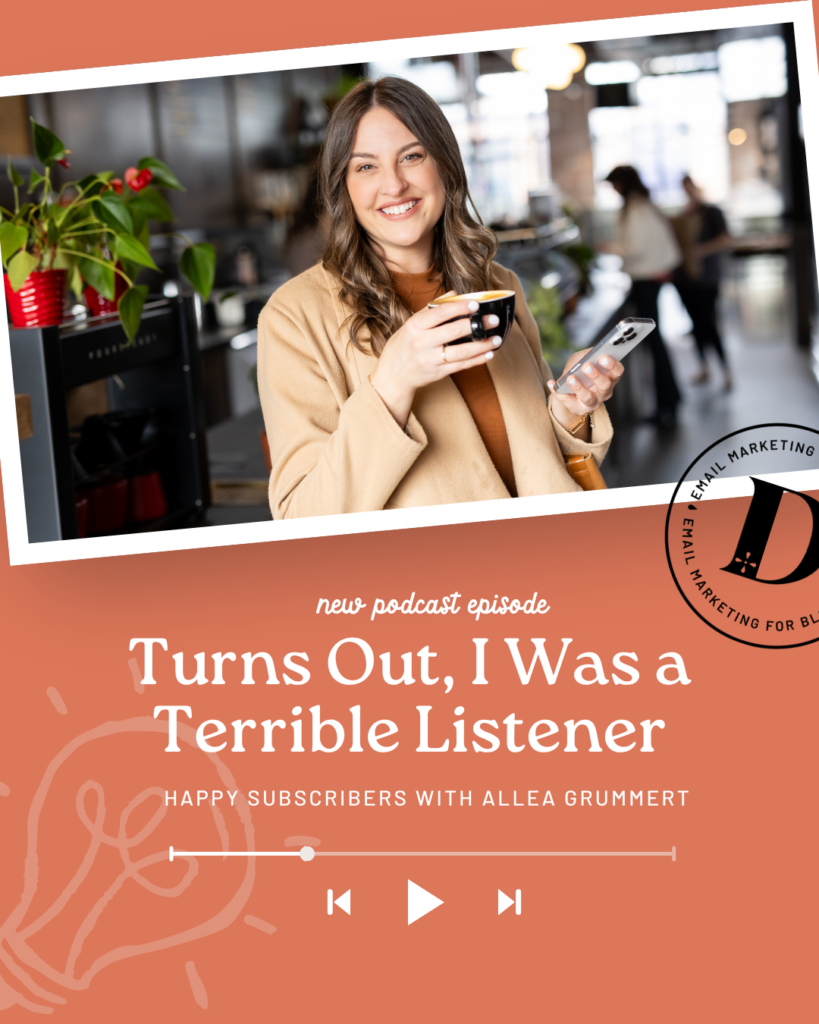
In my early twenties, my boss pulled me aside to tell me I wasn’t a good listener. Explicitly. I cried about it for three days — not because the feedback stung, but because they were right.
It was that I needed to allow space to know the other person and to hear their story. In short: I needed to ask follow-up questions (instead of making it about me).
The fix was simpler than I expected. And it turned out to be the foundation of how I work now — with clients, on this podcast, and in the email strategies we build at Duett.
In this solocast, I’m making the case for why “asking first” might be the most underrated skill in your business. It doesn’t just show up in a few places — it informs how you’ll create content, what products you build, and how your emails actually connect with the people in your audience.
In this episode:
- My “bad listener” origin story
- The compliment that I hear the most now that makes me want to tear up (in a good way!)
- How audience research at Duett works — from surveys with 2,800+ replies to the specific questions that surface real pain points in your audience’s own words
- Why asking questions in your emails helps your deliverability and inbox placement, not just your relationships
- Real questions to help you brainstorm what you might ask your audience next
Episode Resources:
- Join the Duett newsletter
- Check out Duett Services
- Book a FREE Discovery Call
- Instagram @alleagrummert
- Free Duett Resources

Subscribe & leave a review!
If you enjoyed this episode, you can show your support by leaving a review, subscribing, or sharing your biggest takeaways on your Instagram story! Just remember to tag me @alleagrummert so I can see it.
Subscribe on Apple Podcasts or Spotify

About Allea

Allea Grummert is an email marketing strategist, copywriter and tech expert who helps bloggers and content creators make a lasting first impression through automated welcome & nurture sequences. She helps her clients build intentional email strategies that engage readers, build brand loyalty and optimize conversions for sales and site traffic.
Allea is the host of the Happy Subscribers podcast, holds the coveted spot as the email marketing industry expert for the Food Blogger Pro membership community, is a Recommended Expert through NerdPress, a trusted Mediavine partner and recognized as a Kit Approved Expert.

Looking for more ways I can help you?
Book a free call with me (no-pressure zone, promise!) and we’ll chat more about what would benefit your business most in this season.
More like this!:
How to Set Up Endless Nurture Broadcasts for New Subscribers | An Interview with Jordan Gill
Answering Food Bloggers’ Top Email Questions with Allea & Bjork Ostrom of Food Blogger Pro
How To Simplify Your Email Marketing In Just 3 Steps
We're Nothing Without Our List: What Kept Healthy Foodie Girl Afloat When 60% of Their Google Traffi...

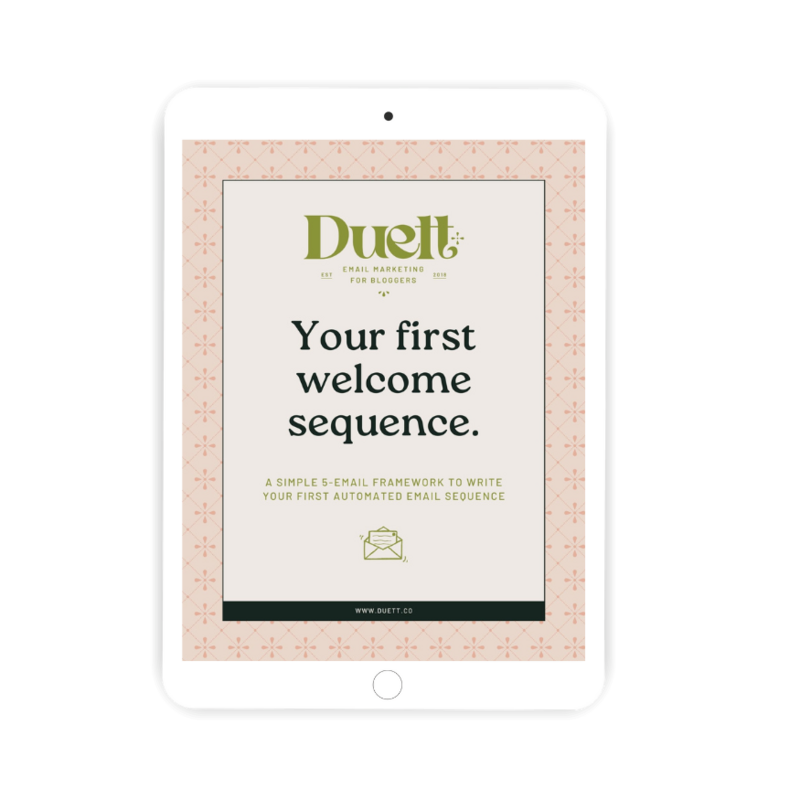
If you’re not welcoming new subscribers and pointing them in the direction of your best, most beloved content — or you feel like the one you have isn’t doing the trick — it’s time we fix that. Use this free 5-part framework to make a meaningful & lasting first impression as you write your first welcome sequence for new email subscribers!
Is Your Welcome Sequence Making a Lasting First Impression?