Oh hey there, I′m glad you're here!

Your Niche Is Not Your Brand — What’s Actually Missing with Katie Trant

CLICK HERE FOR TRANSCRIPT
Allea Grummert (00:12)
Hey there, welcome to Happy Subscribers, a podcast that explores how bloggers and content creators can create more purposeful relationships with your audience through email marketing. I’m Ali Grimert, email marketing strategist, copywriter, email platform expert, and founder of the Done For You Email Marketing Agency, Duet. I started as a personal finance blogger in 2016 and have since helped hundreds of bloggers and creators like you maximize your email marketing for more impact, more traffic, and a better connection with your subscribers. Be prepared for some advanced email talk as well.
as tactical tips to help get your valuable content into the hands of your audience faster and easier. I’m excited you’re here, so let’s do it. We can create a deeper, more meaningful connection with the community you love and serve through email.
You guys, Katie Trant is with me today. She is a branding expert, a copywriter, and an OG food blogger. I love that. For more than a decade, she has worked at brand consultancies, helping huge global players define their brands. In 2024, Katie launched Foodie Brand Lab, a brand consultancy built for creators who want to build a brand, refine their brand strategy, and future-proof their revenue with the power of a strong brand. I met Katie at
Pacemaker in California earlier this year. Katie, thanks so much for joining me.
Katie Trant (01:32)
Thank you for having me. I’ve got my taste maker mug with me. You’re dog Yeah. It made it all the way from LA back to Stockholm where I live. Across the Atlantic.
Allea Grummert (01:36)
What my I’ve gotten texts from clients being like, this is the most comfortable mug I’ve ever held.
Katie Trant (01:48)
It is very it’s a good it’s a good mug shape. I like it a lot.
Allea Grummert (01:53)
Yeah. I was just telling Katie before this, I had like less than a total month to prepare for a tastemaker. So this is the one bit of swag that I had at the booth. I was like, these mugs have to get here. And then they weren’t going to be able to ship them in time. And the guy calls me and we’re on like a first name basis. I’m like, Derek, I’m gonna need it by the seventh. So I had to overnight them. But it’s worth it when it’s the only swag you have. Yeah, for sure. And now it’s all the way in Stockholm. That makes me happy. Yeah so for some context, guys, I used to work in branding. I was more like project management style. But I mean, I’ve had this kind of mindset around branding quite naturally because I went to school for advertising. I worked in the agency. It’s just kind of like fed into I don’t know, everything that I do and how I look at brands and clients. So I’m excited to have Katie here to talk about branding because there are often some real big misconceptions. You have like your visual branding. Well, we have that. But, Katie, how else would you define the pieces of a brand that’s goes beyond visual?
Katie Trant (03:00)
There are so many pieces of a brand. I think this is the main thing because the word brand gets thrown around so much in the creator industry. We talk about working with brands. We talk about, you know, rebranding, which in most contexts is about changing the way your website or your visual identity looks. And we talk about brand, brand this, brand that. ⁓ but a brand, the way that I always like to explain it is that a brand is a tool that’s used to shape perception and it’s used that that’s true whether it’s a personal brand or whether it’s a more traditional brand like a company or a product, but the act of branding is the act of applying an identity to something. And all of the components within our brand, like our brand position, our brand purpose, our brand values, our brand’s value proposition, our brand personality, our brand identity I don’t know, I could probably list like ten more if I kept going. But those are all elements of your brand. ⁓ and they come together to help shape perception.
Allea Grummert (04:07)
Absolutely. And I’ve mentioned this on the podcast. Thank you for bringing up perception. Because that’s that’s I mean, it sounds simple and obvious, but that’s how people perceive you. The value of your work or your content, whether they can trust you, whether they will buy from you, whether they’ll take a recommendation from you. Like all of those things are based on how someone perceives you. And that’s all based off of an experience. Like how they’ve interacted with you or how they’ve seen you online. Like I think of just like people on Instagram that I follow that I don’t know that I’m like, my gosh, I adore you. I mean, yeah, yeah. A little bit of a parasocial relationship there with a few of them. But yeah, like there’s that perception. But the way that I’ve understood it, Katie, is that like you have your brand position. Yep. And that’s like how you intend to or want to be perceived. Okay.
Katie Trant (04:57)
Yes. Yeah. I would say that your brand position is what you want to be known for. Okay. So it’s like you’re taking a flag and like sticking it in the dirt and being like, this is my position. This is what I’m trying to claim. And it could be like the expert in no waste sourdough baking. Or something like that. So it’s like quite specific where like the niche would be sourdough. The niche is like the type of content you create. And then the brand’s position is within that niche, what do you want to be known for? Because you’re going to find in the creator space hundreds, thousands of other creators in the same niche. So the position is what differentiates you within that niche.
Allea Grummert (05:44)
Yes. And then how is that how does that play along with unique selling proposition? Or do you not use that phrase?
Katie Trant (05:53)
no, I don’t usually use that phrase to be honest, but it’s like what is the brand’s yeah, the unique selling proposition would be like, or the unique value proposition. What do we specifically offer our audience that nobody else can? So I think it’s adjacent to brand position, probably, but ⁓ not something that I usually work.
Allea Grummert (06:13)
Yeah. I was just curious. I know it’s like that could be an old school phrase at this point. I wouldn’t know. I’m like, I learned it in college.
Katie Trant (06:19)
I think it’s more marketing than brand.
Allea Grummert (06:22)
Okay. Yeah. Yeah, unique selling. And sometimes because I work with creators, the selling is the content. So for me they they’re like super overlapped. ‘Cause it’s like the unique selling proposition is that you can become a really great sourdough baker with low waste. Yes. And this person is the person to tell you that because they have this much experience or you know, kind of like what are the stories that we’re telling in order to bring that brand position into perception. ‘Cause they there might be a mismatch.
Katie Trant (06:24)
Sales, right? For sure. And the crazy thing about brand is that it actually lives in the hearts and minds of the consumers. So it doesn’t even belong to you.
Allea Grummert (07:01)
to have more? Yeah.
Katie Trant (07:03)
Because, you know, we can perceive through all of the branding work that we do, through the visual identity and the brand personality and the brand position, and the value proposition and so on, all of that is in name of shaping the perception, but it’s up to the end user to perceive it, right? Like the particles are floating through the air, like whatever goes in is up to them how they take that information and scramble it and and spit it back out. So they might you might say, I want to be known as the sourdough expert who helps you do no waste sourdough. And they’ll be like, That’s the person who does sourdough with sprinkles or whatever, you know, but it’s it is it is in the eye of the beholder as
Allea Grummert (07:48)
Yeah. Yeah. It makes me think about how when I teach about content calendars and planning your emails is that you don’t wanna you want to v have a variety of things that support your overall brand. So if you are doing sourdough, then you probably don’t want to be sharing your dinner recipes. Yeah. You know? So like let your content help shape that brand perception. You know, and I’ve always said like if all I did was talk about this one email marketing platform for six to eight weeks in a row, you’d think that’s the only platform I use. Yeah. When in reality I also have other products or I have free workshops or things like that that also support my brand.
Katie Trant (08:30)
Yeah. And I think that’s probably more important now than it ever has been because in the before times, and I mean like a year ago, ⁓ it was so easy to build a robust following or ⁓ you know, to have a really successful, profitable creator business by chasing keywords.
Allea Grummert (08:45)
⁓
Katie Trant (08:54)
And that is gone now, right? Like, you know, those easy low competition keywords have been just eaten up by AI overviews. And so I think being really clear on what your brand is and having that supporting content in a channel like email has become so important. And like if you’re this sourdough expert, yeah, don’t send out your dinner recipes, but maybe you’re sending out like, I don’t know, jams and jellies that are good on sourdough or something like that. This actually supports your brand so I think that I don’t know, I’m I’m an brand expert, not an SEO expert. So you know, take what I say about keywords with a grain of salt. But I feel like the days of chasing keywords are gone so
Allea Grummert (09:36)
Yeah. Yeah. So I mean, I’ve worked with multiple types of creators in the food space who are like, I’ve worked with multiple Italian bloggers, multiple sourdough makers. And it’s interesting, like their products always end up completely different because the person behind it is completely different. Yeah. But I I can imagine the person listening to this thinking, like, how do I know whether my brand is clear or not? Like, I thought having a niche was enough. Like what are the kind of the thought process and the pieces that go along to say like here’s here’s where maybe there’s a gap and this is how you kind of differentiate yourself. I
Katie Trant (10:14)
Well, when I onboard new clients to my like VIP brand strategy package, I start with a brand audit. And I spend a lot of time on their site going through their top 20 posts. And I like to look at the top 20 in terms of traffic and also their personal favorites because they’re not always the same. Their personal favorites tell you a lot more about the type of brand they want to be and their top 20 from traffic tell you more about perception. But that is also perception from robots as well, because that’s like where the traffic, so it’s like, how does what kind of a brand does Google think I have? ⁓ And then, you know, I do, I kind of comb through the data and then I do a competitor analysis and we do a brand mapping exercise to look for gaps, like look for opportunities in the market and untapped territory and it’s not always, it’s in fact very rarely an issue of adapting their content, like making a different type of recipe or a different type of, I don’t know, like crochet pattern if you’re working with craft creators or whatever. but it’s typically like refining that brand voice to bring some alignment between perception and reality as well.
Allea Grummert (11:34)
Okay. What is brand voice versus brand positioning?
Katie Trant (11:37)
⁓ the brand voice is how the brand sounds. And it can be so it’s like the tone of voice, which is part of the brand personality. So the pr brand personality is gonna have ⁓ the visual identity, so how the brand looks, the tone of voice, so how the brand sounds, and the brand experience. So what is it like to actually interact with the brand across different touch points? And I think that the brand personality and voice can it it should be fairly consistent and on brand, but it can play differently depending on the channel. So your brand voice might be different in Instagram than it is in email, for example. You know, you might have a more laid-back conversational vibe. I mean, for me personally, I love because I control I own my email list. And so I feel like I can do whatever I want there. ⁓ you know, it’s like I’m not writing an email for SEO. I’m not trying to hit certain keywords. I’m not trying to keep it. I’m like, I want my audience to understand who I am and what I want them to know about this, about my brand. So I’m gonna be much more true to my brand voice in email than I am, you know, say for example, also Pinterest. That’s where it’s purely visual. We’re just talking about headlines. So you don’t has have as many opportunities to express yourself in different ways.
Allea Grummert (13:00)
Yeah. It’s a brand voice. So let’s talk about the whole like niching is not really enough piece. Mm-hmm. Is that a hot take that I just took? Did I borrow that from you? Do you feel the same?
Katie Trant (13:15)
What I feel about niche, like my hot take about niching is that for so long, like I started my food blog in 2010. So I’ve been in the game for a long time. And everybody’s been told to niche down, niche down, niche down, niche down. And I think that it is good advice to be known for something specific. But that doesn’t necessarily mean niching down. And I think that niche is confused with brand. People think that their brand is their niche. ⁓ I just spoke at a conference last week or the week before, and I had like a big slide that said your niche is not your brand. And everyone was like, What? ⁓ and I think that your having a powerful brand is so much more important than having a
Allea Grummert (13:59)
Yeah.
Katie Trant (14:09)
A super narrow niche. And I think that there are creators out there, like some of the big names, really big, powerful creator brands, who really have no niche. And I think that if you have a strong enough brand, the creator themselves becomes the niche. And they kind of transcend this idea of niching down because they’re they have such a strong and beloved brand that they just create whatever content they want and then people will follow.
Allea Grummert (14:41)
Mm. Do you feel like that’s a privilege of people who’ve been in the game longer? Who have a bigger audience? Yeah.
Katie Trant (14:48)
Potentially it is. And I’ll give you an example from a non creator world. I am an unapologetic Swifty and I make it I make it my business to like drop Taylor Swift in every presentation and interview that I do. But think about like if you did a brand mapping exercise, if you followed Taylor Swift across all her eras, right? She started out as a country music singer as a teenager and then she became, so this is like her, you know, her her debut. And then we go to like 1989 and reputation, and she’s a pop star. And then we go to folklore and evermore, and it’s like indie folk pop. And then like midnights come out, and what is that? That’s like synth pop. And now she’s back, you know, her latest album, The Life of a Showgirl, that’s much back towards like the reputation 1989 territory. Her brand has stayed the same the entire time, right? She has a brand that is about storytelling based on her personal life experiences, her heartbreaks, her romances. That has stayed consistent. The red thread is there. Super powerful, powerful brand. And she has moved her audience with her through all these different niches she’s explored, right? Yes. So it is, you know, we’re not all Taylor Swift, unfortunately. ⁓ But I think it’s a really good example of how you can take a brand and evolve it over time as you grow and as your brand grows and as your needs grow and as your audience changes and as platforms change. Yeah. ⁓ if you had, imagine if she had just been like, no, I do country music, she would not be the mega power superstar brand she is today. And I think the same is true for food creators. And of course, there is there is privilege in that, you know, having that huge audience who is, you know. Ride or die, and they’re gonna follow you no matter what. but that is the power of a really strong personal brand.
Allea Grummert (16:54)
Absolutely. So how much of the personal brand? Because I think of Taylor, first name basis. Yeah. Think of Taylor as like also just being a very kind, approachable, yeah, grateful person. What does she always say? She’s like, thank you for saying that. Like she’s she’s been saying that since she was a toddler. They have it on video. And she’s like, you know, somebody gives her a compliment, thank you for saying that. Like her brand experience. And then when you’re at like I went to the Aero Store in Kansas City night one, speak now release day. Yeah. And the whole space just felt like really safe. Yeah. And like and super inclusive. Like we were part of it. I don’t know. Did you read the book on the marketing of Taylor Swift? Like her whole backstory? I listened to the audiobook. Katie, I’ve been following along for so long. There were only two things in an eight hour audiobook that I didn’t that I didn’t know before. Yeah. And it does feel a little weird when you’re like, ⁓ I received a specific type of marketing to get me to think a certain way and I did.
Katie Trant (17:42)
Really? 100%. She she is a master brand strategist. I mean, she ⁓ there’s a there is a really good podcast episode. I haven’t read that book, but I’ll look into it. But there’s a podcast, a business podcast called Acquired, and they did a an episode about the business of Taylor Swift. It’s like two hours long, and unfortunately, they did it before the Ares Tour. I would love to hear them re-release it, you know, now now but you know, what I learned from that is that every move that she makes is so calculated. She does nothing by accident. And I, you know, I it is masterful. I feel like I’m attending a master class in brand strategy. I also I went to the Ares Tour in Stockholm and I had the same experience. It was super safe. It was just the whole city transformed for three days because there was. Americans and Canadians flying in because it was cheaper to go to the concert in Stockholm in Europe than it was in the US. So it changed the vibe of the entire city. It was just like a sea of sequins and this whole experience of being there from start to finish was just so perfect. Like top four moments in my life.
Allea Grummert (19:09)
Yeah, yeah, yeah. It is up there.
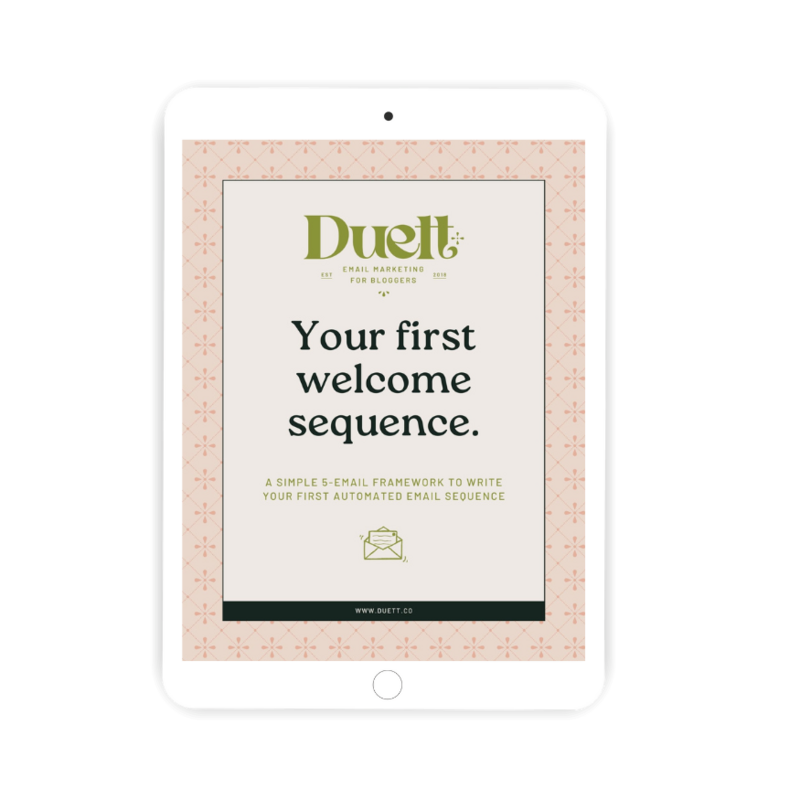
Hey Allea here. I wanted to take a few seconds to remind you that you can get my freebie called Your First Welcome Sequence, which is a guide and a framework for you to write your first email welcome sequence. The very first introduction people get to meeting you and learning about your content and your brand, so you build a meaningful and lasting first impression with your new email subscribers. You can get it from me for free if you go to duet.co/slash happy, and then you can continue to build your email marketing empire from there.
But let’s look, can we talk about the the tension and rub it feels on being on the receiving end of somebody who’s a master strategist? Because here’s what like almost offends me. I love her. We’ll love her till I die. But almost what offends me is that how much she’s marketed her likability and approachability. Because which is like still a choice. Like that’s that shows something about her that she wants to be known. ⁓ but being on the receiving end of that, I’m like
How much of this was marketing because you chose what to tell us versus what’s actually true? There’s a bit of like dissonance there.
Katie Trant (20:19)
Do you think she’s secretly a really horrible person?
Allea Grummert (20:21)
No. I think she’s awesome. Are you kidding? Yeah. She is awesome.
Katie Trant (20:26)
Yeah. Yeah. I I hear what you’re saying, but I do think that she’s I mean, who knows? Maybe she is secretly a really horrible person, but I doubt.
Allea Grummert (20:36)
There was there was that time when Kim and Kanye played back footage that was like poking holes in like Taylor’s perfect reputation. ⁓ you know, they had claimed that she knew about the him including her in a song in a really derogatory way. And she said, No, I had no idea and then they played back the video of her saying, Yeah, I think that’s a great idea. And so, for those of you who are not Swifties, that was the T from a Million Years Ago. And so then it was like, how much are they covering up? Yeah. Of like, but at the same time, I want her to be an individual, which means like you can live your life however you want. If you want to project this brand and that’s what you want us to know you as, great. We don’t actually need to know every intimate detail of your life. You don’t owe us that. Yeah.
Katie Trant (21:21)
I have a friend, I feel like we’re going down a Taylor Swift rabbit hole. I’ll leave you with this nugget. I have a friend who is obsessed. Do you know the Gaylor theories? That she’s like secretly gay. Yeah. There’s a whole like you can search online, you can find a like a power a Google Doc presentation that it’s like 30 slides and it goes through all these, you know, details of like, you know, things that clues that fans are picking up on.
Allea Grummert (21:24)
But I’ll jar after that.
Katie Trant (21:50)
And I have a friend who’s obsessed with this, and she genuinely thinks that like this whole that Travis is just like her beard and it’s this elaborate ruse. Like, you know, I just feel like if Taylor Swift was gay, she would just be gay. But maybe not. I mean, maybe her, you know, polished good girl reputation is just so important to her that she’s these are the lengths she’s going to. I don’t know. I don’t I don’t think so personally.
Allea Grummert (21:59)
Yeah. I don’t think so either, but I know I know the the arguments. So that being said, can we talk about being a swifty? I literally love this angle though, because let’s ⁓ you you can pull me out of this, Katie, if you want to. But the fact that we all sat and watched an hour and forty five minute interview of her on the New Heights podcast, just like I literally texted a friend saying, I don’t know if I’m allowed to see this. Like they are being so vulnerable and sharing these details. And so I don’t know where to go with that. Other than I think that there’s also and this is what’s this is what’s weird for branding, is that not everybody needs to know everything about your business in order for you to be a vulnerable brand. Yeah. Like a in a good way. Good vulnerable, approachable. So because I have going through my own personal branding experience and looking through my whole life story, there’s so much that people don’t need to know. There’s because it’s private. Like my friends know, but like that doesn’t need to be made publicly. Like you don’t need to like strip yourself bare and be like
Katie Trant (23:08)
One hundred percent.
Allea Grummert (23:16)
Do you love me or not? Internet who makes flash decisions on whether you like people. Like, I’m not gonna go put all that out there. Yeah. But you get to like pick the pieces of your story. Yeah. Can you tell us about how to like how do you pick those out?
Katie Trant (23:26)
Yeah. I call that defining your strategic self. And I because I think there’s a big difference between being personal and being personable. And in this a time that we’re in right now, where we’re competing with not only other creators, but also robots and AI-generated content and blah, blah, blah, we’re told over and over and over again that person having a personal brand is so important. And I talk to so many people who feel like I’m an introvert. I don’t want to put myself out there. I don’t wanna, you know, I don’t wanna be super personal. And I tell people, well, you don’t have to. You have to sit down and define your strategic self and what parts of you, what parts of your personal personality belong in your brand and what parts don’t. And I just went through an exercise with a creator who this was a really, really interesting experience because her domain name for her recipe site is her first and last name. And it’s the first time I’ve ever, you know, I have worked with Fortune 500 companies. I’ve been in the rooms with like entire C-suites presenting brand strategy. It’s the first time I’ve ever experienced this where the person was the brand, but also she’s not the brand, right? She’s a person. So we had to do really extensive work, like back. I have a normal process that I follow, and I was like, okay, we need to back up like five steps here And really dig into where does she, the person, end and where does she, the brand, begin? And where is their overlap? ⁓ and you know, that it took extensive background work and you know, brand strategy and like what elements, and she’s a very open book kind of person, right? But it took doing that to lay the foundation before we could go further with her brand strategy because it is her first and last name. So literally she’s all over the brand. Right. but yeah, I think, you know, think about what’s the difference between being personal and what’s and personable. Because you can be per I think Taylor Swift’s super personable. We only know the personal details that she wants us to know. Right.
Allea Grummert (25:44)
And I think that’s wise. Yeah too. I think she’s also we can’t escape that, Katie, I didn’t know we would go here today and I love talking about each other because it’s brand. But I think she’s also overshared before.
Katie Trant (25:47)
For sure. Yeah, just keep this now that we’ve
Allea Grummert (26:02)
She learned her lesson. So I think she even said, like during the 1989 secret sessions where she invited people into her literal homes all over the United States. She was like, maybe wouldn’t do that again. I think it had some backlash as well because only so many people could be invited and and whatnot. And so, like, that’s an example of probably oversharing. You know, we we don’t hear her bashing her exes publicly anymore. You know, I remember watching her talk about how Joe Jonas broke up with her in like a 27 second phone call on on some TV show, like on some yeah like the not the voice, but one of those types of morning shows. And you don’t hear her do that anymore. And she’s really like changed her tone. And a lot of that is maturity. Yeah. In but I also want to say, y’all we’re talking about Taylor Swift as if it’s like this wonderful case study. It’s been twenty, twenty years of Taylor Swift, topically. She’s had a lot of time to learn and shift. Yep. And so
Katie Trant (26:57)
And also define those bumper lanes, right? Of like what gets shared and what doesn’t. Cause I think that I I I too have kind of learned my lesson about oversharing on the internet. And I used to write a lot of really personal posts and I would write about my kids. And ⁓ I started I had a really annoying reader for a while who would reply to all of my emails with unsolicited advice and I I got so frustrated, but then I realized I can I cannot control how she responds to what I put out there, but I can control what I put out there. Yeah. And I think that was a really good learning for me. And it kind of shifted my content strategy in a way and like where what I’m gonna share in which channels. and I also one thing that I think we have to keep in mind when we are writing content like emails or whether it’s Instagram or blog posts or whatever, if you’re choosing to peel back the curtain and share bits of your personal story, does this benefit the reader? Like what do they get out of it? And is that relevant to the brand? And ⁓ you know, another example that I’ll give you, we were talking before we hit record. I got divorced last year and I talked about it really transparently on my Instagram stories, but in the context of so I have a a food blog, as I said. I talked about, you know, I talked about that it was a an extremely painful process. I talked about like my appetite shifting and like learning to cook for one and things like that. I did not talk about what happened. I did not talk about like the down and dirty details of what went wrong and why I felt I had to step away from my marriage, but I talked about the parts that actually would serve my audience because I talk about food and nutrition and ⁓ you know, sort of nourishing myself through that process was actually relevant. ⁓ so there are you have to define those strategic bumper lanes, like personal versus personable. And does this benefit my audience, is there a purpose to sharing this? And is it does sharing it align with my brand strategy and my brand position with what I want people to perceive my brand as?
Allea Grummert (29:29)
Mm-hmm. Yeah. Well, and we had mentioned before hitting record one of my emails this summer mentioned going through a breakup and and you related to that. Whereas like I think it’s interesting because I’ve I am going through a personal branding experience right now and trying to figure out what stories do we share. But like twice a year I just go like whole hog and I’m like, here’s a personal update. And part of that is because I want to be known in an online space. I want, you know, but I get to pick and choose and I I do kind of tailor them toward, you know what what I’m going through. ⁓ but sometimes I don’t. And like I know like my initial like my what my purpose is in that. And I know that it’s infrequent. Whereas it’s interesting, I’ve been thinking about this, Katie, because girl, I could never be an influencer. My gosh. I don’t need to record every bit of my life. I like the amount of times I think, do I need to tell the internet about this? And I’ve just basically said no. Like here’s a picture of my cat snuggling on a Sunday. Like that’s all I can muster. But I don’t want to have to report back to the internet. And so I have to find other ways. Well, and probably more meaningful ways to connect with my audience than just like, yeah. Here’s a record of me hanging out with my friends on a Saturday. Like, great. I have friends. I’m being present with my friends. So there’s also just a lot of like, I feel like friction of yeah, how much do you share? And does that even support your brand?
Katie Trant (30:52)
Yeah, for sure. I so I get your emails and I have I don’t know how, but I have signed up for your email list on two different email addresses. And I think I’ve been segmented differently on them because I get, you know, two emails at the same time on the same day, but with different subjects. It’s been really interesting. I’m like, I wonder how I got tagged in this one because it’s a different topic.
Allea Grummert (31:11)
Yeah, Interesting. I don’t have a massive tagging situation on the back end. Katie, do you want me to show you what happens? Is that when you sign up, you go into the welcome sequence, then you go in once that’s done, you start getting my nurture emails and my live emails. But if you signed up at different times, you’re just going to get a different nurture email and on Tuesdays. Yeah. And sometimes we turn them off because we’re doing a little promo and we don’t want to overwhelm people. That’s what you can say. So it’s not that serious. It’s just even, yeah, one of my friends texted me today. She was like, she got a text email or like a notification of an email from me. And the subject line is, But who are you? And I’m like, Yep, that’s a welcome email. And she was like, This is so weird. Why are you asking? why is it why is this not a text? Like, why am I hearing from you in my inbox? So yeah, that’s I’m I even want to revamp my own email strategy. Like it’s not the primary driver of client work. And so it doesn’t get the most of my time and attention. But it’s also, I do want to say, like, having an email list allows me to practice sharing my brand, like my expertise or experience with people. Can you talk just a little bit about like how do you actually implement what you’ve learned about your brand or after somebody works with you in your VIP project?
Katie Trant (32:21)
Yeah.
Allea Grummert (32:33)
How do you actually implement what you’ve what you’ve learned, what’s new?
Katie Trant (32:38)
It’s always different. As you said, when you onboard a new client, you know, the client kind of tells you what they need. So every process is always different and every brand is different, and the brand always tells me what it needs. And I think that there’s different creator brands at different stages of maturity who you some of them are really well established across different channels. Some of them need significant guiding in like I was was saying to you, I have a client who Does not do any email. And I’m like, okay, you’re gonna have to talk to Ali when we’re done. I need to fix that. And another one who I always su sign up for my clients’ email lists to see what they’re like and how many emails they’re sending and what the emails are like. And I had one client recently who she wore, she’s like, I’m gonna warn you, you’re gonna get a lot of emails. And she was right. And I read them and I was like, these have a completely different tonality than.
Allea Grummert (33:12)
Yeah.
Katie Trant (33:37)
The writing on your site. This is not the same brand. You know, we need to do some work here to get a unified brand voice because I feel I really love the tone of voice on the site. It’s very comforting and it’s very like her role is as this guide through the process of Southern cooking. And the emails felt like they’d been written by a teenager. They were like, cutesy you know, much more casual language. ⁓ so there’s some work to be done to align the brand across all the different platforms that it exists on.
Allea Grummert (34:14)
Yeah, there’s a lot of it it is. It’s like a meshing of all the things into being cohesive. Yeah. and I’ve always thought of email marketing as like it’s an extension of your brand. Like if somebody comes from social or they come from your site, it’s the same, it’s the same brand. That’s the vibe that we want. ⁓
Katie Trant (34:33)
It’s all part of the ecosystem, right? Like I think that if you have a creator, then you’re gonna have the creator themselves and possibly their site, like their recipe site or whatever kind of site they have in the middle. And then there’s little like spores that come off of it. And so we’ll have email, we’ll have Instagram, we’ll have Pinterest, maybe they’ll have a physical product like a cookbook, maybe they’ll have a paid subscription, maybe they’ll have I don’t know, like a line of whisks or spatulas or whatever, you know. So all of these things are brand touch points. So they all need to speak to the same brand strategy, but how the brand comes to life in each of these different applications can be a little bit different depending on on where it is. Yeah.
Allea Grummert (35:19)
Yeah. And I was telling Katie before we recorded too that oftentimes like when you have that brand brand understanding or like who it is you’re serving and what it is you want them to receive from you. Like if it’s just goodness or inspiration or encouragement or, you know, reminding them like, hey, I’m a busy mom with young kids too, but here’s a crock pot meal that we use every week. Like using that language when you send out your content as well helps thread all of that together. So it doesn’t just feel like just this nameless broadcast. It’s like as somebody who understands where you are, we’re in the same boat here. Here’s a resource. And so those little threads, it’s kind of like I it feels natural to me. So I don’t necessarily know how we teach that, other than like giving yourself kind of a menu of things to consider when you write your newsletter of like, am I sharing anything about my brand here or anything specifically calling out my audience’s needs here and consider those things as you write that email.
Katie Trant (36:19)
Yep. Yeah, I think that’s ⁓ I would agree with having some a menu or a checklist. and then also just as like a bit of a litmus test, like does is it in the same voice? Does this serve the reader? Am I writing content or creating content in a way that aligns with how I want to be perceived as a brand?
Allea Grummert (36:40)
Yeah. Well I obviously know about the value of your work, Katie, because the brand sets the tone for so many things. And like you said, once you have that, it impacts your email, it impacts these other channels, it impacts your products and your content itself. But do you mind ⁓ kind of just telling people like how they can work with you or what that experience looks like?
Katie Trant (36:59)
Yeah, sure. I have ⁓ there’s a lot of ways that you can ⁓ not work with me but ⁓ follow along for free. For example I have an email that comes out twice a month called Brand Bytes. ⁓ and it’s just like bright bite-sized brand strategy. so that’s free. And Instagram, of course, like little branding nuggets is there and I do have a webinar that I put on in January about personal brand. I have the replay available for free if anyone wants that. ⁓ and then in terms of paid services, I’ve got a course which is called Foodie Brand Lab. It was created for food creators, but I think the information in it is relevant for creators and other spaces as well. It’s just the examples are from food sites. ⁓ and it’s a self-paced, self-directed digital course that walks you through all of the various ⁓ components of a brand platform. And then you have templates to package everything up at the end. And then I have my VIP brand strategy package where I roll up my sleeves and I get in and really do all the heavy lifting ⁓ and workshop it together with the client. ⁓ And they come out at the end of it with a brand book that ⁓ articulates their brand strategy. Plus a list of ⁓ key recommendations. So here’s what we recommend that you do in order to implement the brand that we’ve worked on and make sure that it comes to life in the best possible way.
Allea Grummert (38:31)
Love that. I love that you have such a variety of things ⁓ that listeners can hop in on. Yeah. Here’s the thing. And I hear about this like with email marketing too. It’s like you don’t know what you don’t know. So if you can if you can dabble in learning from an expert, you’re going to be thinking about things in a new way. And if you get to the point you’re like, I really need someone to help direct this for me, like doing a self-paced course is such a great idea. But just get get started by dabbling in her free stuff. You’ll obviously just spent time listening to Katie. She knows what she’s talking about. So where can people best connect with you to reach those resources?
Katie Trant (39:06)
On ⁓ Instagram it’s Foodie Brand Lab and on the website is foodybranlab dot com. And as I mentioned to you, I am gonna rebrand. I’m gonna the brand the brand is gonna rebrand. Ooh. To be more inclusive to not just food creators, but to creators of all sorts. But that’ll happen after the summer, I think. So yeah. When this episode drops, it’ll still be called Foodie Brand Lab.
Allea Grummert (39:31)
Yes. But if you get on Katie’s email list, I’m sure you will follow along with the rebrand there. And absolutely so especially or in addition to if you’re not a food blogger, definitely follow along. we we love a good, clean brand. It’s gonna benefit your business both in the short term, but especially in the long term. It’s gonna help with your decision fatigue. It’s going to help with your audience recognizing you as the resource and wonderful content creator that you are. Yeah and keep them coming back. And we want that. Yeah.
I love it. Katie, thank you so much for being on Happy Subscribers today.
Katie Trant (40:04)
Thank you for having me.
Allea Grummert (40:10)
Thanks so much for listening to Happy Subscribers and our conversation about email marketing today. I hope you feel inspired to take action, even if it’s a small change, so you can more confidently share your valuable message with your community through email.
Special thanks goes to my team who makes it possible to produce and share these episodes with you. Seriously, thank you guys. If you want to hear more email marketing tips, strategies, and success stories to help you develop deeper, more meaningful relationships with your email subscribers, be sure to subscribe to Happy Subscribers so you don’t miss an episode. If you have a few seconds, I invite you to share this episode link with a friend or post it on social media so your peers and community can benefit from it as well. And if you have a few minutes, I’d appreciate if you’d leave a written review of the podcast.
Since that helps more people hear about it. And I believe we need more creators sending more valuable emails to their audience with more confidence. If you want to reach out to me directly, the best way to do that is to join my email list through one of my top freebies listed in the show notes. You’ll get regular emails from me that are packed with value. And if you hit reply to any of those emails, it’ll land in my inbox and I can’t wait to chat with you there. Until next time, let’s do it.

I did not expect to spend this episode nerding out about Taylor Swift as a brand strategist — but here we are. And honestly? It’s the best possible way to explain what my guest Katie Trant means when she says “your niche is not your brand.”
Taylor went from country music to pop to indie folk to synth pop. Her audience (including Katie and me 😂) followed every single pivot. Because the niche changed. The brand didn’t.
Katie Trant is an OG food blogger, a former brand consultancy pro who’s worked with Fortune 500 companies, and the founder of Foodie Brand Lab. She joined me to unpack what a brand really is — beyond the visuals, beyond the niche — and what needs to be in place before the channels you use, the content you create, and the emails you send actually click into place.
In this episode:
- Why “your niche is not your brand” — and what could happen once you unconfuse them
- What brand positioning actually is, and how to plant your flag within your niche
- The terms we throw around all the time — position, voice, personality, experience — and how they actually connect under the umbrella of brand
- The difference between being personal and being personable — and how to define your “strategic self”
- Why email might be the one channel where your brand voice can be most true to itself
Episode Resources:
- Foodie Brand Lab
- Katie on Instagram:
- Brand Bites Newsletter
- Join the Duett newsletter
- Check out Duett Services
- Book a FREE Discovery Call
- Instagram @alleagrummert
- Free Duett Resources

Subscribe & leave a review!
If you enjoyed this episode, you can show your support by leaving a review, subscribing, or sharing your biggest takeaways on your Instagram story! Just remember to tag me @alleagrummert so I can see it.
Subscribe on Apple Podcasts or Spotify

About Allea

Allea Grummert is an email marketing strategist, copywriter and tech expert who helps bloggers and content creators make a lasting first impression through automated welcome & nurture sequences. She helps her clients build intentional email strategies that engage readers, build brand loyalty and optimize conversions for sales and site traffic.
Allea is the host of the Happy Subscribers podcast, holds the coveted spot as the email marketing industry expert for the Food Blogger Pro membership community, is a Recommended Expert through NerdPress, a trusted Mediavine partner and recognized as a Kit Approved Expert.

Looking for more ways I can help you?
Book a free call with me (no-pressure zone, promise!) and we’ll chat more about what would benefit your business most in this season.
More like this!:
Using Email to Create Conversations with Tara Bench of Tara Teaspoon
From 1% to 4%: How Carissa Erzen Rebuilt Her Email Foundation and Finally Knows Her Audience
How to Use Audience Research to Fuel an Effective Email Marketing Strategy
Use This One [Free] Tool to Make Writing Email Campaigns Fast and Easy

If you’re not welcoming new subscribers and pointing them in the direction of your best, most beloved content — or you feel like the one you have isn’t doing the trick — it’s time we fix that. Use this free 5-part framework to make a meaningful & lasting first impression as you write your first welcome sequence for new email subscribers!
Is Your Welcome Sequence Making a Lasting First Impression?